This Blog covers nature sightings and related news in the Calderdale area.
It includes all groups - Plants, animals and fungi with links to specialist sites.
Anyone wishing to become a member of this Blog and post sightings please contact us.
If you would like to join the Halifax Scientific Society either email me or come along to the next meeting.
All welcome:
calderdalewildlifeblog@gmail.com
Please contact us about any sensitive records before posting on the blog

Saturday, 28 November 2015

Duck eggs in Todmorden


These eggs were laid under nettles on the tow path at Todmorden. The nettles have died down now. They're near the town centre, where all the feral Mallards are fed by people. 

Birds, especially waterfowl, are known for "dumping" eggs in other birds' nests. There might be the produce of more than one duck here.  

At the Raptor Forum we heard in a fringe conversation about a Peregrine pair on a sea cliff  seen tenderly feeding their prey to some Herring Gull chicks! That was in the SW of England. 

This could be how nest parasitism evolved. It seemed a real conundrum to me till I heard about egg dumping. I've also read that there are various forms of it. Our northern Cuckoo's habit is the most extreme example.

Thursday, 19 November 2015

Now they want to legally shoot the Buzzards ! From Nick Carter. Click on the line below his name.

Please consider signing this important petition raised in response to recent developments and their potentially serious impact on bird of prey protection in this country.


Thanks in advance :)

Nick


After you have signed you will receive an email. You MUST click on the link on that email to make your vote count.

Bruce


Thursday, 12 November 2015

Abnormal Timothy

This Timothy grass--Phleum praetense, is late flowering on a pile of bare soil in the park at Todmorden. But what makes it different are the small 'leaves' growing from the base of the flowering spike.

The usual small scales on the spike are in evolutionary terms modified leaves and some grass species occasionally 'remember' their past and elongate these scales (glumes and lemmas) into leaves.

This is known as Proliferation and occurs in grasses more frequently than in other plants. Sometimes the process is called Vivipary but this term should only apply to seeds that germinate in situ on the plant.

There are many theories why Proliferation occurs but it does seem to happen more towards the end of the flowering season. It seems the Florigen hormone has been used up producing normal flowers, so the plant goes into vegetative growth within the spikelets.
 
I have seen this often in Cocksfoot but never before in Timothy.
 
                            
                                      Proliferating Timothy Grass
 

Special Conference for those interested in Birds of Prey and the North of England Raptor Forum


Once again the Calderdale Bird Conservation Group are proud to be hosting the annual NERF conference to be held at Rishworth School on Saturday 21st November, details below


The annual NERF Raptor Conference is being hosted by Calderdale in 2015 at the prestigious venue, Rishworth School.

The conference committee has drawn together an exciting and varied program that will address a wide range of issues that are of interest to Raptor Workers.

There is ample on-site parking. Registration, coffee and exhibitions will be available for delegates from 0930 and the conference will open at 10.00. Lunch and refreshments will be provided. In response to feedback from previous conferences years there will be increased opportunities to catch up with friends and benefit from those irresistible bargains available from the specialist retailers who cater for the birding community.

The NERF Conference is the primary training aid for birders interested in Birds of Prey in the North of England. This year’s conference will be opened by Superintendent Chris Hankinson, Chair of the Partnership for Action Against Wildlife Crime [PAW], Raptor Persecution Working Group.

Dave Leech, BTO, - an unmissable presentation will bring us up to date with the new mandatory procedures for using IPMR and making licence applications / compulsory returns.

Hen Harriers continue to dominate the concerns of Raptor Workers. Stephen Murphy, NE, and David Hunt, RSPB will give us full accounts of the highs and lows of the 2015 season.

After lunch Paul Irving, NERF Chair, will bring us up to speed with NERF’s activities over the last 12 months.

Raptor Workers are well aware that the severe reduction in Police resources is having a negative impact on their ability to respond to raptor persecution and the situation is likely to get worse in the foreseeable future. Raptor Workers invariably discover these offences and provide expert witness statements. With that in mind a member of the PAW Forensic Working Group will guide us through the techniques that we can use to strengthen Police investigations.

The Cumbrian Osprey Project is probably the most important Bird of Prey assisted breeding program ever undertaken in the North of England. Nathan Fox, Forestry Commission, will talk us through the trials and tribulations of the scheme over the last 5 years.

Delegate Fees
£10.00 for delegates aged 14 – 18 years and £22.00 for adults. Once again demand for places at this year’s conference is expected to be high. Please book early to avoid disappointment.

Booking forms are available from midgleybirder@yahoo.co.uk

Wednesday, 11 November 2015

Just trying to find out why my Firefox email stopped working and found this on BBC News

MP Oliver Colvile calls for hedgehog as UK symbol

  • 8 hours ago
  •  
  • From the sectionEngland
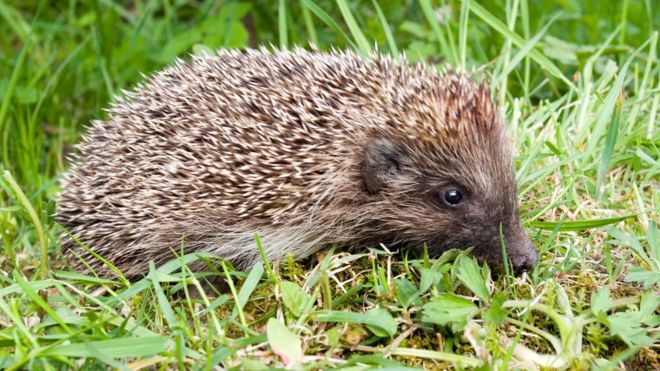
European Hedgehog (Erinaceus europaeus)Image copyrightScience Photo Library
Image captionHedgehog numbers in the UK have fallen from about 36 million in the 1950s to less than a million, campaigners say
The "great British hedgehog" should become a national symbol of the UK, an MP has suggested.
Oliver Colvile, Conservative MP for Plymouth Sutton and Devonport, said numbers of the prickly creatures had fallen by a third in the last decade.
He said that declaring the hedgehog to be Britain's national symbol might enthuse people to protect it.
But environment minister Rory Stewart questioned hedgehogs' suitability, and said the lion should remain the symbol.
Mr Colvile said his love of hedgehogs stemmed from his mother reading Beatrix Potter's The Tale of Mrs Tiggy-Winkle to him as a child.
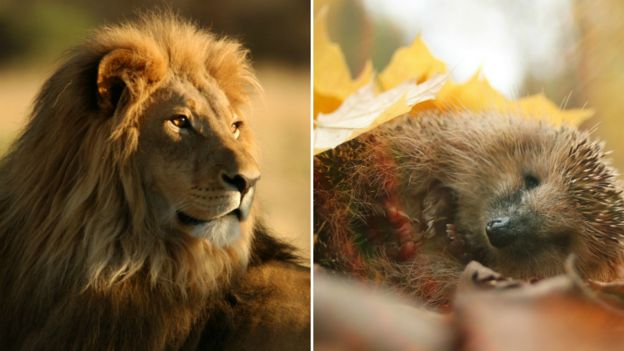
Lion and hedgehogImage copyrightThinkstock
Image captionMinister Rory Stewart asked if the UK wanted to have as its national symbol "an animal that when confronted with danger rolls over into a little ball"
Read more on this story as it develops throughout the day on our Local Livepages.
He said: "The principal reason for this prickly animal's decline is due to the loss of habitats.
"Likely factors for the hedgehog demise are the loss of permanent grassland, larger field sizes, use of pesticides and herbicides and a reduction of hedgerow quality."
Mr Stewart responded in the House of Commons: "Do we want to have as our national symbol an animal that when confronted with danger rolls over into a little ball and puts its spikes up?
"Do we want to have as our national symbol an animal that sleeps for six months of the year, or would we rather return to the animal that is already our national symbol, the lion?"

European Hedgehog (Erinaceus europaeus)

What can you do to help hedgehogs?

  • Solid fences and walls restrict a hedgehog's movement through gardens. Make sure you leave small gaps at their bases
  • Hedgehogs can swim but often drown in garden ponds because of their steep and slippery sides. Provide them with an escape route: a piece of wood, chicken wire or pile of stones
  • Bonfires make good places for hedgehogs to nest. Check them to make sure a hedgehog has not made its nest before lighting
  • Be prepared to leave a small part of your garden to go wild. Long grass, log/leaf piles and undergrowth provide foraging and nest places for the perfect hedgehog habitat
  • Feed your local hedgehog, but please provide dog/cat food and not bread and milk
  • Sign up as a volunteer on the hedgehogstreet.org website.
Source: Devon Wildlife Trust

In response to a crashing hedgehog population, a 90-hectare refuge was created this year by the Warwickshire Wildlife Trust.
Funded by the British Hedgehog Preservation Society, the conservation area stretches across a nature reserve, a public park and the surrounding streets.
The trust said that during the 1950s, some 36 million hedgehogs used to snuffle in UK gardens, although there may now be less than a million.
Gavin Williamson, Conservative MP for South Staffordshire, said he was doing his bit to help.
He said: "It's very important to use our gardens which are a specific habitat for hedgehogs.
"Just recently in my own garden I built a hedgehog house. Sadly I have no residents in it but hopefully it will encourage them and the growth of hedgehogs in South Staffordshire."

Peregrine found shot dead in Halifax


Don't know if this as new as the date on it. News to me !
Thanks to Nigel Griffiths for sending me the link.


https://raptorpersecutionscotland.wordpress.com/2015/11/07/peregrine-found-shot-dead-in-halifax-west-yorkshire/

Friday, 6 November 2015

Winter Wildfowl 2015


Nows the time to watch out for Wildfowl coming into our area,mainly they will be Common species,check out any Water Bodies,this Male Teal ,top was feeding in earnest on Warland Marsh,whilst the Male Tufted was on Longfield Dam,but  you never know what might turn up.Also check out any Canada Geese as one or two Pink Footed Geese can turn up with them,as as been the case on Lumbutts Road in recent Years.

Thursday, 5 November 2015

Lichen or Fungi?

I was taken by this Horse Chestnut tree in York and the striking sulphur yellow markings. Is this a lichen, or a fungi that has not yet developed?

The numerous bonnet mushrooms at the base may be Lilac Bonnet Mycena pura?


Thursday, 29 October 2015

I inadvertently grew some garden bird food.

Quinoa, (pronounced Keenwa or Kwinowa)


I've occasionally been given this seed by friends with adventurous cooking habits. It's used like rice or couscous, but is much more nutritious, providing vitamins and protein as well as carbohydrates. It has a bland, slightly nutty flavour.

I thought it might grow in the Pennines, being a native crop of cool highlands in South America, so I bought a packet of cooking Quinoa and sowed a few of the seeds.

They shot up! I guess you can use the leaves as greens, as the plant is in Amaranthaceae, same as beetroot, spinach, and the wild plants Good King Henry, Fat Hen and Goosefoot, all of which have edible leaves.

A tragic consequence of it becoming a "wonder food" in the west is that some poor farmers in South America can no longer afford to eat their crop, or they think they can't, as it raises more cash for them than the cost of imported rice, which is far less nutritious.

If anybody wants some seeds, I've got loads left.

I only got round to cooking one head while it was fat and fresh and moist. I steamed it as a whole sprig over some potatoes I was boiling. It was good, eaten straight off the stem, which stayed behind like the core of a corn-on-the-cob, only branched. I got my little crop after a mid-summer sowing.

I thought I'd leave the others to fully ripen, then dry the seeds off to keep through the winter, but the birds soon realised there was something full of goodness there. First I noticed a Dunnock perched  on the plants, pecking in to it, then the Robin, true to character, sent it off and started pecking itself.

Since then I've been informed it has been grown on a large scale in this country, but only as a fallow-land crop. If anyone knew of any little corners with fairly rich, disturbed soil, it might be worth sowing it in summer as a winter bird food. In gardens it would save buying a lot of expensive wild bird food.

To aid birds on a wider scale, it could be planted in odd corners of fields or muck-heaps where it might benefit House Sparrows, Tree Sparrows,Yellowhammers, Reed Buntings and lots of other seed eaters. Some would say the native seeding plants are best, which I would agree with in an area of arable farming, but here most fields are kept as lush, wildlife-unfriendly grassland.

Tuesday, 20 October 2015

Further Fungus/ Botanical Foraying

Next weekend, on Sunday 25th October, we are meeting for another fungus/botany foray to the Holywell Green area. We will pass near the Deer Farm which has a big herd of Sika Deer. In Autumn it is the rut, and there is a chance of seeing some antler-locking stags, and hearing their roaring. Buzzards are regularly heard and seen in fine weather. Feel free to come along. No charge but small donations help with HSS funds.

The Foray starts at 10.30 for 10.45. Meet in West Vale.
Directions:
Take the Stainland Rd from the Calder and Hebble road junction. 
Go straight on through both sets of lights in West Vale. 
Pass one pub on the left, then a second (the Queen), and pass under a high railway viaduct.
Park or meet on the left just opposite the entrance to the industrial estate.

I will have two spare seats from Halifax town centre, leaving at 10.15.

The walk will be through woodland, along stony tracks and fields, some of them steep. Bring a packed lunch and something waterproof to sit on. Children and dogs welcome. Some lanes with traffic may be unavoidable.


Blackening Waxcap last year at Saville Park.

Sunday, 18 October 2015

Monthly Outdoor Meeting of Halifax Scientific Society

The meeting this month was a fungus foray in Stoodley Glen, which took place today. Sundays are sometimes chosen to give people who can't attend on a Saturday a chance to join in. There was also a waxcap identification session in the fields at Broadhead Clough last Friday 16th Oct, when Kara Jackson of Yorkshire Wildlife Trust brought along laminated keys to hand out, but I wasn't able to attend that one.

Sunday was a calm but dull day letting the changing colours of the trees smoulder through.

It really starts as you pull out of Luddenden Foot on the way to Mytholmroyd - a truly breathtakingly beautiful valley, wide spreading, with seemingly 50% each of mature deciduous trees and open fields.

The Stoodley Glen itself is wooded at the bottom end after you cross the river and then the canal, the latter dark and glassy, with dry leaves floating that parachute gently from the trees.

The woodland is "greenwood" as I wrote about in last Thursday's Hebden Bridge Times. Occasional grazing prevents understorey shrubs and saplings springing up. So it is open and grassy.

Higher up as you walk past all the little waterfalls you come out onto wide sheep-grazed fields; this is where the blue Harebells, still flowering today, and the waxcap fungi start.

The view looking back with distant Todmorden in the centre was stunning, with fields and moorland hills and valleys decorated with trees, near and far, in every shade of green, yellow, brown, orange and bronze. There was a strange light, as Annie pointed out, with brooding shade over the higher land, and Todmorden bathed in a gentle, not quite bright glow.
      Stoodley Pike above us seemed strangely animated; slipping in and out of the mist.

      It was a good day for a fungus foray.

We don't collect baskets full, not even the ones we know are good to eat. Our aim is to enjoy seeing and if possible identifying them. The complete list, not ignoring the common ones, is part of an ongoing survey, which when added to the records over many decades, should give an objective measure of fungus diversity and its changes in our area.

The best finds of the day for me were Elfin Saddle Helvella lacunosa and a Coral, possibly Crested Coral, Clavulina coralloides, attacked by another fungus, turning it grey. Also the bright Yellow Brain fungus, Tremella mesenterica. The most numerous was Amethyst Deceiver, as usual, closely followed by it buffish relative, The Deceiver.


Elfin Saddle beside the track in Stoodley Glen.

The little group of native Crab-apples was fruiting well at the top of the glen, with larger fruits than some years. I pocketed a few  as they grow easily from the pips, but I never see them self-seeding. Their partner animal that evolved to spread the seed in its dung, as well as maybe breaking the turf to give them somewhere to germinate, must be one of the extinct fauna. A male Reed Bunting was nearby.

Our complete Stoodley Glen fungus list for today can be read by clicking on "Calderdale Fungi" at the top.

As we finished in good time, we all drove to Hippins Clough on the other side of the Calder Valley, to search for the Violet Coral, Clavaria zollingeri, but didn't find it. However we did explore further along the valley-side than I had been before, to an area with an ancient wall built of huge wallstones, and an area of boulders including one as big as a small bungalow with a flat top you can easily climb up on to.

Near here was a colony of suckering Blackthorn, some of them so old they made small trees.

We put up two Common Snipe and saw a group of 11 Mistle Thrushes on some wires, oddly accompanied by one Redwing and one Goldfinch. We saw a dead Common Shrew lying on the turf.

Next weekend, on Sunday 25th October, we are meeting for another fungus/botany foray to the Holywell Green area. Feel free to come along.

The Foray starts at 10.30 for 10.45. Meet in West Vale.
Directions:
Take the Stainland Rd from the Calder and Hebble road junction. 
Go straight on through both sets of lights in West Vale. 
Pass one pub on the left, then a second (the Queen), and pass under a high railway viaduct.
Park or meet on the left just opposite the entrance to the industrial estate.

I will have two spare seats from Halifax town centre, leaving at 10.15.


Tuesday, 13 October 2015

Talk by Dr Mark Avery,Impact of Driven Grouse Shooting

There is a talk by Dr Mark Avery ,on the impact of Driven Grouse Shooting on our Uplands and Wildlife ,tomorrow Wed 14 Oct.It is free admission at 7 30 at the Trades Club Hebden Bridge.He was the former Conservation Director for the RSPB for 13 Years,He is the Author of Inglorious ,Conflict in the Uplands .and started the Petition to Ban Driven Grouse Shooting,which is a really important issue for us in Calderdale.

Sunday, 11 October 2015

Glow-worm

I have never seen a glow-worm larvae before, but here is a photo taken in Borrowdale in the Lake district a few days ago in the company of Ancient Tree Forum members. We were visiting the Borrowdale Yew trees, the 'Fraternal Four' made famous by Wordsworth, although the fourth blew down many years ago and is now rotting on the ground.

The remaining Yews have been dated to at least 1,500 years old and Keith Alexander the National Coleoptera recorder found this Glow-Worm larvae on a section of rotting bark.

We also looked at many of the ancient Ash pollards dotted about the landscape, most of which are many hundreds of years old and were the working trees for generations of people. The National Trust continues the essential pollarding of these on a regular cycle and hope that Ash disease will not destroy them all. Pollarding, done correctly, does not kill trees but prolongs their life span way beyond the natural life cycle. A truly sustainable practice that benefits people and wildlife and creates a historic landscape.

                                            Glow-Worm larvae


                                        Borrowdale Yew tree

Wednesday, 7 October 2015

Aurora borealis update 07 10 2015

At the moment 17.00,there is some Minor Aurora Activity,yellow alert,it is still rising,we need kp 7 red alert really to see it locally,with clear skies ,I will try and update this info as the night progresses,fingers crossed,regards Brian.

Monday, 5 October 2015

Autumn Crocus (Crocus nudiflorus) now flowering in Calderdale till mid-October.


These are widespread but elusive in Calderdale. My good friend Howard Owen has just spotted a new colony in a field off Green Lane in Soyland, though this might be the one mentioned in the old records as being "Behind Making Place, Soyland".

The previous survey in 1950 had 23 sites in Calderdale, but we now have a list of 42. Sadly this is partly because some of the biggest colonies are much reduced and fragmented.

It was brought from the Pyrenees in the middle ages it seems, possibly as a source of saffron, but this isn't directly documented. There is a possible reference to them in a medieval will to "my heads of crocuses" which indicates a high value. Crocus vernus, another European crocus which flowers in spring has been mentioned as a source of saffron, though the true Saffron Crocus is Crocus sativa. This is still cultivated in Norfolk. See "Norfolk Saffron" on line. Saffron Crocus is probably not viable as a crop in the Pennines, though Crocus nudiflorus, coming from the plateux of the Pyrenees, does well. It has much smaller "threads" though, (the stigma that are the saffron.)

Many of the spots we see it are close to places with St. John in the name, and some are near Holdsworth House, Bradshaw, where there is a Maltese Cross on the gable, showing a connection with the Knights of St. John, the Knights Hospitallers. 

They grow in many different places, often in fields, and often on river banks well away from gardens. They thrive at 300 metres at Cold Edge near the Ovenden Wind Farm, and right down near Cromwell Bottom Nature reserve, near Park Nook Lock, on the bank of the Calder. Strangely, all the river bank sites are on the left banks - on the Calder, the Ryburn and the Hebble. It is even found among mature deciduous trees. It is fascinating to think that they were probably there before the trees.

There is a longer version of this and a list of sites in my booklet "The Mystery of the Autumn Crocus" (2010) available now. (See panel on the left.) Also from me personally £5.00 
or £6.00 including postage. Steve.blacksmith@gmail.com. The £5.00 goes to Halifax Scientific Society. A copy comes free with membership which is £15.00 a year.

N.B. there is a cofusion-species in the Meadow Saffron, Colchicum autumnale, which has nothing to do with saffron, and is poisonous. It's a lily-relative and therefore has a flower full of stamens, six in number, whereas the crocuses have just three club-shaped stamens around the feathery stigma. Catch them on a sunny day to see this easily. Beware that garden centres sell Colchicum bulbs as "Autumn Crocus". They do have a superficial resemblance.


Autumn Crocuses on the plateau above Foix in the Ariege district of the French Pyrenees. Free-range cattle with cow-bells and horses keep the grass short but leave the crocuses.


Friday, 2 October 2015

Todmorden Crocus nudiflorus


It is a good year for them in the Halifax area.

There is just one showing in this picture in Centre Vale Park. (Recognise the Bandstand?) Click the picture to enlarge.

There were more on this bank, but they were getting crushed by football spectators, so myself, Phillip Marshall, Linda Kingsnorth and others moved most of them to the wild flower area to the left of the bandstand (looking in).

There was also a small colony in a field above Bacup Rd. which Portia reported to me, and I found in about 2008.

I am going to check these 2 colonies this evening Friday if anyone wants to join me. (Sorry for the short notice.) Meet at the park gates nearest the cricket ground at 6.00pm.

No one recently has seen them at Great House near Cross Stones. The fields are much altered with artificial fertilisers, but they could still be there. These location details are all I have.

Wednesday, 30 September 2015

Offering - any one interested in Natural History archives?


In the library we have a quantity (perhaps a brief case full) of duplicates of these from the early 20thC. It appears we inherited them from the Ovenden Naturalists when they folded.

We need funds, and would welcome purchase offers, or offers of help selling them.

Does anyone perhaps enjoy selling things on line?

Just like the HSS, the Yorkshire Naturalists Union was at this time interested in archaeology, and the only photographs in this edition are of bronze axes unearthed in Yorkshire. It was after all well before the era of wildlife photography.

They are a fascinating read, with birds, taxidermy, egg collecting, mammals and the problem of shooting much discussed.

Sunday, 27 September 2015

Aurora Borealis 17 03 2015.

Hi,sorry this is late,Managed to see Aurora Borealis this March gone.Seen from Flowerscar Road near Todmorden .Could see light green cast about 22 30 which intensified towards Midnight,i couldnt see any purplish colour with naked eye,which camera picked up,but certainly could see the Green ,amazing to see Locally ,all the conditions have to be perfect to have a chance,but it does happen occasionally.Regards Brian.

Our monthly Society walk took place on Sat 26th September.

Eleven of us did the popular Bradshaw-Ogden-Soil Hill- Strines Beck- Holdsworth-Bradshaw walk.
We had never seen so many Autumn Crocuses in Bradshaw Churchyard.
We all sat down on rocks for our picnic lunches on Soil Hill.

There was also a good showing of crocuses at the hollow sycamore down at Strines Beck.

A fast-moving Silver-y moth (a day-flying moth) was hovering around, obviously attracted to the crocuses. 
It landed near the base of the purple part of the flowers each time. Peachysteve saw its long tongue probing, so maybe it was getting nectar. Very few insects have been noted visiting the local Autumn Crocus, and there's no record of anyone finding a seed capsule. These develope underground with crocuses, then push up and split at the soil surface. 


A single Small Copper Butterfly on Creeping Thistle; the only thistle flower noticed to have a scent out of the species we find in Calderdale. The aroma is of honey.
Emma Hoyle, Bruce's daughter, discovered this.

An unidentified caterpillar, possibly feeding on nettle.

Non-members are welcome on walks, as they are at our monthly talks (click on tab at the top.) With thanks to Bruce for leading this one, and thanks to everyone for waiting (slowing down) for me as I went back about half a mile to get my binoculars I left on a wall! What a twit! 

Tuesday, 22 September 2015

Consultations -

 - with thanks to Hugh Firman for the links

Probably most know this already but here is the link if individuals wish to comment on Cromwell Bottom:


You probably know there is also a consultation for Norland Moor and here is the link, you may wish to comment or  mention ways in which the moorland can be improved for birds.


Hugh.
---------------------------------------------------------------------------------------------------------------------


       There is certainly a paucity of birds on Norland Moor. Our archives at Halifax Scientific Society show that in the 19thC there was a variety of waders to be found there (often they were shot). I don't think the shooting will be remembered by the birds today.
      Also it is stated that Twite nests were easily found at Norland Moor, though the species is dependent on surrounding grassland having the right mixture of seed producing plants. There was also a lot more control of mammalian and avian predators.    
      Not that I am supporting any kind of shooting or other anti-social and inhumane ways of killing animals.

Steve

Wednesday, 16 September 2015

Petition to Ban Driven Grouse Shooting

Hi ,I've been out of the loop for a while,so not sure if People are aware of this Important Petition by Dr Mark Avery to Ban Driven Grouse Shooting.The sheer Mismanagement of Burning And Drainage of some of our Vitally Important Peat Uplands as previously reported by Ban The Burn Campaigners,  in order to Artificially Boost Numbers of Red Grouse which are then Shot ! is going to have a Profound Impact on our Environment and Wildlife.Dr Mark Averys Book Inglorious ,Conflict of the Uplands,tells it as it is in a very matter of fact way.We have a real chance of doing something about this Victorian Practice

Link to Mark Avery's e-petition here:  https://petition.parliament.uk/petitions/104441

Tuesday, 15 September 2015

Ash Die-back disease

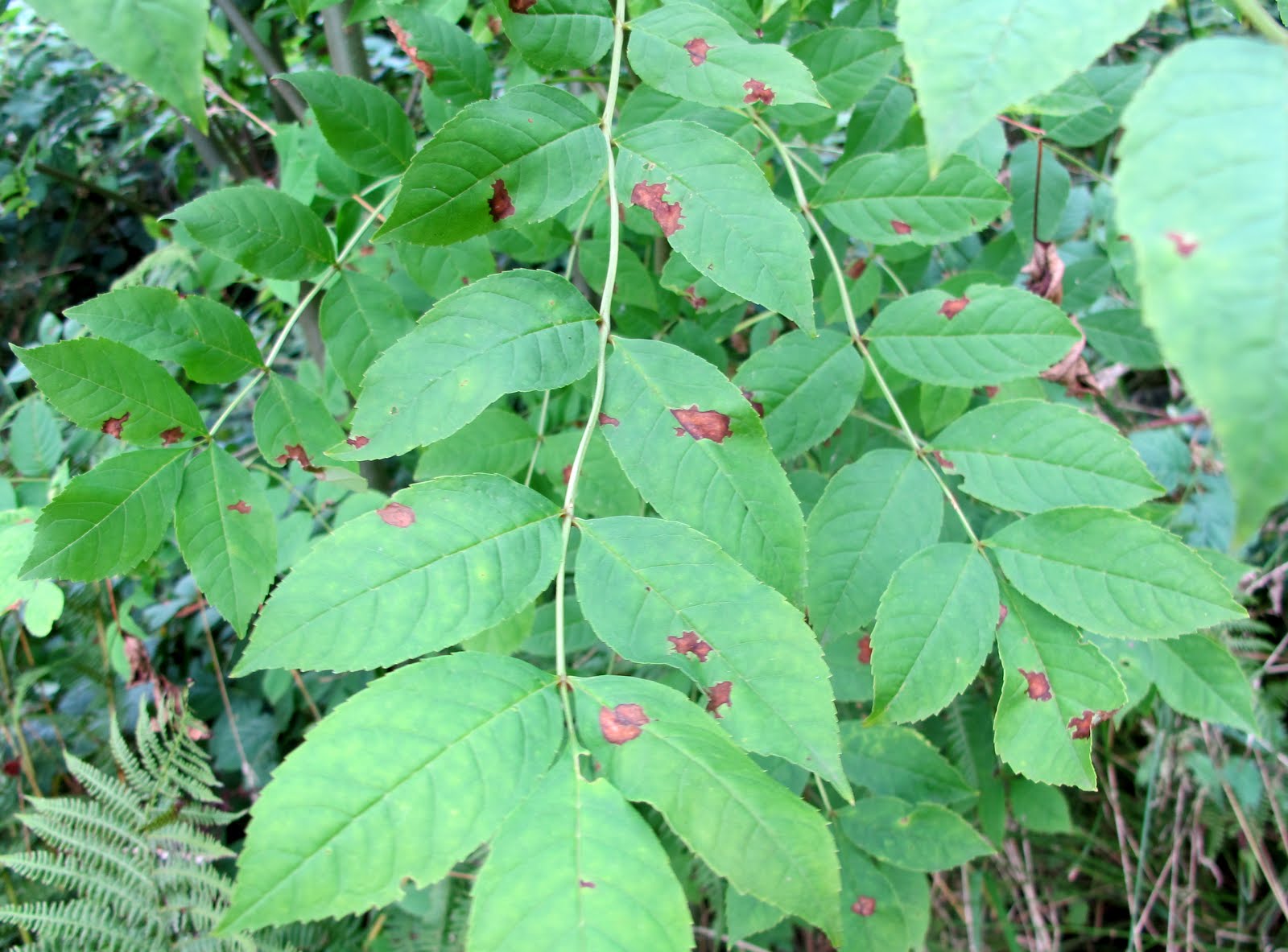
These photos show what may be signs of Ash Die-back in Todmorden. I understand that young saplings are more susceptible to the disease and they start showing signs of this from the top downwards.

Photos are of a dead sapling that died in a matter of weeks and the discoloured sapwood when the stem is cut. Nearby saplings showed purple coloured stems progressing downwards and long lesions. Leaves with brown dead bits. Only time will tell if it is the Ash disease but these symptoms are significant.

Best to look closely at the top length of young stems as the changes can be quite subtle.

This year I have seen a lot of mature Ash trees with most of their leaves eaten to the central vein. I think a saw-fly caterpillar may be the culprit but it is the first time I have ever seen Ash leaves eaten by anything. I wonder if the trees' natural defences are being weakened by the Ash disease before we can see any physical sign of it. Although Ash generally have had a very 'light' crown of leaves this year. Anyone else noticed similar?


Mushroom

I found this on a standing mature Beech tree where the bark is dead. I think it may be a Pleurotus but maybe someone can identify?

Saturday, 5 September 2015

Ash Dieback

Has anyone yet seen this Ash disease in the Calder Valley?

The fungus responsible is commonly called Chalara fraxinea but now officially named as Hymenoscyphus fraxineus.

According to Forestry Commission mapping, most of the Upper Calder Valley is within the zone where the disease has been confirmed, as is Brighouse, Elland and parts of Halifax. The FC say this means there is a high likelihood of other Ash trees/woodland in the same area also being infected. http://www.forestry.gov.uk/chalara

If you know of any old or historic Ash trees, now is a good time to photograph them and record them.