This Blog covers nature sightings and related news in the Calderdale area.
It includes all groups - Plants, animals and fungi with links to specialist sites.
Anyone wishing to become a member of this Blog and post sightings please contact us.
If you would like to join the Halifax Scientific Society either email me or come along to the next meeting.
All welcome:
calderdalewildlifeblog@gmail.com
Please contact us about any sensitive records before posting on the blog

Thursday, 25 April 2019

Insect apocalypse

We have all seen Monarch butterflies on TV programmes and the vast numbers that migrate across America. Yet scientists have found their population has fallen by 90% in 20 years, a loss of 900 million individuals.

This is an extract from a New York Times article which is titled

It is a long article but anyone who persists in reading it to the end will be appalled and frightened at what is happening to species throughout the world. E.O. Wilson, the naturalist and prophet of environmental degradation has suggested we are living in the Eremocine, the age of loneliness.

Climate change may play a part in this but a large part is human degradation of ecosystems. Perhaps we should ask our Council to declare "No further loss of species numbers" to complement their "Climate Change Emergency". But I rather sense the former would not gain any traction.

We are on a treadmill and the old Chinese proverb is a warning, 
"He who catches a tiger by the tail can never let go".

Sunday, 21 April 2019

Stag


Phil Dyson sent me this of a stag on one of our highest moors. The sheep fence would be no barrier to it. It has shed one antler, and no doubt the other will fall soon. Whether it is a true Red Deer, a Sika, or a hybrid is beyond my experience. A magnificent animal to come across out on the hills in any case. Well done on the editing to make it clear, Phil.

Saturday, 20 April 2019

White Holme, 20th April 2019

A walk to White Holme, from Turvin Road, and part way along the drain, brought me my first green hairstreak up here, plus many green tiger beetles, a few emperor moths and lots of peacock butterflies.  I also heard a reeling grasshopper warbler and a merlin flew northwards over.  It was also nice to bump into and chat with a man from Halifax Scientific Society.  I think he was called Pete Smith.

Chris J-B
                                          Green hairstreak
                                         Green tiger beetle
                                          Emperor moth
                                         Peacock                                  

Friday, 19 April 2019

Speckled Wood butterfly

My first sighting this year; yesterday in Centre Vale Park Todmorden.

Thursday, 18 April 2019

Brimstone

By the promenade adjacent to Elland Wood on A629 south of Salerhebble.

An others this year?

Sunday, 7 April 2019

A tree chrysalis

This tree in Nidderdale caught my eye. It was in a field and appeared nearly dead and not worth looking at. But I could see there was something about it that made me climb a fence to have a closer look.

It was an old Rowan that had suffered badly, perhaps from grazing animals eating its bark. This should have made the tree go into terminal decline and as you can see it was well on the way to expiring.

What the Rowan decided to do next is remarkable. It sent aerial roots down through its own decayed trunk, using its own mulch of nutrients to keep alive. The old carapace then burst open and a new tree has appeared with strong multiple roots and stems. The old crown has decayed and fallen over, to be replaced by a lower and younger crown.

The resilience of trees is amazing.


                                                Rowan tree in the distance next to the wall


A closer look showing severe decay


New aerial roots bursting forth


Dead carapace bursting open to reveal a new tree


Friday, 29 March 2019

Friday, 22 March 2019

Help a toad across a road!

We need help with taking toads safely across the roads at Cottonstones near Mill Bank to prevent them being squashed by traffic.  We are collecting between 50 and100 per evening at the moment, and it would be wonderful if you could lend a hand.  All you need is warm clothing, high vis jacket, torch, bucket and a notebook to write down the numbers collected. We go out around 7pm for a few hours - but any time you can spare would be great.  Please contact Charlotte at charlotte@charlottew.co.uk or call/text 07801 968404 if you require more info.  Otherwise....see you there!

Tuesday, 19 March 2019

Rhododendron

In the Conservation Land Management magazine there is an interesting article studying the effects of invasive Rhododendron on the ground flora. This study was done in the Atlantic oak woods of  Scotland which also has Birch, Hazel and Rowan, as well as a rich ground flora.

Under Rhodo there is little that can survive the deep shade. When areas were cleared of this noxious shrub the original ground flora never reappeared, even after 30 years. However the Bryophytes did return and carpeted the ground with mosses, which produced a novel ground flora for which there is no comparison in natural ecosystems.

They found the popular idea that Rhodo 'poisoned' the soil was not supported by soil tests and is a bit of a myth. They found the only way to return a semblance of the original flora was to reintroduce seeds and scarify the moss covering.

I read elsewhere that we refer to it as Rhododendron ponticum but in reality this country has introduced multiple species from different parts of the world. These have hybridized to such an extent the resultant shrubs cannot be named with any certainty as it is a mish-mash. This has made it more invasive than R. ponticum.

Rhodo is a prolific spore distributor of the disease Phytophthora ramorum, an oomycete pathogen, which arrived in this country in about 2002. It has killed millions of Larch trees. It also affects Beech and the disease has been confirmed in the upper valley, where mature trees are dying and collapsing.

It is difficult to understand why there is not more effort to clear Rhododendron. It is easy to cut down and just needs a bit of effort for a year or two to strip off any regrowth and the stump is dead.


Sunday, 10 March 2019

Recent photo's

I took this photo of a bat species at a roost in Shibden recently.
Perhaps a Daubenton's but waiting for the experts to see if that species can be confirmed.


Also from Nigel G a nice shot of a Common Lizard in Crimsworth Dean on 4th March. 


Our March indoor meeting with speaker coming from Edinburgh


Thursday, 7 March 2019

A bit of colour in a rainy spell - Scarlet Elf Cup


Scarlet Elf Cup - Sarcoscypha austriaca 

This fungus disappeared from Calderdale for many years and started being found a little in the 1970s, then gradually more till it's now fairly common.
It grows on rotting willow branches on the ground, sometimes when they're covered by fallen leaves.

These were growing near Woodhouse Lane Todmorden, when it was fruiting like this in three places on  6.3.19

Old texts say it was once popular as a Christmas decoration, but in my experience it always appears well after mid-winter. Maybe they collected and dried it for the following  Christmas.

Wednesday, 6 March 2019

Linnaeus and his Unio pictorum

Most people have heard of Linnaeus as being the founding father of modern botanical names; all Latin binomials and nomenclature begin with his book Species Plantarum published in 1753. Binomials had been used by other botanists before him but he was the first to create a logical system.

But how many know Linnaeus was the first person in the world to produce cultured pearls? 

At that time the only method for finding pearls was to use the time consuming effort of looking for natural ones. He believed that a technique for culturing pearls would be more effective and profitable for Sweden.

He experimented with the Painters Mussel, Unio pictorum, so called because the shells were good for the mixing of paints by artists.  Linnaeus drilled a hole in the mussel's shell and inserted a small granule of limestone between the mantle and the shell. The idea was this 'irritant' would stimulate the growth of pearls. These mussels were then returned to the riverbed for 6 years and they produced the world's first spherical cultured pearls.

It wasn't as profitable a business as he had hoped but even so he was ennobled for his efforts by the king of Sweden, taking the title of von Linné.

The pearls, patent, and Linnaeus' secret were sold to a Swedish merchant but nothing came of it.

You then have to wait 150 years until the Englishman William Saville-Kent formed a syndicate in 1905 called "The Natural Pearl Shell Cultivation Company of London". This was the first commercial venture and took place in the Torres Straight which runs between the tip of Australia and New Guinea.

Monday, 4 March 2019

Amphibians waking up!

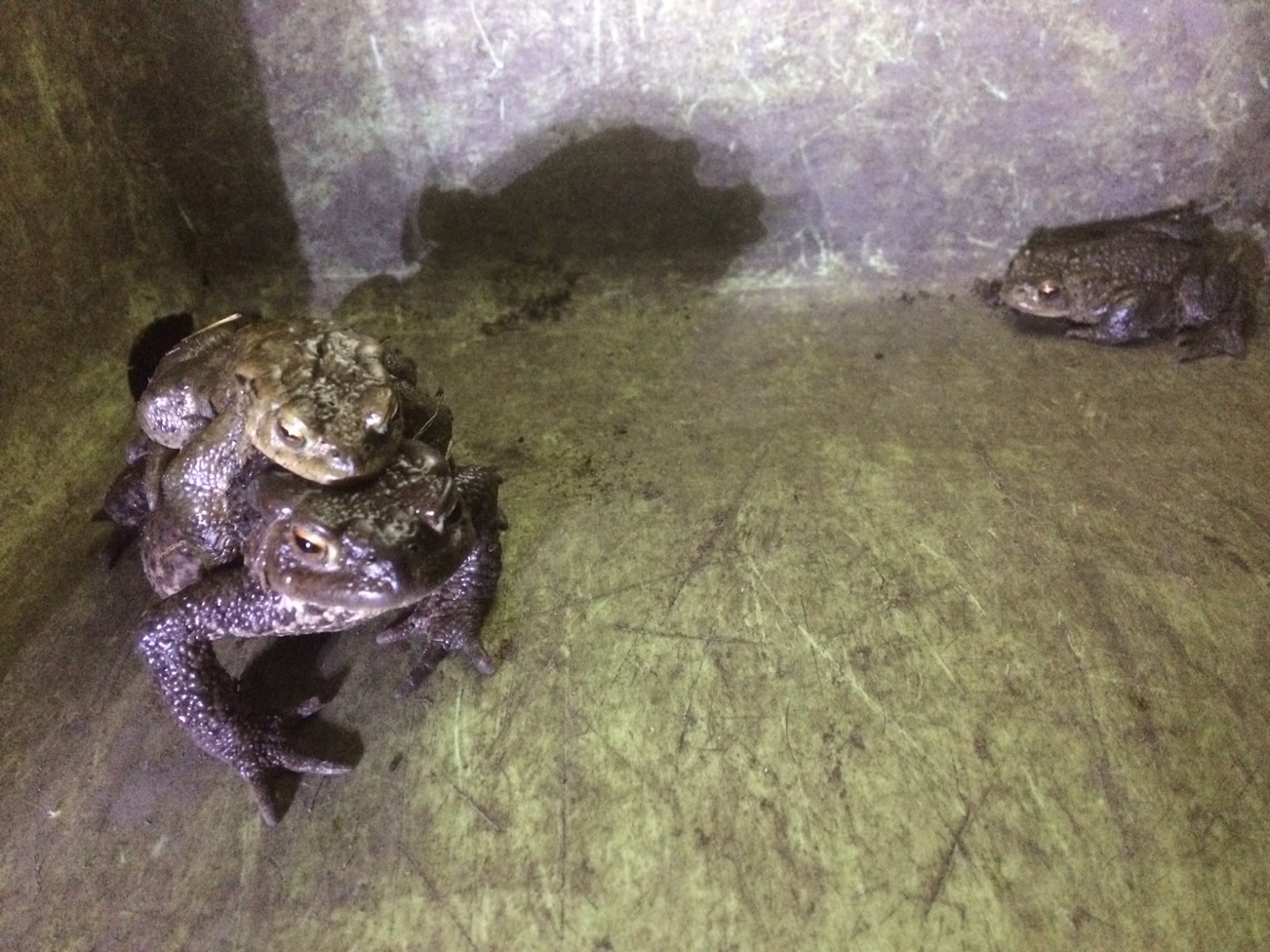
This weekend we saw our first frogspawn and mating toads on the move to their ponds.


Frogspawn in a swampy field near Sowerby Bridge 3/3/19
Ranger Natalie Pownall reported some the previous weekend at Gibson Mill, Hardcastle Crags, which was the first I heard of this year.


Toads spotted by Annie Honjo and picked up off the road at Copley New Road just after dark on 3/3/19. The smaller male often arrives on the back of the larger female, as here. 


Re: Frogspawn. This can be seen from a distance when freshly laid, as it tends to float high in the water. Later it sinks below the surface. You can estimate the number of pairs of frogs as each clump comes from one pair, and that is their lot for the year.


Toads: They usually appear later in the year than frogs, and cross the roads in swarms trying to get to their ancestral ponds, when they often get decimated by traffic. It has to be about 8C for them to move, and it happens just after dark very often. Their spawn is harder to see, as it is in long strings in deeper water. Many people go out in the evening to pick the toads up and save them from the traffic. This can be read about on the Toads on Roads website, part of Froglife.

Steve Blacksmith, Recorder of Amphibians and Reptiles for Halifax Scientific Society.

Wednesday, 27 February 2019

Our March Indoor meeting with speaker coming to us from Edinburgh


Annual Dinner

Halifax Scientific Society Annual Dinner

At the Maypole Inn, Warley

Wednesday 17th April 2019 at 7.00 for 7.30

Informal Dress

Please reply by 12th April to help with food preparation,thanks.

A selection of Meat, Fish and Vegetarian Dishes.
Gluten free or other dietary needs will be provided if possible on advanced request. **

 Specific Evening Menu (HSS)

2 courses £16.00 per head
3 courses £19.00 per head
Single course as per general menu

Starters
Chef’s Tomato & red pepper soup (V,VG)
Served with a crusty bread roll

Creamy garlic mushrooms
Served on char-grilled bruschetta, topped with dressed rocket & parmesan shavings

Beer battered brie wedge
Served on a bed of mixed leaves with caramelised red onion chutney

Salmon. Haddock & dill fishcake
Served with a salad garnish & homemade tartar sauce

Chicken liver & brandy parfait
Served with wholemeal toast mixed leaves & caramelised red onion chutney

Homemade onion bhaji’s (V,VG)
Served with a mixed leaf salad & mango chutney

Main Courses
Landlord’s steak & ale pie
Served with hand cut chunky chips & mushy peas

Beer battered haddock
Served with hand cut chunky chips, mushy peas & tartar sauce 
                                                                                                          
Chef’s chicken Kiev
Served with chunky chips and dressed salad

  Fabulous fish pie
 Mixed fish in a creamy dill sauce topped with creamy mash potato & cheddar cheese served with seasonal vegetables 

Moroccan chicken & mixed pepper skewers
Served with hand cut chunky chips, dressed salad & homemade tzatziki sauce

Bangers & mash
Served in a giant Yorkshire pudding with caramelised red onions & gravy

Large oven roasted pork chop
Served on a bed of wholegrain mustard mash, finished with a creamy leek & blue cheese sauce

 Beetroot & caramelised red onion tart tatin (VG)
Served with dressed salad finished with a balsamic glaze

Desserts
Sticky toffee pudding
Served with hot butterscotch sauce & vanilla ice cream
Hot chocolate fudge cake
Served with vanilla ice cream
Chef’s crumble (VG)
Served with custard
Cheese cake
Served with pouring cream
Mixed berry Eton mess

** For other vegan and vegetarian options please see the Maypole Menu on line at https://maypole.jimdo.com/menu/

Main Dish side orders £2.95 (General menu), Cheese and Biscuits £7.95, Tea and Coffee £1.95

Payment Preferred: Cash on the night to include discretionary tip. 


Your Order:  Name: _ _ _ _ _ _ _ _ _ _ _ _ _ _ _ _Please forward to Laurence Sutton
                                                            Laurence text, mobile 07880 721330
                                                            Email: lasusu@laurencesutton.co.uk
Or print page and send to: 2 Heath Avenue, Manor Heath, HX3 0EA

Special dietary requirements……………..
                                                            
Starter:   _ _ _ _ _ _ _ _ _ _ _ _ _ _ _ _ _ _ _ _ _ _                             
Main:     _ _ _ _ _ _ _ _ _ _ _ _ _ _ _ _ _ _ _ _ _ _          Plus desserts in variety - on the night.                          

_______________________________________________________________________________    

Your Order:  for Wed 17th April at 7.00 for 7.30      (Please keep this portion for your reference.)

Starter:   _ _ _ _ _ _ _ _ _ _ _ _ _ _ _ _ _ _ _ _ _                                  
Main:     _ _ _ _ _ _ _ _ _ _ _ _ _ _ _ _ _ _ _ _ _             Pay on the night - cash is most convenient.     


  !! IF YOU CAN: OFFER CAR LIFTS TO THOSE WITHOUT TRANSPORT.                        

Friday, 15 February 2019

Found on "Stop hunting Fox-cubs" Facebook page


Unbelievably we still have gamekeepers in Calderdale in 2019.

First butterfly

Wild bees and Small Tortoiseshell butterfly today in our garden at Tod.

Thursday, 7 February 2019

Timothy Grass, an unusual history

Timothy Grass, Phleum pratense, is one of the few native grasses named after an individual and its origin has an interesting history.

It is a native plant that is often seen in the Calder Valley but mostly on waste ground and canal banks. Other parts of the country cultivate it as a crop.

But who was “Timothy” ?

A variety of this grass was unintentionally taken to America from Scandinavia in the late 1600’s and first records there are from New England. John Herd was a New Hampshire farmer who grew it for horse and cattle fodder and in 1711 gained the name “Herd’s Grass”. It had a reputation for superior feed for horses that were driven long and hard and has the energy equivalent of 93 octane petrol. Has now gained a reputation as race horse delicacy in America.

Subsequently there was a New England farmer named Timothy Hanson who lived in Maryland and began farming there about 1720. He used “Herd’s” grass seed and was the first person to grow it commercially.

Both George Washington and Benjamin Franklin bought the seed and it was Benjamin Franklin who first began calling it “Timothy’s seed”. Its name became Timothy grass by 1736 and just plain Timothy by 1747.

When the grass had proved its utility in America, seeds were sent back to England in 1760 whereupon it was first recommended for agriculture over here. Genetics have shown the American cultivated grass is hexaploid, whereas our British wild form is diploid, ie fewer chromosomes.

America then, in returning the grass to England, was not giving back what it had received, but was sending a new (possibly hybrid) race which had originated there and had enhanced value for fodder.

In this country it is the food plant for the Marbled White and Essex Skipper butterfly. Its pollen has recently been used in a new vaccine developed for hay fever.

Thursday, 31 January 2019

Saturday, 26 January 2019

Pollarding

Roe Deer numbers are at their highest level in the Country for at least 1,000 years. Until about 20 years ago they hadn't been seen in the upper valley for centuries and at one time were nearly extinct in England.
Their present numbers make the practice of coppicing a difficult activity when all regrowth is constantly nibbled back. Piling brash on cut stumps does help to a certain extent but not for long.

Fencing an area of land is expensive and time consuming; it is also ineffective as the Deer always find a way in. Of course when they are in it is almost impossible to get them out! In effect you are creating a perfect inclosure where deer can happily browse.

So how to manage woodlands when thinning out the trees and expecting them to coppice is a frustrating failure?
Pollarding could be done as it is a practice that goes back into the mists of time and probably predates coppicing.

It has the advantage of being better for wildlife and all regrowth is above the browsing height of deer. The trunk increases in girth each year, providing many vertical habitats for wildlife not available on coppice. The cycle of cutting regrowth from the bolling opens up the woodland floor to sunlight, benefitting flowers and butterflies.

One has to query why it is totally out of fashion. There is a lot of misunderstanding of the practice but it could be part of any woodland management plan.

By cutting a pollard Oak the sapwood is rejuvenated and dormant adventitious buds are stimulated into growth.

Second photo showing Hawthorn hedge just layed and since then all the thorny brash has been piled alongside to keep the Deer from browsing new growth.


                     Recently cut pollards first done about 30 years ago and now in their 3rd cycle


Newly laid Hawthorn Hedge, ideal for birds.


Friday, 18 January 2019

Annual Meadow Grass

If you want a grass species that is easy to identify, choose Poa annua (annual meadow grass). It is nearly a certainty that you will have no difficulty because in deepest winter this grass will be the only one in flower. Look at any pavement or roadside edge in urban areas and you will see it everywhere.

Frosty weather makes no difference to its flowering. It is normally self-pollinating and seeds are viable within only a couple of days.

It is a highly variable species and can be annual or a short term perennial. Annual Meadow Grass is actually a hybrid of Poa infirma and P. supina, a fact only verified in 1957 by Prof. TG Tutin. It was a puzzle to think how these 2 species had hybridised, as supina is found in the mountains of central and northern Europe and infirma is found in arid Mediterranean regions.

It is suggested the 2 species got together in the Quatenary ice-age when climate change caused glaciers to move. So Poa annua is a relatively recent hybrid formed 2½ million years ago!

Unlike other grasses, P. annua has an innate ability to resist herbicides. It also seems to be able to develop specialised adaptations and growth forms which enable it to grow on dry golf courses or paddy fields.

It is the only non-native plant to have successfully established in the Antarctic and because of its close association with human activity, has spread throughout the world.

Sorry--no photo. Non needed, just take a look on the pavements.

Thursday, 17 January 2019

Hebden Bridge Park today (Calder Holmes Park)


This must be the broadest trunked Spruce in Calderdale. I believe it's Norway Spruce, Picea abies, the one that used to be the most popular for Christmas trees till we found Nordmann (Caucasian) Fir, Abies nordmanniana had advantages. The tallest Norway Spruces we have are perhaps those along the Hebden Water in Hardcastle Crags, downstream of Gibson Mill.


The blue around the red of Robins' breasts seems more noticeable in winter. It even continues over the front of the crown. Hunger drives the Robin nearer us on frosty days, and the cold causes them to fluff up their feathers for insulation.


This Birch beside the Calder in the park hosts more and bigger Witches Brooms, caused by the fungus Taphrina betulina, than any other I've seen.

There were c.110 Mallards on the Hebden Water in the town centre, only one showing signs of hybridisation, and on the Calder beside the park there were five Goosanders, along with a very elegant Heron in full breeding dress, its plumes wafting in the breeze.

Friday, 4 January 2019

First Indoor Meeting and talk of 2019 this Tuesday 8th Jan.

See poster a few posts down.

All welcome, including members of the public.

Wednesday, 2 January 2019

New Years's Day Bird Count, first walk of the year.

Seven members and friends joined in. We had a record 32 species of bird on the day. Previous record 31 on 1.1.2017.  We walked from Clay House through North Dean Woods, round Norland Moor and back through the woods by a different route.

With many thanks to MH for the Little Owls.

1          Jackdaw
2          Blue Tit
3          House Sparrow
4          Dunnock
5          Robin
6          Collared Dove
7          Blackbird
8          Magpie
9          Great Tit
10        Long-tailed Tit
11        Coal Tit
12        Feral Pigeon
13        Crow
14        Redwing
15        Dipper
16        Chaffinch
17        Black-headed Gull
18        Wren
19        Woodpigeon
20        Bullfinch
21        Raven
22        Buzzard
23        Nuthatch
24        Jay
25        Pheasant
26        Stonechat
27        Mistle Thrush
28        Starling
29        Little Owl (2)
30        Rook
31        Mallard
32        Song Thrush