This Blog covers nature sightings and related news in the Calderdale area.
It includes all groups - Plants, animals and fungi with links to specialist sites.
Anyone wishing to become a member of this Blog and post sightings please contact us.
If you would like to join the Halifax Scientific Society either email me or come along to the next meeting.
All welcome:
calderdalewildlifeblog@gmail.com
Please contact us about any sensitive records before posting on the blog

Wednesday, 8 July 2020

Rishworth Today - Purple Toadflax and More!

Hello all,

I went out for a nice walk today and spotted a few plants.
One or two may want IDing.
I am not sure of the status of Purple Toadflax in Calderdale, anyone know?
It is non native I believe, yet a foodplant for the Toadflax Brocade and Toadflax Pug Lepidoptera.

Purple Toadflax Flowers

Purple Toadflax Leaves

A couple of the Purple Toadflax plants

The Purple Toadflax plants again with a bit more leaf view

All plants and where they are growing

Don't know this one

All of the Don't Know plants

A self-seeded wildflower bit in Heathfield School car park

Bush Vetch in the car park

Red & White Clover in the car park

Spear Thistle

Spear Thistle

Hedge Woundwort

Hedge Woundwort as above just less zoom

Hedge Woundwort growing through the Rosebay Willowherb

What is This?


Tuesday, 7 July 2020

Indoor Meetings

It's unlikely that we will be able to have meetings again this year.
So all indoor meetings are cancelled for the foreseeable future.
If something changes which means we are able to go ahead with meetings we will contact members to let them know.

Monday, 29 June 2020

Pellucid Fly

The hoverfly that I had in a recent post up for ID (the picture captioned 'ID Hoverfly on Foxglove) I have identified it as Pellucid Fly, looking at the NBN atlas they do not seem to common.

Saturday, 27 June 2020

Aquatic larvae in my water-butt


I've only seen these twice. Spotting them in my water-butt I told my partner Annie without giving the common name, as I think it's a bit pejorative. (Rat-tailed Maggots.)

She got this video, risking dropping her phone in the water. You can see their intestine through their skin. We can't work out if they're feeding on floating vegetable matter or drowned insects.

She was delighted with them as I thought she would be, and found out they are the larvae of a kind of hoverfly - news to me.

Her suggested new name for them is Chevron-larvae.

Wednesday, 24 June 2020

Rishworth Yesterday.

I went back out yesterday.
It was a warm warm day and there was lots to see.
Wild Rose
Peachy Steve tells me Common Valerian can be quite common
but I didn't think as common as this!
Hedge Woundwort Now in flower

Monday, 22 June 2020

Today in Rishworth - A Plant Walk

I went out on a walk through the meadows and on the lanes, here is some plant life seen.
See lepidopterous things Here.
I also saw many other plants real examples include...
Birds Foot Trefoil, Bush Vetch, Red Clover, White Clover, Wild Columbine, garlic mustard

Helophilus Pendulus on Common Valerian
Bistort
Hedge Woundwort
Marsh Thistle
ID Hoverfly on Foxglove
Common Valerian on its own
White Dead Nettle

Sunday, 21 June 2020

Today in Rishworth - Siskins and Plant ID's

Hello all.
My first post on this blog - I just thought I'd share some of what I have seen today.

My post on Calderdale Moths blog is linked HERE to see moths from this morning.
I have been a member of that blog since September.

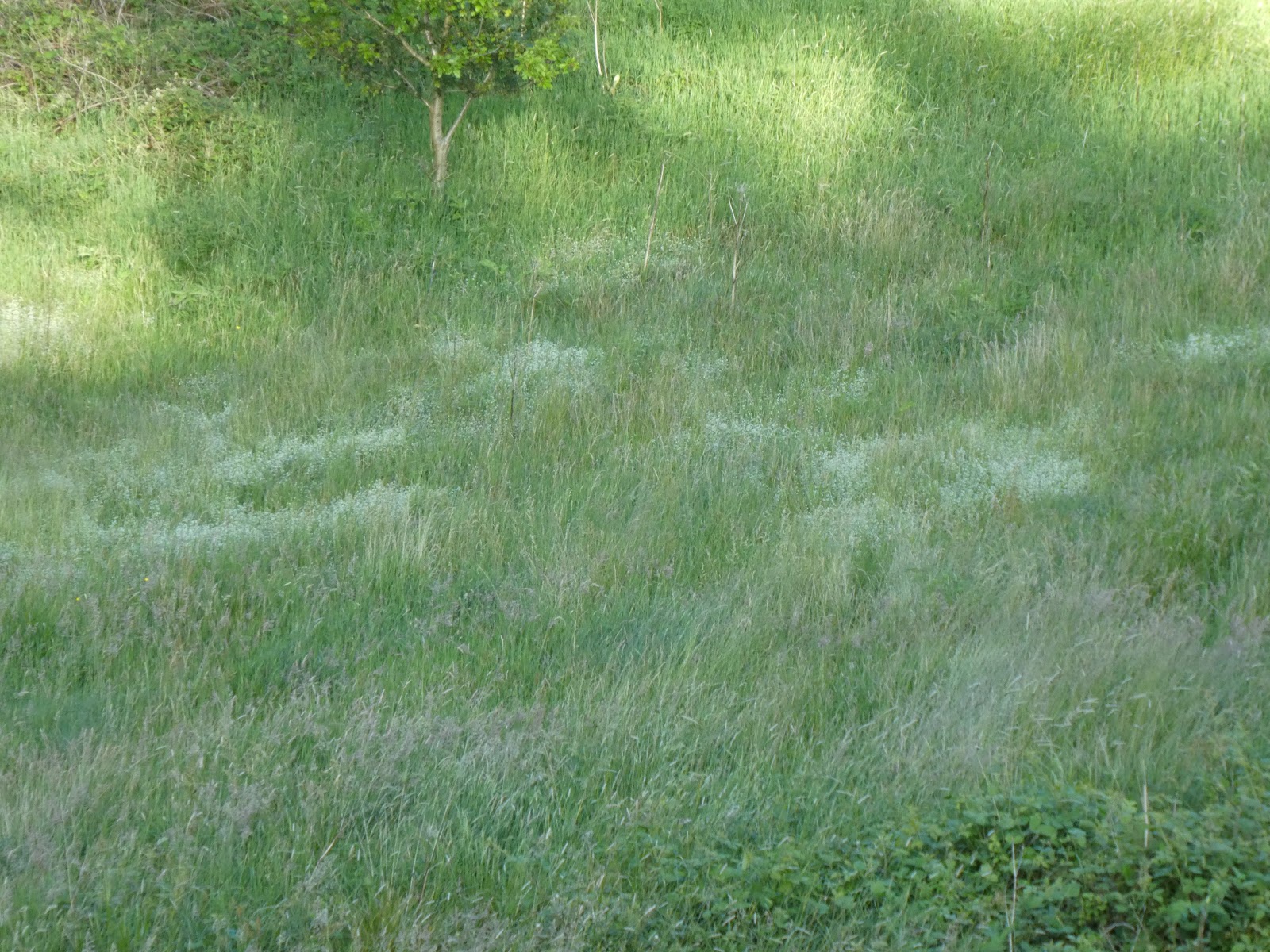
Here is a patch of a wildflower that is in the natural meadow that seperates the house from the wood.

Also a female Siskin on the bird feeder for interest.

F Siskin

Any ideas? Click to enlarge.
They aren't grass seedheads as you can see from the second pictures, they are flowers.

Tree planting and optimism

I remember this field below Green Lane, Lumb Bank at Heptonstall, being quite open before self-seeded Birch, Sycamore and Oak filling it up. A nice woodland in the making but just going over now.

Every time I pass by, my first impressions are of a congested and increasingly shady woodland; crying out for some good thinning before it looses all ground flora and the light demanding Oaks become degraded and derelict.

Imagine my surprise to find that instead of reducing the number of trees, much of this woodland has been underplanted with yet more of them!

Even without knowing which species have been planted, it is difficult to know why this has been done. As can be seen from the photos, the light levels in the woodland are fairly dim and the fact that even grass won't grow on the bare and shady ground should tell something about the optimism of the planters.

It would be very interesting to discover if anyone knows who did the work and can give an update of the management plan. I am keen to know and quite prepared to praise them for good ideas and my comments are a load of nonsense.
Calderdale Council owns much land in Colden, I do hope they are not responsible.

But I have seen the same underplanting happen in many other woodlands and the saplings have failed to survive.

Woodlands are not made by numbers, it is often the spaces and glades that give them a purpose.


There is an Oak tree here destined to be ruined by new planting.
Keep the glade open and let it grow.

Young Oak on left and right at risk from new planting. No room for any more trees.
 

A small glade with vegetation now under threat

Existing trees need thinning. Shade will inhibit any growth

Some thinning on left has taken place but nowhere near enough to be meaningful


Wednesday, 17 June 2020

It's those pesky weeds again

The newly built school at Todmorden, with re-graded slopes at school entrance, seeded with a wild flower mixture last year. 

Beautiful show of flowers and grasses this spring with bees and butterflies, so I took a photo.
Yet within just a few days the whole lot had been mown down.

Why would anyone contemplate doing this and think it a good idea; particularly as it was specifically sown to be an attractive entrance to an educational establishment.

We are all encouraged to keep an area for wildlife, yet this kind of official behaviour continues and scraped clean grassland is proudly proclaimed as the ideal level of attainment we should all aspire to.


Before


A few days later

Friday, 5 June 2020

Little Owl

Seen from the bedroom window on a haylage bale.
It was still there hours later.
I just caught it as its head rotated fully to the back.


Saturday, 23 May 2020

Self-seeded Limes (Tilia sp.) in answer to the previous post from Philip


Lime (Tilia sp.) self seeded at Lightcliffe in the 1990s.
Still healthy, though rarely repotted, just watered.


Close up showing the galls they get every year.
I think it is known as Military Gall, and caused by an insect.

Another remarkable thing about those Lime trees at Lightcliffe is that when the seeds were ripe in summer, a few Black-headed Gulls would sometimes tear them off (without perching on the trees) and fly off with them.
I never saw them eat the seeds, but presumabely this is why they wanted them.

Thursday, 14 May 2020

Do Lime trees set seed?

Has anyone ever found a self-seeded Lime (Tilia) sapling?
I am wondering if our changing climate may be encouraging germination.

All Lime trees in the valley will have been planted but the other day I saw two saplings in separate places which appear to be self-seeded, one of  which I think is Common Lime (Tilia x europaea).
The other with the heart shaped base leaf and stem dieback could be a Small-Leaved Lime (Tilia cordata).

Lime trees need long hot summers to set viable seed and the genus is on the northern edge of its range in the UK.
I have never seen a self-seeded one anywhere.

The Flora of Cumbria says about Small-Leaved Lime in the Lake District
"The individual trees can fairly be described as potentially immortal.
The massive bases have been dated by C.D. Pigott as up to 2,300 years old.
Pigott has demonstrated that most of these old 'bases' are of root tissue rather than shoot.
When trees fall, they sprout freely from the base and if the original trunk remains partly rooted,
shoots grow up from the crown and may eventually root and form individual trees."

It was also shown that Cumbrian populations of Tilia cordata only produce viable seed in exceptionally warm years and the trees must be considered relicts from the post-glacial warm period, possibly even from 3,000 BC.

Tilia x europaea ?


Tilia cordata ?

Wednesday, 13 May 2020

Hungarian Oak

For those interested in unusual planted trees, here is one at Centre Vale park Todmorden.

It is about 25 years old and was sent from the nursery as a Red Oak.
I had walked past it all that time until about 3 years ago I realised it was actually a Hungarian Oak (Quercus frainetto).

My photo is of a dead leaf but shows it to be much larger than a native Oak leaf and has deep square shaped lobes, which are divided into sub-lobes.
The tree has not yet produced any acorns.

The native range is the Balkans and the tree was introduced to Britain by Charles Lawson, an Edinburgh nurseryman, about 1835.

A very unusual characteristic is the lovely sweet balsam smell from the autumn leaves which lasts for months if they are put in a bowl as a pot-pourri (the living leaves on the tree don't smell).
This attribute is not mentioned in any account I have come across and may be a good way to confirm the identity of the tree.

The books say Hungarian Oak is planted in parks and large gardens but I have never seen another one, except in the arboretum at Thorpe Perrow in North York
---incidentally this also had the balsam smell on its dead leaves.

I would be interested to know if anyone knows of another growing in Calderdale.
If not, visit Tod Park and tick it off your list.

Hungarian Oak--next to the lamp post


Leaves can grow up to 25cm long

Tuesday, 12 May 2020

Brimstone

Last week during the warm weather we had numerous Brimstone butterflies in our woodland at Todmorden.
In the past there have been the occasional sightings and some years none at all.
Perhaps it is a combination of the warm spring and the maturing Alder Buckthorn we planted 30 years ago.
The woodland is of an open character with glades.
I would recommend anyone who does tree planting to include Alder Buckthorn and it thrives in damp ground.

Difficult to get closer for a good photo--looks to be feeding on the bluebells.

The Brimstone is one of the world's longest lived butterflies.
It also chooses to hibernate in Ivy.
A banking was covered in Ivy, then it was all eaten within a few winter months by Roe deer.
Apparently Ivy is the main food source for Roe in the winter months.
They left the banking with all the rope-like surface runners, like a net spread over the ground.
The Ivy isn't dead and is now growing new leaves.

See photo for the browse height on this gatepost; so measure the height and it will give you a guide when saplings can be released from having the leader nibbled off.


Brimstone

Sunday, 10 May 2020

Return of the Rabbits


Every few years the rabbits disappear from my area due to Myxomatosis. Usually at this time of year I can look out of my window and see them out on the hillside, but they have been gone since mid-summer last year. They are still not colonising the hillside opposite my window, but early one morning, coming back from my daily Dawn Chorus walk (that's another story!) I rounded the corner of Lumbutts and Causeway Wood Road to see these 2 beauties basking in the morning sun. And of course, rabbits being rabbits, where there are two, there will be more!

Sunday, 3 May 2020

Tadpoles at four weeks old

The fifth post showing the progress of the frog tadpoles in my garden pond.


Not many photos to show this week owing to the breakdown of my well-used macro camera lens! Could only manage this blurry effort, showing that the tadpoles have got a little bit rounder and even more speckled. They seem much more aware of me as a potential predator, swimming under a leaf as soon as my shadow falls on the pond.

Here are a few photos from my garden taken earlier this week.


Just looking closely at the pond, I suddenly became aware of the inscrutable gaze of this small frog. 


Something flew heavily around the garden, eventually careering into the ivy. It was this shield bug.


New oak leaves, Quercus robur. Note the tiny pink female flowers.


Until next week, when I hope my new camera lens will have arrived!

Friday, 1 May 2020

Lee Mount

A new sighting for here and I'm not well versed on newts !

I went out to check the moth trap this evening and nearly trod on this newt.
We have lived here since the 70's and we have never seen a newt here before !

I suspect it's a male Palmate Newt as the text seems to suggest the male has a short extension to the end of the tail and back feet are webbed - this one seems to fill both criteria?

Palmate Newt