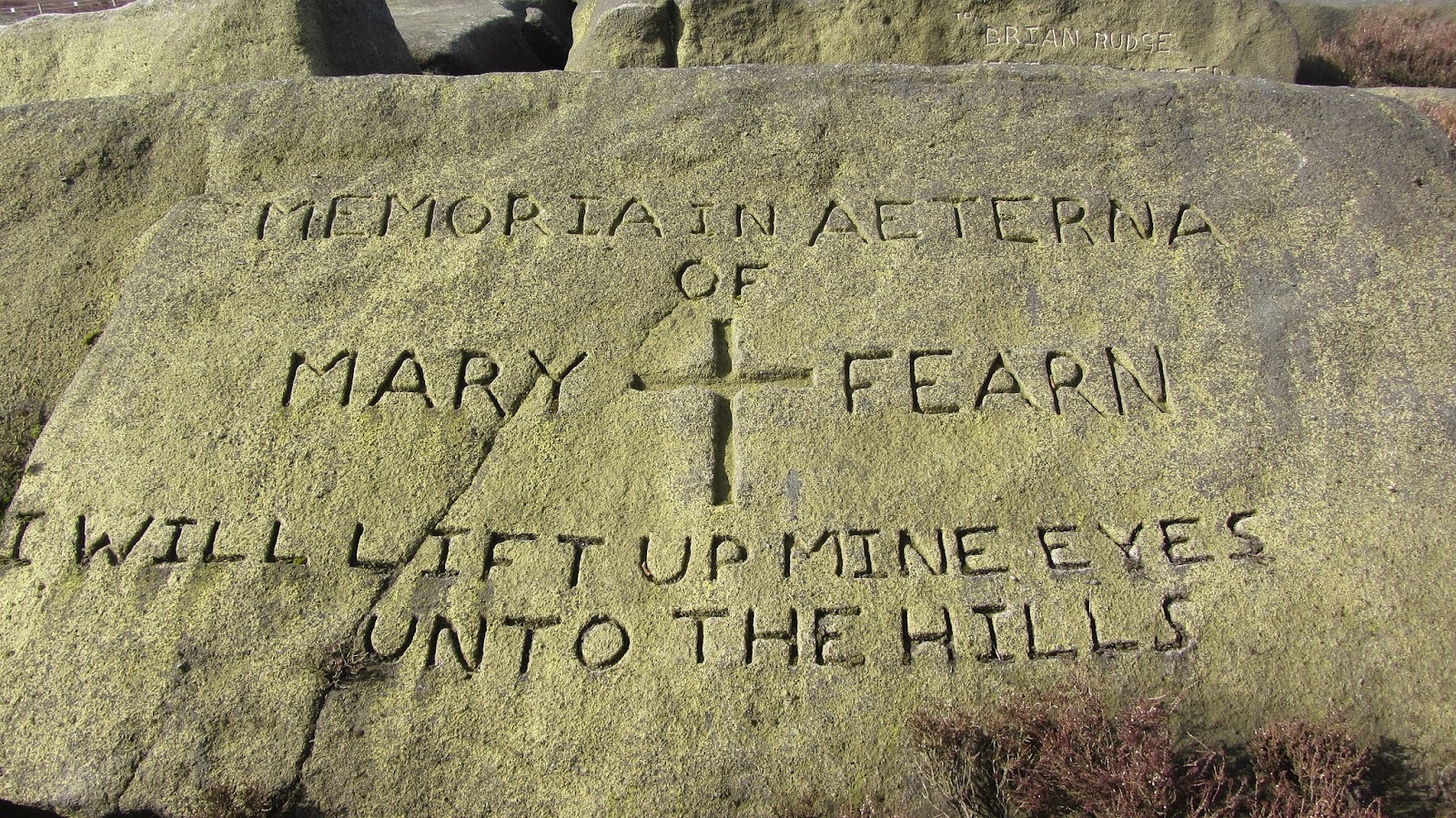
With the sun out I thought I might try the moor in the slim chance of an early emperor moth and/or the beetle Carabus nitens. It was still rather chilly and damp up here and I didn't see either. There weren't many birds about either, apart from red grouse, curlews, meadow pipits, a lone swallow heading west and a redshank was heard. I did however find four species of sphagnum moss, including S. fallax, S. denticulatum, S. capillifolium and possible S. palustre. There were also some (recent) significant carvings on Closet Stone (or thereabouts).
S. denticulatum
S. capillifolium
S. palustre?
This Blog covers nature sightings and related news in the Calderdale area.
It includes all groups - Plants, animals and fungi with links to specialist sites.
Anyone wishing to become a member of this Blog and post sightings please contact us.
If you would like to join the Halifax Scientific Society either email me or come along to the next meeting.
All welcome:
calderdalewildlifeblog@gmail.com
Wednesday, 13 April 2016
Sunday, 10 April 2016
Native Daffodils and equally beautiful (interesting?) Toads on the Roads to their ancestral breeding ponds.
The turn-off is easy to find; left opposite the Rishworth bus turning circle, which is just beyond Rishworth School on the Oldham Rd a few miles beyond Ripponden.
Common Toad, much more widespread in Calderdale than the old records suggest, but amphibians were not much mentioned, and maybe were taken for granted.
It is a Calderdale priority action species, as the deep ponds and old dams it needs to breed in are often drained for housing. Malcolm Smith in his British Reptiles and Amphibians (New Naturalist Series - available to borrow from our library) maintains they are site-faithful, and can walk up to 5 miles when they disperse, and come all the way back when old enough to breed.
This fact alone makes them a fascinating animal to me, and when we see that so many individuals get run over crossing roads near their journey's end, they deserve our attention.
Several of us in the Hx Sci Soc go out in the evenings in March and April to rescue them on the roads and put them into or on the edges of their ponds. The rush happens just after dark, so we generally only stay out about an hour.
They started appearing on 12th March this year, but the big night at Boulderclough was 3rd April, when four of us rescued 113. There were several sites for which we had only one volunteer or none.
There may be a few more nights of movement, as the cold spell on Friday/ Sat 8th and 9th has put a stop to toading. I have just heard that there were 2 toads tonight (Sunday) and a Palmate Newt, equally worthy of saving from the tyres.
Well done to all the volunteers throughout Calderdale ! (there are several sites and an active group that co-ordinate with the help of Facebook in the Upper Valley.)
The toads seem to move when the temperature reaches 8C, and a rush occurs when it reaches 10C or warmer. They must respond, I think, to a combination of temperature and day length.
In June and July you may notice while out on walks near water that the ground is studded with hundreds of tiny toads, often mixed with tiny frogs. Many of these will be eaten by birds and animals, making them an important part of the food chain; another reason to preserve them and their ponds.
Female Common Scoter at Ringstone last Sunday 3rd, and possible White Wagtail today
with thanks to AT for texting the alert to DJS
this was following a male Pied Wagtail -
could it be a female White ?
Mankinholes today.
Friday, 1 April 2016
Beech anomalies
The lovely Fern Leaved Beech in Centre Vale Park Todmorden was felled today. It was a victim of Phytopthora ramorum disease, which is a very serious fungal like pathogen.
Shame to lose this tree as there are now only two Fern leaved Beech in Todmorden--one near Holebottom and the other at Dobroyd.
Also felled was this common Beech, about 175 years old, which was dying from Phytopthora symptoms. I was intrigued by the unusual growth pattern which had created these isolated growth columns, separated by included bark reaching to the centre.
It almost looks as though it could have been a bundle planted tree, ie one where numerous individual saplings are planted in the same hole. This was sometimes done on boundaries and as the saplings grow they fuse together and create a more spreading crown and large feature tree.
Tuesday, 29 March 2016
Amphibian watch at Cromwell Bottom
On 26th March we made our annual survey of amphibians at Cromwell Bottom Local Nature Reserve.
Having the walk listed in the Calderdale Council's Wildside booklet usually ensures a good group of children; Easter school holidays also helps bring them out.
We had a brilliant total of 19 people including four children plus two dogs.
The kids are so enthusiastic, it brings out the energy in us big kids.
Many thanks to the members of Cromwell Bottom Wildlife Group who attended the walk with us or stayed back in the cabin with the kettle on ready for our mid-day break, a welcome innovation.
They also lent us some lovely new pond-dipping equipment which saw good use.
CBWG had been called on to rescue some frogspawn from Lloyds Bank Copley Data Centre, where it looked like it was going to dry out. They had placed some of this in various ponds on the reserve. There was also plenty of naturally appearing frogspawn clumps, though I didn't get a count of these. I'm relying on Allan, as he knows where the Copley spawn was put.
No adult newts were spotted despite much staring into ponds. We saw plenty last year on 28th March. However, when we got to Tip Pond, one of the boys, Dylan, made a sweep with his net and tipped the wet and weedy contents into one of the white trays being carried by an adult. What was at first thought to be a leech, then a small fish, turned out to be an immature newt, about 1.5 inches (4cm) long.
It had its four limbs (very filamentous) and still had its external feathery gills that newt larvae have. (See picture.) Annie commented on its similarity to a tiny Axalotl, which is after all, just a large amphibian. Dylan's newt would not yet have left the pond it developed from the egg in.
The species of newt that have been identified at Cromwell Botton NR are Smooth and Palmate, but no-one was prepared to have a stab at identifying this little one.
No frogs were seen, but when four us went to look at how the Sphagnum Bog had fared after the Boxing Day Floods, we found a dead Common Toad. I think it had possibly been crushed underfoot, as its tongue was exposed, as when they are run over on the road. Another was spotted, very still, halted in mid-crawl and covered in white fly-ash.
At first we thought it had been poisoned by the alkaline ash and petrified, but I noticed its eyes were not covered, and it was slowly blinking occasionally. I took it to clear water at the nearby Wet Woodland and washed it, when after being photographed (see picture,) it swam away perhaps soon to find a mate.
The floods had poured into the Sphagnum Bog via Pixie Wood, disturbing the fly ash, and covering everything in a thick white layer. Some of the "quaking bog" effect had returned, long remembered by local kids, now grown up, as the "Wibbly Wobbly".
It was a very successful amphibian walk, with two species seen, and another seen to be present by its spawn.
Species mentioned: Common Frog Rana temporaria
Common Toad Bufo bufo
Smooth Newt Lissotriton vulgaris (also called Common Newt, but scarce here.)
Palmate Newt Lissotriton helveticus (this is the one we usually encounter in Calderdale.)
Having the walk listed in the Calderdale Council's Wildside booklet usually ensures a good group of children; Easter school holidays also helps bring them out.
We had a brilliant total of 19 people including four children plus two dogs.
The kids are so enthusiastic, it brings out the energy in us big kids.
Many thanks to the members of Cromwell Bottom Wildlife Group who attended the walk with us or stayed back in the cabin with the kettle on ready for our mid-day break, a welcome innovation.
They also lent us some lovely new pond-dipping equipment which saw good use.
CBWG had been called on to rescue some frogspawn from Lloyds Bank Copley Data Centre, where it looked like it was going to dry out. They had placed some of this in various ponds on the reserve. There was also plenty of naturally appearing frogspawn clumps, though I didn't get a count of these. I'm relying on Allan, as he knows where the Copley spawn was put.
No adult newts were spotted despite much staring into ponds. We saw plenty last year on 28th March. However, when we got to Tip Pond, one of the boys, Dylan, made a sweep with his net and tipped the wet and weedy contents into one of the white trays being carried by an adult. What was at first thought to be a leech, then a small fish, turned out to be an immature newt, about 1.5 inches (4cm) long.
It had its four limbs (very filamentous) and still had its external feathery gills that newt larvae have. (See picture.) Annie commented on its similarity to a tiny Axalotl, which is after all, just a large amphibian. Dylan's newt would not yet have left the pond it developed from the egg in.
The species of newt that have been identified at Cromwell Botton NR are Smooth and Palmate, but no-one was prepared to have a stab at identifying this little one.
No frogs were seen, but when four us went to look at how the Sphagnum Bog had fared after the Boxing Day Floods, we found a dead Common Toad. I think it had possibly been crushed underfoot, as its tongue was exposed, as when they are run over on the road. Another was spotted, very still, halted in mid-crawl and covered in white fly-ash.
At first we thought it had been poisoned by the alkaline ash and petrified, but I noticed its eyes were not covered, and it was slowly blinking occasionally. I took it to clear water at the nearby Wet Woodland and washed it, when after being photographed (see picture,) it swam away perhaps soon to find a mate.
The floods had poured into the Sphagnum Bog via Pixie Wood, disturbing the fly ash, and covering everything in a thick white layer. Some of the "quaking bog" effect had returned, long remembered by local kids, now grown up, as the "Wibbly Wobbly".
It was a very successful amphibian walk, with two species seen, and another seen to be present by its spawn.
Species mentioned: Common Frog Rana temporaria
Common Toad Bufo bufo
Smooth Newt Lissotriton vulgaris (also called Common Newt, but scarce here.)
Palmate Newt Lissotriton helveticus (this is the one we usually encounter in Calderdale.)
Thursday, 24 March 2016
Growing wild seed
This from Calderdale council's News Centre has just been issued. Large trays of wild flower seed are being given away for planting out; "Council is making sure that parks and grass verges will benefit too – especially in areas that have become overgrown or unused."
Are overgrown areas a good place for wild flower seed? I thought they needed minimum competition. I do hope there aren't disappointed people. Like many things--the success is in the detail not the hype.
Monday, 21 March 2016
A bat feeding at mid-day.
Brian Taylor sends these observations and thoughts - "at Gorpley dam
yesterday (Sunday 20th March) I came across a bat, which I took to be a
pipistrelle as it was quite small, hawking for flies around the dam wall
and the water treatment plant (particularly the pond), in broad daylight
around mid-day. Presumably it had woken up hungry! I wondered whether
they might roost in the old mine adits? Have others been seen emerging
from hibernation?
On the moor nearby I've seen snipe recently, and yesterday a surprisingly confiding golden plover -with white underparts apparently indicating winter plumage, or a first summer male- and got to thinking its that time of the year when we need to be talking to dog owners about the need to keep their pets under close control on moorland. There was an excellent article in the Rochdale paper recently by someone from Lancs Wildlife Trust. He wrote it from the point of view of a responsible dog owner. As you're no doubt aware, there's still/also a need for more and better notices at access points round here ..."
with best wishes, Brian.
On the moor nearby I've seen snipe recently, and yesterday a surprisingly confiding golden plover -with white underparts apparently indicating winter plumage, or a first summer male- and got to thinking its that time of the year when we need to be talking to dog owners about the need to keep their pets under close control on moorland. There was an excellent article in the Rochdale paper recently by someone from Lancs Wildlife Trust. He wrote it from the point of view of a responsible dog owner. As you're no doubt aware, there's still/also a need for more and better notices at access points round here ..."
with best wishes, Brian.
Monday, 14 March 2016
Amphibians starting to breed.
On the toad front we had two on the road at Todmorden on Saturday, but none at the same site on Sunday, when the temperature dropped to about 7C.
Frogs: on the impromtu walk yesterday (3 turned up - see below) we saw c.40 frogs having a great get together among c.20 clumps of spawn at Cunnery Wood, near Shibden Park, and I now have 6 clumps in my tiny garden pond, where it appears about one per night, with no sign of the frogs!
We have a good team of volunteers at Boulderclough Dam, near Sowerby, but need people at Thornhill Beck Lane, Brighouse. If you can go just a few of the warmest nights (around 10C seems optimal - or warmer) that would save a lot of toads.
There are also sites at Todmorden where volunteers would be welcomed, plus one at Hebden Bridge, at Hebden Hey to be exact, where I'm not aware of anyone intending to go along.
Please try to count your toads if helping them across roads, and send me your records at the end of the season (in about 2 to 3 weeks depending on temperatures.) Count squashed ones as well please.
Steve 0771 500 5379
p.s. though we see many toads, we don't often see their strange strings of spawn, so different from that of frogs. I will endeavour to find some this year, and organise a visit for those toad patrol volunteers who are curious to see it. One year it was very prominent at Widdop Res, in the channel along the side, and also in the main reservoir itself.
Saturday, 12 March 2016
Impromtu Walk Sunday 13th March 1pm. up Beacon Hill.
Some of us hope to walk up Beacon Hill. The path is cobbled - the "Magna Via" - it is thought to be the original main track into Halifax from Wakefield in the Middle Ages.
Meet at the phone box outside the Railway Station, opposite Square Chapel. We will be in sight of the new library which is really progressing now.
Meet at 1.00 for 1.10pm. Snacks and refreshments might be a good idea as we pass no shops or cafes.
If we make good time we might go over the top and down the other side slightly to Cunnery Wood; though we will go the speed of the slowest up the Magna Via, with stops to look at things. Distance c.3 miles, but with a big hill.
Meet at the phone box outside the Railway Station, opposite Square Chapel. We will be in sight of the new library which is really progressing now.
Meet at 1.00 for 1.10pm. Snacks and refreshments might be a good idea as we pass no shops or cafes.
If we make good time we might go over the top and down the other side slightly to Cunnery Wood; though we will go the speed of the slowest up the Magna Via, with stops to look at things. Distance c.3 miles, but with a big hill.
Wednesday, 9 March 2016
Calderdale Barn Owls 07 03 2016
I Was watching a Barn Owl Locally on 07 03 16 when another flew nearby, the two were close together at one point,certainly been quite a few sightings Locally over the last few Years .I know Phillip saw 2 outside our area,recently,and a few of us have had some great sightings Locally in the last few Years.So watch out if anyones out and about late afternoon onwards,there could be more than we realise.
Tuesday, 8 March 2016
Will this disease arrive here?
I had never heard of this bacterial pathogen until recently but it is another very real threat to our trees and shrubs. I follow with a few quotes which should alarm us all.
"Plant disease Xylella fastidiosa could wipe out the English oak in the same way as ash dieback is killing the UK's ash trees"
The lethal bacterium, already widespread on mainland Europe, has not yet entered the UK. "But if plant material keeps coming across from the Continent without any thought to bio-security it is only a matter of time before this menace becomes a reality".
"The European Food Safety Authority currently lists more than 350 plant species susceptible to Xylella fastidiosa, while the European Commission has called it "one of the most dangerous plant bacteria worldwide".
"The potential for Xylella will blow Chalara (Ash Dieback) totally out of the water - it is the unknown. We've seen it establish itself in France in a very short period of time, and maybe it's already in the UK. I would be very surprised if it is not more prevalent than it is at the moment".
"Plant disease Xylella fastidiosa could wipe out the English oak in the same way as ash dieback is killing the UK's ash trees"
The lethal bacterium, already widespread on mainland Europe, has not yet entered the UK. "But if plant material keeps coming across from the Continent without any thought to bio-security it is only a matter of time before this menace becomes a reality".
"The European Food Safety Authority currently lists more than 350 plant species susceptible to Xylella fastidiosa, while the European Commission has called it "one of the most dangerous plant bacteria worldwide".
"The potential for Xylella will blow Chalara (Ash Dieback) totally out of the water - it is the unknown. We've seen it establish itself in France in a very short period of time, and maybe it's already in the UK. I would be very surprised if it is not more prevalent than it is at the moment".
Friday, 4 March 2016
Navelwort and Polypody
On the large wall near the canal opposite Sowerby Bridge cemetery is this Navelwort - Umbilicus rupestris. Next to it is a clever re-use of a stone gatepost, still with its former pintle on the side. The head of the gatepost now has a let-in iron hinge for a new gate. Nothing wasted then. Looks like Wall Rue is lurking in the shadows above the pintle.
I remember about 20 years ago Calderdale Council had a contractor pump in grout to all the drystone roadside walls from Todmorden to Eastwood. Every hole and cavity was filled in, presumably as a cheap way of stabilising them. Goodness knows how many mammals and birds etc were made homeless. With all this flooding we need to make sure our old walls aren't stabilised with similar methods but rebuilt properly. They are a great history book and home to allsorts.
Also Common Polypody-- Polypodium vulgare, in a wall at Mytholmroyd, showing the lovely orange sori underneath.
Thursday, 3 March 2016
Tuesday, 1 March 2016
Glaucous Gull at Cant Clough Res. 29.2.16
Cant Clough is just over the watershed from Upper Gorple Reservoir.
The gull comes in about 4pm and roosts alone an the otherwise deserted reservoir.
It's quite confiding, and appears to be a small individual, maybe slightly smaller than the average Lesser Black-backed.
With thanks to Ian C. for the tip-off.
Sunday, 28 February 2016
Conifers in the Crags, our monthly walk - 27th February
Eight people turned out for the walk to Hardcastle Crags, near Hebden Bridge, West Yorkshire.
Peachysteve and myself as joint leaders, plus, Emma, Annie, Stella, Alison, Oliver and Am.
Plus four dogs, Basil, Lacey, Meg and Tig.
Our best achievement (for me) was to locate and get to know the Weymouth Pines near Walshaw Bridge.
Pictured above, it is the one with banana-shaped cones,beautifully spotted with white resin. It has soft, blue-green needles in bunches of five. Compare with the Scots pine at the bottom.
Pinus strobus, named after the British collector, Weymouth, but from Eastern USA, where it is known as Eastern White Pine among other things.
Scots Pine is P.sylvestris. It is easily rcognised from a distance by its reddish bark on the branches and sometimes trunk. Its needles are in twos, and vary from bluish-green to deep green on different trees.
Of course we looked at the three Douglas Firs at the Weymouth Pine site, but I forgot to photograph them.
We couldn't locate the Lodgepole Pines, P. contorta, which are supposed to be there.
So I'm still not familiar with those.
Part of the party coming along Hebden Water.
A poor picture of a Dipper, our Society's emblem.
We saw few other birds.
Weymouth Pine and its distinctive style of "handwriting" against the sky.
Looking up the trunk of one of the most massive Scots Pines on the river bank between Midgehole and Gibson Mill. Probably the largest living thing in Calderdale.
s
Other conifers we saw in the Crags were Yew (Taxus baccata) Norway spruce (Picea abies), Sitka Spruce (Picea sitchensis) and the two larches, European and Japanese, with their distinctive cones (the Japanese with outcurving scales - the European with straight scales,) plus several that were hybrids, with the cones showing various degrees of out-curving. Austrian Black Pine, P. nigra, is quite frequent through the woods. There is a beautiful Hemlock, Tsuga heterophylla, at Hebden Hey, the Scout Headquarters, but we didn't have time to cross the valley to see it. A couple of Lawson's Cypresses Chamaecyparis lawsoniana, had been sawn off near a landslide on the private side of the valley near Hebden Hey.
The Deodor, or Indian Cedar Cedrus deodora, which was in the Lodge garden until fairly recently, has been felled. And the couple Cedars of Lebanon ( I found mentioned as being in the Crags in an old press cutting in our archives,) I have never known to be there.
Thanks to Peachysteve for his encyclopaedic memory, his energy ferreting around for the larch cones, and his constant stream of moss names, three species of which he has decided to learn per day, with the help of the BBS Key and the confirmation of other Bryologists he contacts on I-spot.
He is concentrating on the common names.
We also looked for the Alternate-leaved Golden Saxifrage in the one site it is known, where we relocated it after many decades last February, and it is still doing well.
A plant of Water Figwort was seen. There were signs of deer and rabbits. Meg walked around with a dead rabbit in her mouth for a while. (Meg is a black labrador :-)
Wednesday, 24 February 2016
Barn Owls
Barn Owl seen today 1 mile over Lancashire border. Then, amazingly, a few hours later saw another one flying and then resting on a wall only yards away from the car but this was near Gargrave. Two unexpected sightings in one day!
Wednesday, 17 February 2016
Early Small Tortoiseshell 15 02 16
Saw a Small Tortoiseshell,flitting over the ice and frost at Langfield Common in the afternoon Sun,just seemed so out of place on a Winters day.regards Bri.
Walshaw Moor Estate,Business As Usual !! 16 02 2016
Had a couple of hours up on Walshaw Moor yesterday,and
yet again More Burning Off was being carried out, on the Walshaw Moor Shooting Estate !
(For issues surrounding this controversial burning please click on link in Bruce's post, a few posts down on 5th Feb. SB )
yet again More Burning Off was being carried out, on the Walshaw Moor Shooting Estate !
(For issues surrounding this controversial burning please click on link in Bruce's post, a few posts down on 5th Feb. SB )
Monday, 15 February 2016
Do something practical for Nature Conservation
National Nest Box Week
NNBW takes place
each year from 14-21 February, and after more than 15 years it is now an
established part of the ornithological calendar.
NNBW aims to
encourage everyone to put up nest boxes in their local area in order to promote
and enhance biodiversity and conservation of our breeding birds and wildlife.
Whether you’re a
family with space for a box in your garden, a teacher, a member of a local
wildlife group, or you belong to a bird club and could organise a work party,
National Nest Box Week gives you the chance to contribute to the conservation
effort in the UK whilst giving you the pleasure of observing any breeding birds
that you attract to your garden.
Go to: http://www.bto.org/about-birds/nnbw
Who can take part?
Anyone can take
part whether you’re a family with space for a box in your garden, a teacher, a
member of a local wildlife group, or you belong to a bird club.
When?
We’re asking you to
put your nest box up from 14 to 21 February to celebrate
National Nest Box Week (NNBW). But, you can put up a nest box at any time
of the year.
Why take part?
Natural nest sites
for birds such as holes in trees or old buildings are disappearing fast as
gardens are ‘tidied’ and old houses are repaired.
Taking part in NNBW
gives you the chance to contribute to bird conservation whilst giving you the
pleasure of observing any breeding birds that you attract to your nest box.
Thursday, 11 February 2016
Early Frogspawn 09 02 16
Some early Frogspawn in a Todmorden Garden Pond on 09 02 16,it's a bit earlier than last Year's in same pond which was seen on 16 02 2015,not really suprising the way the Temperatures have been recently !
Friday, 5 February 2016
Geology Lecture at The Halifax Scientific Society
Tuesday 9 February
Will Varley of the Huddersfield Geology Group will give a talk ...
"In the beginning…… a brief History of Geology"
Please meet at the Halifax Central Library at 19:15 on Tuesday the 9th of February 2016
Friday, 22 January 2016
Wednesday, 20 January 2016
Bird Group - Halifax Scientific Society - Walk to Cranberry Dam
Some of us want to fit another walk in because the next scheduled is not till 27th February to Hardcastle Crags. Members of the Upper Calderdale Wildlife Network are invited to join us.
It seems a while since the last walk; the one on 1st January - the New Year Bird Count.
Up on the tops of the Pennines we might see some interesting birds, and maybe find that Cranberries still grow near Cranberry Dam. Bring a snack and a drink. It is a short walk of less than 3 miles, but there are rough paths and a couple of stiles to negotiate.
It is spectacular rugged geology. We will be looking at everything - not just birds. No doubt we will pass some Flying Bent collecting sites. It will be interesting to see what the area looks like after the Boxing Day deluge.
Meet on Sat 23rd January at the bridge over the Calder at Todmorden Bus Station.
Time; 10.30 for 10.40. Lifts available up to the start of the walk at Walsden.
Buses come in regularly from Halifax. (The whole journey is 49mins.)
Or lifts from Halifax.
Please say if you can come by posting a comment here or contacting me.
A "Rock-run". I have read an explanation of how they are formed.
It seems a while since the last walk; the one on 1st January - the New Year Bird Count.
Up on the tops of the Pennines we might see some interesting birds, and maybe find that Cranberries still grow near Cranberry Dam. Bring a snack and a drink. It is a short walk of less than 3 miles, but there are rough paths and a couple of stiles to negotiate.
It is spectacular rugged geology. We will be looking at everything - not just birds. No doubt we will pass some Flying Bent collecting sites. It will be interesting to see what the area looks like after the Boxing Day deluge.
Meet on Sat 23rd January at the bridge over the Calder at Todmorden Bus Station.
Time; 10.30 for 10.40. Lifts available up to the start of the walk at Walsden.
Buses come in regularly from Halifax. (The whole journey is 49mins.)
Or lifts from Halifax.
Please say if you can come by posting a comment here or contacting me.
Cranberry Dam on an earlier visit.
A further Bird Group activity I propose is installing nest boxes during February if readers can suggest locations. I want to attract Starlings and collect BTO Nest Records. (British Trust for Ornithology.) They need walls or trees 2.5 metres or higher.
What we did and What we Saw on the day.
Nine people braved the mud and got up to the dam without too much trouble.
I personally was gutted to see an array of giant wind turbines all along the skyline. They've been imposed since I was last up there. I suppose people have to jet-wash their patios.
Two large raptors took to the air as we approached the dam. They were buzzards, Common Buzzards most probably but we didn't see them soaring, or well enough to be certain.
As we ate our lunch in the shelter of a wall ( there was a damp breeze, ) we saw only Carrion Crows but there was definitely a Raven somewhere. I heard its deep "prruk" call once.
A Mistle Thrush was singing at Ramsden Wood, and a black rabbit fortunately escaped the dogs up near the dam.
We found no cranberry plants. Someone suggested the dam might have been built by someone called Cranberry :( . . . .
but there was much hair moss (Polytrichium sp.) and a small amount of sphagnum moss.
We have found cranberry associated with sphagnum before.
Anyway we enjoyed the rugged scenery, especially at Ragby Bridge, where the woodland was compared to a mini-Hardcastle Crags.
In the valley on the way up, it appears that there is a natural scree formation under the cliffs; I can't think of any other such in Calderdale. Above it there is a natural re-growth of young trees to supplement the few Oak and Common Ash that cling on there.
Also, in the ravine below the dam is a "Rock-run" of small stones down a slope. These are such a feature of parts of the Falkland Islands (special plants grow in them there,) that Charles Darwin discussed them in his memoirs of his visit during the voyage of the Beagle.
Some information boards around Middle Ramsden Farm, placed by Natural England, were disappointing for their misleading information and dilapidated, weather-affected condition.
Judy took us to a ruin she remembered where the arched cellar was intact. Down there Peachysteve identified five different ferns. Common Male Fern, Hard Shield Fern, Hartstongue, Maidenhair Spleenwort, and another I can't remember.
Is this true scree, and is there another in Calderdale?
The shale hillside exposed possibly by overgrazing in the past.
Information board.
Friday, 1 January 2016
Flying Bent
Many older grass books refer to Purple Moor Grass as Flying Bent. This is a good observation for this grass where all its foliage dies above ground in Winter. The leaves then become airborne in windy weather and get trapped on fences, the sail like effect can then break fences in heavy weather. Sometimes dry stone walls are completely covered in a mass of dry leaves on the windward side.
These 2 photos taken up Kebs Road above Todmorden give good examples of Flying Bent having landed!
Incidentally, the stems of this grass used to be twined by fishermen in the Orkneys to make ropes; also prized by continental fishermen as enduring longer then hempen twine. Countrymen made brooms from its strong and long straw---sold cheaply it is said. From "Gramina Britannica-J L Knapp" 1804.
Subscribe to:
Posts (Atom)