This Blog covers nature sightings and related news in the Calderdale area.
It includes all groups - Plants, animals and fungi with links to specialist sites.
Anyone wishing to become a member of this Blog and post sightings please contact us.
If you would like to join the Halifax Scientific Society either email me or come along to the next meeting.
All welcome:
calderdalewildlifeblog@gmail.com
Please contact us about any sensitive records before posting on the blog

Monday, 6 October 2014

Ash Trees

As a follow-on from the Ash disease posting, here is a very large Ash by the side of the canal towpath at Luddenfoot. It must be one of the largest girth maiden Ash we have locally and probably is as old as the canal. I hope someone is looking after it. We need a local Notable Tree Register to document these 'forgotten' specimens.

Luddenden Foot


The Yorkshire Sculpture Park at Bretton Hall has trees that hold my interest more than some of the sculptures. This Ash is individually fenced and is fantastic. It appears at first to be a complete tree until you look at the other side to see it is only a third of its original diameter. It must be approaching 6oo years old and the only reason it is this old is because of past management as a pollard. Not one other passer-by even glanced at it.

Pollarding is out of fashion and misunderstood by many people in the tree profession but look at this photo to see that as long as there is functioning sapwood, trees can survive. Pollarding rejuvenates the tree and re-sets the clock.

Ash looking 'whole'
 
Showing outer skin of sapwood

The tree is still pollarded regularly


Thursday, 2 October 2014

Ash Dieback Disease

This serious threat to Ash trees caused by the Chalara fraxinea fungus is getting closer; see this Craven Herald report http://www.cravenherald.co.uk/news/11508969.Disappointment_as_ash_dieback_arrives_in_Craven/

Wednesday, 1 October 2014

Velvet Shield - Park wood.

I went looking for the Parasitic Boletes today in Park wood, Elland, without any luck but did find some nice fungi. Pick of the bunch I think were these Velvet Shields (Pluteus umbrosus).

The caps had a lovely, velvet appearance and the gills were pinkish, dark-edged and free. I feel confident on the ID but if anyone knows different please let me know.


Thursday, 18 September 2014

Autumn Crocus Walk to Ogden, Soil Hill and Oats Royd.

There will be a walk this coming Saturday the 20th of September to see the Autumn Crocus. There should also be plenty Fungi to see. Meet School Lane / Riley Lane junction at 10:30 or Bradshaw Church at 10:45 for a 3 to 4 mile gentle stroll. Bring refreshments.  Bruce.

These are just below Dean Lane, Sowerby, only re-found recently.

The Autumn Crocus are very early this year, which Bruce alerted us to. Any sightings would be gladly received. Take care not to mix them up with Colchicum which is grown in gardens, and misnamed Autumn Crocus by some garden centres.

A good display of them for less mobile people is usually in a roadside field on the left just before the former Withens Pub above Wainstalls at Cold Edge. They have been known there for over 100 years. Steve.


Beautiful Yellow Underwing

 One of the many poetic moth names.


Caterpillar of Beautiful Yellow Underwing c.3cm long

Found on Whirlaw Common, Todmorden, on Sunday last among the Bilberry and Cowberry, where it was put back.

The name is apt for the caterpillar as well. 

Wednesday, 17 September 2014

Ring Necked Parakeet

There were 2 of these birds seen over Mytholmroyd last Thursday and today there is one calling and being chased by 2 Jackdaws over Todmorden near the Tudor Chippy.

Monday, 15 September 2014

Autumn Crocus Walk to Ogden, Soil Hill and Oats Royd.

There will be a walk this coming Saturday the 20th of September to see the Autumn Crocus. There should also be plenty Fungi to see. Meet School Lane / Riley Lane junction at 10:30 or Bradshaw Church at 10:45 for a 3 to 4 mile gentle stroll. Bring refreshments.

Thursday, 11 September 2014

Latest update on Hedgehogs in Calderdale

A big thank you to everybody who got in contact with their hedgehog records and a special thank you to Hugh Firman, Steve Blacksmith and Laura Price who have helped and supported me along the way and by creating all the wonderful maps! I'll be leaving the countryside team to return to university but all your records are still in high demand so please send in your sightings with its location/postcode and date to countryside@calderdale.gov.uk


Downloadable distribution map (click on link below)


Betony

Earlier post
When have you last seen a hedgehog? Have you seen or heard a hedgehog rustling around in your back garden or woodland (or even a squished one on the road)? If so, Betony Atkinson, a student placement working with Countryside Services, would like to know. Please send details, including the location and date of the sighting, to betony.atkinson@calderdale.gov.uk to help her draw up a picture of their distribution in Calderdale.


photo – credit to Mrs. Pat  Morris, BHPS


Wednesday, 10 September 2014

Radio Programmes

Book Of The Week: Sapiens - A Brief History Of Humankind

Ep 1-5/5
Tuesday 9 September,Thursday 11 September,Wednesday 10 SeptemberFriday 12 September and Monday 8 September
9.45am-10.00am
BBC RADIO 4
Adrian Scarborough reads from Yuval Noah Harari's ground-breaking account of humankind's remarkable history, from insignificant apes to rulers of the world.
100,000 years ago, at least six human species inhabited the earth. Today there is just one. Far-reaching and provocative, Sapiens challenges everything we thought we knew about being human - ending with a look at what lies ahead for humankind.
Abridged by Penny Leicester.
Reader/ Adrian Scarborough,  Producer / Gemma Jenkins for the BBC
BBC Radio 4 Publicity


Heard this today - very thought provoking - especially after our meeting last night with Neil KIngsnorth's talk on Fracking and Climate Change. Steve B. (Don't know why the schedule is garbled on the right, but you can look it up if you're interested.)

Wednesday, 3 September 2014

Pure white Rose-bay Willowherb seen last month


 Chamerion angustifolium (White variety )

This patch has been known a long time at Ogden. We used to look for it with Frank Murgatroyd who had seen it, but it never seemed to be there. I refound it shortly before he died. It's in a little overgrown quarry at the junction of Keighley Rd. and the Ogden Golf Course turn-off.


On the same day, just after refinding the Ogden patch I found another just 1.5km away in Mixenden. It's not so extensive. The light was going when I visited it this year, but you can see the white flowers against purple heather.

I tend to drive east from the M74 to the Ardrossan ferry port when going to the Hebrides along a winding road, the A70 from Douglas, with many patches of Rose-bay. You can tell how big some of the patches have got, each from a tiny flying seed, as they vary in the pinkness and sometimes flower-spike size. But there's no white along that long road. I've never seen it anywhere else in the wild, and only once in a garden where it was being cultivated. It's probably possible to order it from specialist nurseries.

If we didn't already have the Autumn Crocus, it could be Halifax's Flower.
 (Somebody is going to tell me there's loads of it in Bradford.)

Tuesday, 2 September 2014

Canary Grass; Phalaris canariensis

This Canary grass photo was not taken in Calderdale but just over the hill at Ball Grove Country Park at Cottontree. It was growing in 2 patches at either side of the path. I haven't seen this grass for a while but it is worth looking for it in pavements cracks and stony ground at this time of year.

It is an annual and is mainly seen in gardens, or where bird seed is scattered. To look at, you wouldn't connect it with the same genus as the common Reed Canary Grass Phalaris arundinacea, as it looks entirely different.

Originally from the Canary Isles and Africa, it has been in this country for 400 years and was grown commercially in the early 19thC for bird seed.


Sunday, 31 August 2014

Luddendenfoot Park 20-08-2014

Oliver and I found the Scarlet Pimpernel just on the outskirts of the park. It isn't common within Calderdale and I do not know where else it can be found in our area so it made our day to find it. Apparently the flowers contain no nectar or scent so very few insects visit it which is surprising considering it so magnificent and bright. The flowers only open between approximately 08.00 and  15.00 and no do open in dull and wet weather and it has been regarded in the past (before we got watches and a weather forecast) as a combined weather gauge and clock.


Scarlet Pimpernel (Anagallis arvensis)


Opposite pairs of leaves.


 It has a five veined capsule that will open transversally by a lid when mature.

Friday, 29 August 2014

Fungi at Ogden


One of my first this season and rather pretty fungi was seen at Ogden on Thursday on grass. My (wild) guess as to species is Coprinus plicatilis. I trust our local experts will correct me.

Monday, 25 August 2014

Fiorin and the Famous Orcheston Long Grass

In an earlier post, Steve had a picture of Creeping Bent Agrostis stolonifera and then he used the name of Fiorin grass. This name Fiorin was often used in earlier grass books but seems not to be mentioned in the modern ones.
 
The word Fiorin has some history behind it and was first mentioned by Dr W Richardson in the early years of the 19thC.  Richardson had land in Ireland near the Giant's Causeway and he learnt the name of this grass from local farmers. Dr Richardson noticed how highly regarded this grass was and he became quite obsessed with it.
 
He wrote a book in 1812 "New Essay on Fiorin Grass" which recommended planting this grass everywhere in Britain. (You can read this book on Google Books). He spent years proselytising about Fiorin and persuaded many landed gentry to grow it successfully.

Richardson noticed how the long stolons of this Bent grass were like long strings and he recommended propagation by laying these strings out and lightly covering with earth. He claimed that all these strings naturally grew Northwards as accurate as a compass. No one seems to know the origin of the word Fiorin but it was suggested to mean 'butter grass', on account of how the milk from cows that fed on this grass made tastier butter.

Fiorin is native to all of Britain and is mentioned in earlier grass books under its other name of "The famous Orcheston Long Grass". It became famous in the little village of Orcheston St Mary in Wiltshire, way back in the 17thC, when John Aubrey wrote of it in his book  the "Natural History of Wiltshire" in 1656.
 
This famous Orcheston grass grew long tresses of leafy stolons up to 24 foot long in the floating water meadows. It became so famous for its continuous, lengthy and lush growth that a 17 foot length of these tresses was presented to King James 1st.

Saturday, 23 August 2014

Fly Id.

Hi all
This fly was seen recently in Todmorden. I have an inkling it may be one of the Ichneumonoidea. We would appreciate a closer Id if anyone can.

Friday, 22 August 2014

Beetle id please

 Can anyone help with an id for this beetle please, found on the Pennine Way footpath near where it intersects with the Calderdale Way above Makinholes.


It isn't in my books and I can't find it on the web either.

Monday, 18 August 2014

These people need their forest for its produce

People in Mahan, India are being intimidated and even arrested trying to save their forest against the ravages of coal mining.

Ahead of a village vote, they're asking for support - will you stand with them?


https://secure.greenpeace.org.uk/save-mahan-forest2

Friday, 15 August 2014

Parsnip Moth update.

Further to Peachy Steve's find of a colony of Parsnip Moth larvae at Sowerby Bridge I took half a dozen home to rear through. Just one of them managed to reach the pupal stage, the other five were all parasitised by a species of Chalcid wasp. At first I thought they had all been "stung" multiple times but in fact that was far from the case. I sent a couple of photos off to wasp expert Dick Askew and here is his reply:

"Hi Charlie,
The parasitoid larvae in the Parsnip Moth caterpillar look to me like those of Copidosoma. This is in family Encyrtidae (Chalcidoidea) and they are polyembryonic, a brood of very many individuals all of the same sex developing by division of a single egg. I do not know whether or not yours will overwinter, but if they do it will probably be as fully grown larvae (ie. much as they are now). Best to keep them in a shed or outhouse."

Above, you can clearly see the dozens of grubs through the larval skin - nice!
Below, one I inspected earlier to see why the larva wasn't pupating as expected.


Wednesday, 13 August 2014

Little Owl and Curlews


I found this Little Owl at Soyland after a morning on the moors with Matt the herpetologist from Littleborough.
I had a report of a snake on a path from a mountain biking friend. Needless to say we were unlucky and didn't spot one. It was a bit too cool and breezy.

If anyone hears reports of or sees a snake, please send exact details to the email at the top. Please keep them off the public blog as some people still have an irrational fear of them and kill them on sight. Lizards also, but these are not so vulnerable to humans, so can be put on the blog.

You can also reach Matt on his well-illustrated blog - European Amphibian and Reptile Blog. He is a keen birder and general naturalist and recently saw a juvenile Little Owl with an adult at  the Quaker Lane owl site were we have seen them every April for 5 or 6 years in succession on the HSS April walk.

Later in the day there were six curlews probing the soft turf of a tee on the golf course at Ogden.


Friday, 8 August 2014

Amazing mimicry


Tawny Owl at Salterhebble this spring. (Spotted along with a young chick by both me and Charlie Streets independently.)
---------------------------------------

Yesterday, mid morning, I heard one of these in the garden I was working in.  I have heard them calling in the daytime before. So I stopped what I was doing and stared at the tree the sound was coming from.

A Jay flew out of the tree and across the garden. It flew to a sparser tree where I could see it, and I heard the owl call again. It was the Jay doing a perfect imitation of the juvenile owl's "Kyick!" call they make to alert their parents where to bring the food to.

Owl juveniles do this for almost the whole of their first year apparently. I wonder if other Tawnys I have reported as calling in the day time have been Jays. I suppose the best pointer is if other birds are mobbing or making alarm calls nearby. 

Tuesday, 5 August 2014

What is this plant?

There are a few of these plants at Dobroyd railway crossing at Todmorden, growing in recently disturbed soil following the footbridge being built. I have looked in my books and cannot seem to find a match. I'm thinking they are annuals and in the cabbage family but what are they? Other plants nearby include a number of opium poppies.


Next Meeting

On Tuesday 12th August evening meeting we are breaking a long tradition and having a walk after a short indoor meeting at the usual rooms and time.

We are meeting in the room, having a short tutorial on bats  for those who want it, then taking a walk of about one mile round the bottom end of town to look for bats and listen for them with a  bat detector/ detectors. There were a few bats in the Piece Hall roof last year. Hugh Firman, Director of the Yorkshire Bat Group, had hoped to be with us but is not able to be there so it will be a member leading.

All members and prospective members including children are very welcome.

We will also be surveying the wealth of plant life/ flowers that are on the outskirts of town, both wild and planted, with a view to publishing as a report. This has never been done before.

If it is a poor night for weather we could still have a tutorial on local bats and then a social including a discussion on what we want to do for the programme of events in 2015, as it is about time to start thinking about it. We couldn't plan much at the Council meeting last night as only three members were available unfortunately.

                         
(Great posts and pics below, Alison, Charlie and Peachysteve.)                      

Sunday, 3 August 2014

Canal Plants

Close to Tenterfields in the canal are stands of Reed Sweet-grass
which are also home to a variety of other plants.


Reed Sweet-grass (Glyceria Maxima)
Glyceria refers to the sweet tasting grains


A tall grass with a large inflorescence


Standing tall in the grass is Great (or Hairy) Willowherb (Epilobium hirsutum)


Large flowers with four notched petals and four lobed stigma

There is also plenty of Himalayan Balsmam (Impatiens glandulifera)
So called because the pod can't wait to shoot its seed.
We've all seen enough of that.
Hidden among it there is some Gipsywort (Lycopus europaeus)


Branched with distinctive jagged leaves and flowers in whorls


Also making it above the bank is Skullcap (Scutellaria galericulata)


With its pairs of trumpet like flowers


Further away from the bank you can see
Whorled Mint (Mentha arvensis x aquatica = M. x verticillata)
a hybrid of Water and Corn Mint


Differing from Water Mint in the lack of a terminal inflorescence
and having long pointed calyx teeth


A few Marsh Woundwort (Stachys palustris) line the bank
Stachys refers to the spike of flowers
Palustris the water loving habit


Differing from Hedge Woundwort by its long narrow leaves
and paler pink/purple flowers


Creeping among these other plants
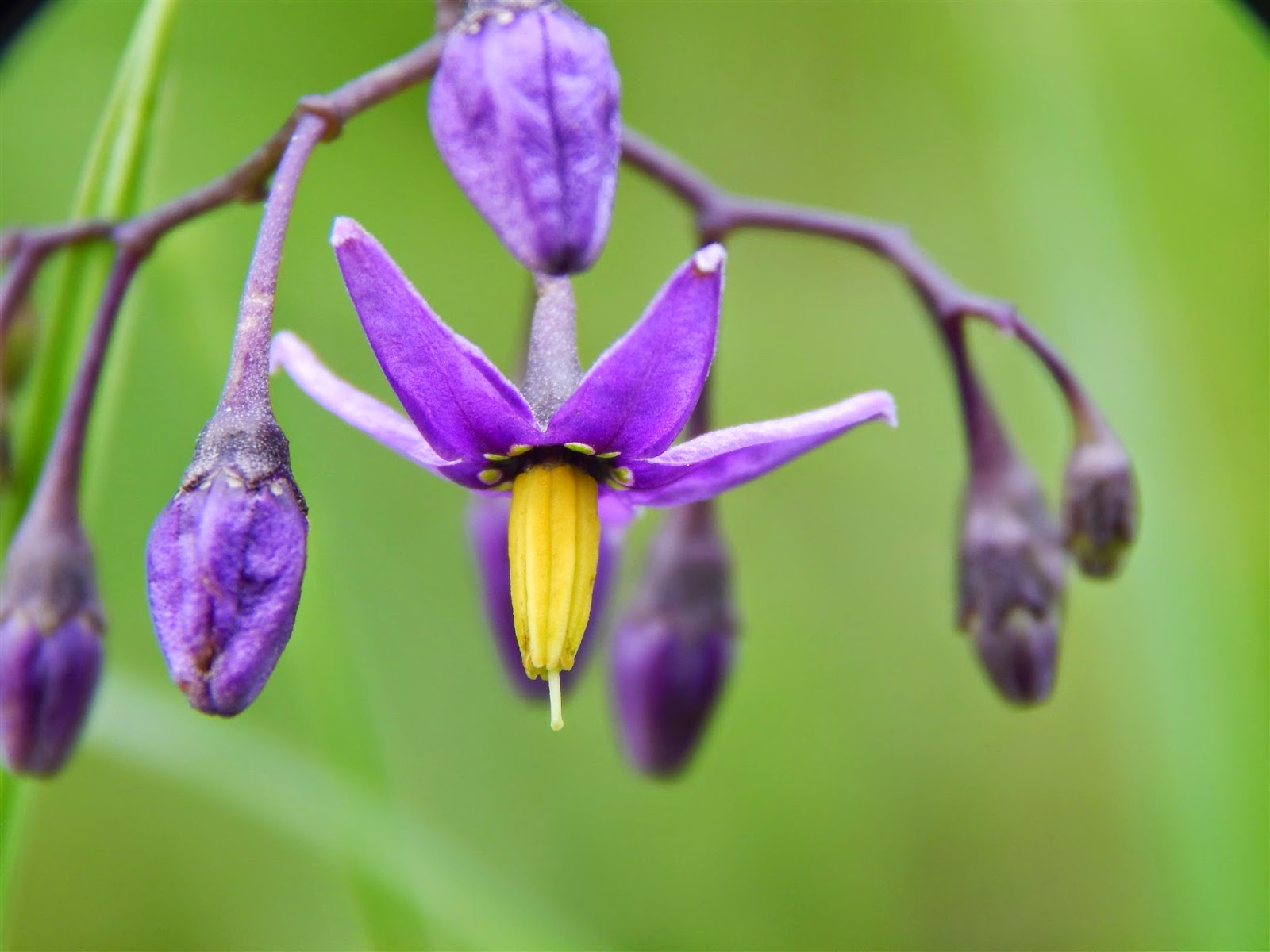
Bittersweet or Woody Nightshade (Solanum dulcamara)


 With its purple and yellow flowers and red berries


Growing right at the base is Water Forget-me-not (Myosotis scorpioides)
Scorpioides refers to the coiled shape of the flowering stem
Like a scorpion's tail


Calyx tube divided less than halfway


And on the other side of the canal a Mallard (Anas platyrhynchos)
practises yoga balancing techniques


Monday, 28 July 2014

Wild Parsnip and Parsnip moth

After a message from Peachysteve about some unidentified larvae munching Wild Parsnip I set off to investigate. Steve found the plants in a car park on Walton Street not far from the County bridge in Sowerby Bridge that crosses the Calder. This ties in well with an extract from the "Flora of the Parish of Halifax": 

"This plant is now well established in the Sowerby Bridge area and probably originated at the Walton Street flour mill (burnt down and demolished some years ago)."

Of the several plants present many had larvae on them and most of the flowerheads had been eaten off just leaving the larval web in situ. I'm happy to ID these as those of the Parsnip Moth (Depressaria radiella) but I have three at home to rear through just to be 100% sure. Two of which are already boring in to some Hogweed stems I took home for them to pupate in. The adults should be out in 2 or 3 weeks hopefully.


Above, one of the larva sealing up it's tunnel with chewed Hogweed stem and Below, the finished article made earlier by a different larva.