This Blog covers nature sightings and related news in the Calderdale area.
It includes all groups - Plants, animals and fungi with links to specialist sites.
Anyone wishing to become a member of this Blog and post sightings please contact us.
If you would like to join the Halifax Scientific Society either email me or come along to the next meeting.
All welcome:
calderdalewildlifeblog@gmail.com
Please contact us about any sensitive records before posting on the blog

Thursday, 29 October 2015

I inadvertently grew some garden bird food.

Quinoa, (pronounced Keenwa or Kwinowa)


I've occasionally been given this seed by friends with adventurous cooking habits. It's used like rice or couscous, but is much more nutritious, providing vitamins and protein as well as carbohydrates. It has a bland, slightly nutty flavour.

I thought it might grow in the Pennines, being a native crop of cool highlands in South America, so I bought a packet of cooking Quinoa and sowed a few of the seeds.

They shot up! I guess you can use the leaves as greens, as the plant is in Amaranthaceae, same as beetroot, spinach, and the wild plants Good King Henry, Fat Hen and Goosefoot, all of which have edible leaves.

A tragic consequence of it becoming a "wonder food" in the west is that some poor farmers in South America can no longer afford to eat their crop, or they think they can't, as it raises more cash for them than the cost of imported rice, which is far less nutritious.

If anybody wants some seeds, I've got loads left.

I only got round to cooking one head while it was fat and fresh and moist. I steamed it as a whole sprig over some potatoes I was boiling. It was good, eaten straight off the stem, which stayed behind like the core of a corn-on-the-cob, only branched. I got my little crop after a mid-summer sowing.

I thought I'd leave the others to fully ripen, then dry the seeds off to keep through the winter, but the birds soon realised there was something full of goodness there. First I noticed a Dunnock perched  on the plants, pecking in to it, then the Robin, true to character, sent it off and started pecking itself.

Since then I've been informed it has been grown on a large scale in this country, but only as a fallow-land crop. If anyone knew of any little corners with fairly rich, disturbed soil, it might be worth sowing it in summer as a winter bird food. In gardens it would save buying a lot of expensive wild bird food.

To aid birds on a wider scale, it could be planted in odd corners of fields or muck-heaps where it might benefit House Sparrows, Tree Sparrows,Yellowhammers, Reed Buntings and lots of other seed eaters. Some would say the native seeding plants are best, which I would agree with in an area of arable farming, but here most fields are kept as lush, wildlife-unfriendly grassland.

Tuesday, 20 October 2015

Further Fungus/ Botanical Foraying

Next weekend, on Sunday 25th October, we are meeting for another fungus/botany foray to the Holywell Green area. We will pass near the Deer Farm which has a big herd of Sika Deer. In Autumn it is the rut, and there is a chance of seeing some antler-locking stags, and hearing their roaring. Buzzards are regularly heard and seen in fine weather. Feel free to come along. No charge but small donations help with HSS funds.

The Foray starts at 10.30 for 10.45. Meet in West Vale.
Directions:
Take the Stainland Rd from the Calder and Hebble road junction. 
Go straight on through both sets of lights in West Vale. 
Pass one pub on the left, then a second (the Queen), and pass under a high railway viaduct.
Park or meet on the left just opposite the entrance to the industrial estate.

I will have two spare seats from Halifax town centre, leaving at 10.15.

The walk will be through woodland, along stony tracks and fields, some of them steep. Bring a packed lunch and something waterproof to sit on. Children and dogs welcome. Some lanes with traffic may be unavoidable.


Blackening Waxcap last year at Saville Park.

Sunday, 18 October 2015

Monthly Outdoor Meeting of Halifax Scientific Society

The meeting this month was a fungus foray in Stoodley Glen, which took place today. Sundays are sometimes chosen to give people who can't attend on a Saturday a chance to join in. There was also a waxcap identification session in the fields at Broadhead Clough last Friday 16th Oct, when Kara Jackson of Yorkshire Wildlife Trust brought along laminated keys to hand out, but I wasn't able to attend that one.

Sunday was a calm but dull day letting the changing colours of the trees smoulder through.

It really starts as you pull out of Luddenden Foot on the way to Mytholmroyd - a truly breathtakingly beautiful valley, wide spreading, with seemingly 50% each of mature deciduous trees and open fields.

The Stoodley Glen itself is wooded at the bottom end after you cross the river and then the canal, the latter dark and glassy, with dry leaves floating that parachute gently from the trees.

The woodland is "greenwood" as I wrote about in last Thursday's Hebden Bridge Times. Occasional grazing prevents understorey shrubs and saplings springing up. So it is open and grassy.

Higher up as you walk past all the little waterfalls you come out onto wide sheep-grazed fields; this is where the blue Harebells, still flowering today, and the waxcap fungi start.

The view looking back with distant Todmorden in the centre was stunning, with fields and moorland hills and valleys decorated with trees, near and far, in every shade of green, yellow, brown, orange and bronze. There was a strange light, as Annie pointed out, with brooding shade over the higher land, and Todmorden bathed in a gentle, not quite bright glow.
      Stoodley Pike above us seemed strangely animated; slipping in and out of the mist.

      It was a good day for a fungus foray.

We don't collect baskets full, not even the ones we know are good to eat. Our aim is to enjoy seeing and if possible identifying them. The complete list, not ignoring the common ones, is part of an ongoing survey, which when added to the records over many decades, should give an objective measure of fungus diversity and its changes in our area.

The best finds of the day for me were Elfin Saddle Helvella lacunosa and a Coral, possibly Crested Coral, Clavulina coralloides, attacked by another fungus, turning it grey. Also the bright Yellow Brain fungus, Tremella mesenterica. The most numerous was Amethyst Deceiver, as usual, closely followed by it buffish relative, The Deceiver.


Elfin Saddle beside the track in Stoodley Glen.

The little group of native Crab-apples was fruiting well at the top of the glen, with larger fruits than some years. I pocketed a few  as they grow easily from the pips, but I never see them self-seeding. Their partner animal that evolved to spread the seed in its dung, as well as maybe breaking the turf to give them somewhere to germinate, must be one of the extinct fauna. A male Reed Bunting was nearby.

Our complete Stoodley Glen fungus list for today can be read by clicking on "Calderdale Fungi" at the top.

As we finished in good time, we all drove to Hippins Clough on the other side of the Calder Valley, to search for the Violet Coral, Clavaria zollingeri, but didn't find it. However we did explore further along the valley-side than I had been before, to an area with an ancient wall built of huge wallstones, and an area of boulders including one as big as a small bungalow with a flat top you can easily climb up on to.

Near here was a colony of suckering Blackthorn, some of them so old they made small trees.

We put up two Common Snipe and saw a group of 11 Mistle Thrushes on some wires, oddly accompanied by one Redwing and one Goldfinch. We saw a dead Common Shrew lying on the turf.

Next weekend, on Sunday 25th October, we are meeting for another fungus/botany foray to the Holywell Green area. Feel free to come along.

The Foray starts at 10.30 for 10.45. Meet in West Vale.
Directions:
Take the Stainland Rd from the Calder and Hebble road junction. 
Go straight on through both sets of lights in West Vale. 
Pass one pub on the left, then a second (the Queen), and pass under a high railway viaduct.
Park or meet on the left just opposite the entrance to the industrial estate.

I will have two spare seats from Halifax town centre, leaving at 10.15.


Tuesday, 13 October 2015

Talk by Dr Mark Avery,Impact of Driven Grouse Shooting

There is a talk by Dr Mark Avery ,on the impact of Driven Grouse Shooting on our Uplands and Wildlife ,tomorrow Wed 14 Oct.It is free admission at 7 30 at the Trades Club Hebden Bridge.He was the former Conservation Director for the RSPB for 13 Years,He is the Author of Inglorious ,Conflict in the Uplands .and started the Petition to Ban Driven Grouse Shooting,which is a really important issue for us in Calderdale.

Sunday, 11 October 2015

Glow-worm

I have never seen a glow-worm larvae before, but here is a photo taken in Borrowdale in the Lake district a few days ago in the company of Ancient Tree Forum members. We were visiting the Borrowdale Yew trees, the 'Fraternal Four' made famous by Wordsworth, although the fourth blew down many years ago and is now rotting on the ground.

The remaining Yews have been dated to at least 1,500 years old and Keith Alexander the National Coleoptera recorder found this Glow-Worm larvae on a section of rotting bark.

We also looked at many of the ancient Ash pollards dotted about the landscape, most of which are many hundreds of years old and were the working trees for generations of people. The National Trust continues the essential pollarding of these on a regular cycle and hope that Ash disease will not destroy them all. Pollarding, done correctly, does not kill trees but prolongs their life span way beyond the natural life cycle. A truly sustainable practice that benefits people and wildlife and creates a historic landscape.

                                            Glow-Worm larvae


                                        Borrowdale Yew tree

Wednesday, 7 October 2015

Aurora borealis update 07 10 2015

At the moment 17.00,there is some Minor Aurora Activity,yellow alert,it is still rising,we need kp 7 red alert really to see it locally,with clear skies ,I will try and update this info as the night progresses,fingers crossed,regards Brian.

Monday, 5 October 2015

Autumn Crocus (Crocus nudiflorus) now flowering in Calderdale till mid-October.


These are widespread but elusive in Calderdale. My good friend Howard Owen has just spotted a new colony in a field off Green Lane in Soyland, though this might be the one mentioned in the old records as being "Behind Making Place, Soyland".

The previous survey in 1950 had 23 sites in Calderdale, but we now have a list of 42. Sadly this is partly because some of the biggest colonies are much reduced and fragmented.

It was brought from the Pyrenees in the middle ages it seems, possibly as a source of saffron, but this isn't directly documented. There is a possible reference to them in a medieval will to "my heads of crocuses" which indicates a high value. Crocus vernus, another European crocus which flowers in spring has been mentioned as a source of saffron, though the true Saffron Crocus is Crocus sativa. This is still cultivated in Norfolk. See "Norfolk Saffron" on line. Saffron Crocus is probably not viable as a crop in the Pennines, though Crocus nudiflorus, coming from the plateux of the Pyrenees, does well. It has much smaller "threads" though, (the stigma that are the saffron.)

Many of the spots we see it are close to places with St. John in the name, and some are near Holdsworth House, Bradshaw, where there is a Maltese Cross on the gable, showing a connection with the Knights of St. John, the Knights Hospitallers. 

They grow in many different places, often in fields, and often on river banks well away from gardens. They thrive at 300 metres at Cold Edge near the Ovenden Wind Farm, and right down near Cromwell Bottom Nature reserve, near Park Nook Lock, on the bank of the Calder. Strangely, all the river bank sites are on the left banks - on the Calder, the Ryburn and the Hebble. It is even found among mature deciduous trees. It is fascinating to think that they were probably there before the trees.

There is a longer version of this and a list of sites in my booklet "The Mystery of the Autumn Crocus" (2010) available now. (See panel on the left.) Also from me personally £5.00 
or £6.00 including postage. Steve.blacksmith@gmail.com. The £5.00 goes to Halifax Scientific Society. A copy comes free with membership which is £15.00 a year.

N.B. there is a cofusion-species in the Meadow Saffron, Colchicum autumnale, which has nothing to do with saffron, and is poisonous. It's a lily-relative and therefore has a flower full of stamens, six in number, whereas the crocuses have just three club-shaped stamens around the feathery stigma. Catch them on a sunny day to see this easily. Beware that garden centres sell Colchicum bulbs as "Autumn Crocus". They do have a superficial resemblance.


Autumn Crocuses on the plateau above Foix in the Ariege district of the French Pyrenees. Free-range cattle with cow-bells and horses keep the grass short but leave the crocuses.


Friday, 2 October 2015

Todmorden Crocus nudiflorus


It is a good year for them in the Halifax area.

There is just one showing in this picture in Centre Vale Park. (Recognise the Bandstand?) Click the picture to enlarge.

There were more on this bank, but they were getting crushed by football spectators, so myself, Phillip Marshall, Linda Kingsnorth and others moved most of them to the wild flower area to the left of the bandstand (looking in).

There was also a small colony in a field above Bacup Rd. which Portia reported to me, and I found in about 2008.

I am going to check these 2 colonies this evening Friday if anyone wants to join me. (Sorry for the short notice.) Meet at the park gates nearest the cricket ground at 6.00pm.

No one recently has seen them at Great House near Cross Stones. The fields are much altered with artificial fertilisers, but they could still be there. These location details are all I have.

Wednesday, 30 September 2015

Offering - any one interested in Natural History archives?


In the library we have a quantity (perhaps a brief case full) of duplicates of these from the early 20thC. It appears we inherited them from the Ovenden Naturalists when they folded.

We need funds, and would welcome purchase offers, or offers of help selling them.

Does anyone perhaps enjoy selling things on line?

Just like the HSS, the Yorkshire Naturalists Union was at this time interested in archaeology, and the only photographs in this edition are of bronze axes unearthed in Yorkshire. It was after all well before the era of wildlife photography.

They are a fascinating read, with birds, taxidermy, egg collecting, mammals and the problem of shooting much discussed.

Sunday, 27 September 2015

Aurora Borealis 17 03 2015.

Hi,sorry this is late,Managed to see Aurora Borealis this March gone.Seen from Flowerscar Road near Todmorden .Could see light green cast about 22 30 which intensified towards Midnight,i couldnt see any purplish colour with naked eye,which camera picked up,but certainly could see the Green ,amazing to see Locally ,all the conditions have to be perfect to have a chance,but it does happen occasionally.Regards Brian.

Our monthly Society walk took place on Sat 26th September.

Eleven of us did the popular Bradshaw-Ogden-Soil Hill- Strines Beck- Holdsworth-Bradshaw walk.
We had never seen so many Autumn Crocuses in Bradshaw Churchyard.
We all sat down on rocks for our picnic lunches on Soil Hill.

There was also a good showing of crocuses at the hollow sycamore down at Strines Beck.

A fast-moving Silver-y moth (a day-flying moth) was hovering around, obviously attracted to the crocuses. 
It landed near the base of the purple part of the flowers each time. Peachysteve saw its long tongue probing, so maybe it was getting nectar. Very few insects have been noted visiting the local Autumn Crocus, and there's no record of anyone finding a seed capsule. These develope underground with crocuses, then push up and split at the soil surface. 


A single Small Copper Butterfly on Creeping Thistle; the only thistle flower noticed to have a scent out of the species we find in Calderdale. The aroma is of honey.
Emma Hoyle, Bruce's daughter, discovered this.

An unidentified caterpillar, possibly feeding on nettle.

Non-members are welcome on walks, as they are at our monthly talks (click on tab at the top.) With thanks to Bruce for leading this one, and thanks to everyone for waiting (slowing down) for me as I went back about half a mile to get my binoculars I left on a wall! What a twit! 

Tuesday, 22 September 2015

Consultations -

 - with thanks to Hugh Firman for the links

Probably most know this already but here is the link if individuals wish to comment on Cromwell Bottom:


You probably know there is also a consultation for Norland Moor and here is the link, you may wish to comment or  mention ways in which the moorland can be improved for birds.


Hugh.
---------------------------------------------------------------------------------------------------------------------


       There is certainly a paucity of birds on Norland Moor. Our archives at Halifax Scientific Society show that in the 19thC there was a variety of waders to be found there (often they were shot). I don't think the shooting will be remembered by the birds today.
      Also it is stated that Twite nests were easily found at Norland Moor, though the species is dependent on surrounding grassland having the right mixture of seed producing plants. There was also a lot more control of mammalian and avian predators.    
      Not that I am supporting any kind of shooting or other anti-social and inhumane ways of killing animals.

Steve

Wednesday, 16 September 2015

Petition to Ban Driven Grouse Shooting

Hi ,I've been out of the loop for a while,so not sure if People are aware of this Important Petition by Dr Mark Avery to Ban Driven Grouse Shooting.The sheer Mismanagement of Burning And Drainage of some of our Vitally Important Peat Uplands as previously reported by Ban The Burn Campaigners,  in order to Artificially Boost Numbers of Red Grouse which are then Shot ! is going to have a Profound Impact on our Environment and Wildlife.Dr Mark Averys Book Inglorious ,Conflict of the Uplands,tells it as it is in a very matter of fact way.We have a real chance of doing something about this Victorian Practice

Link to Mark Avery's e-petition here:  https://petition.parliament.uk/petitions/104441

Tuesday, 15 September 2015

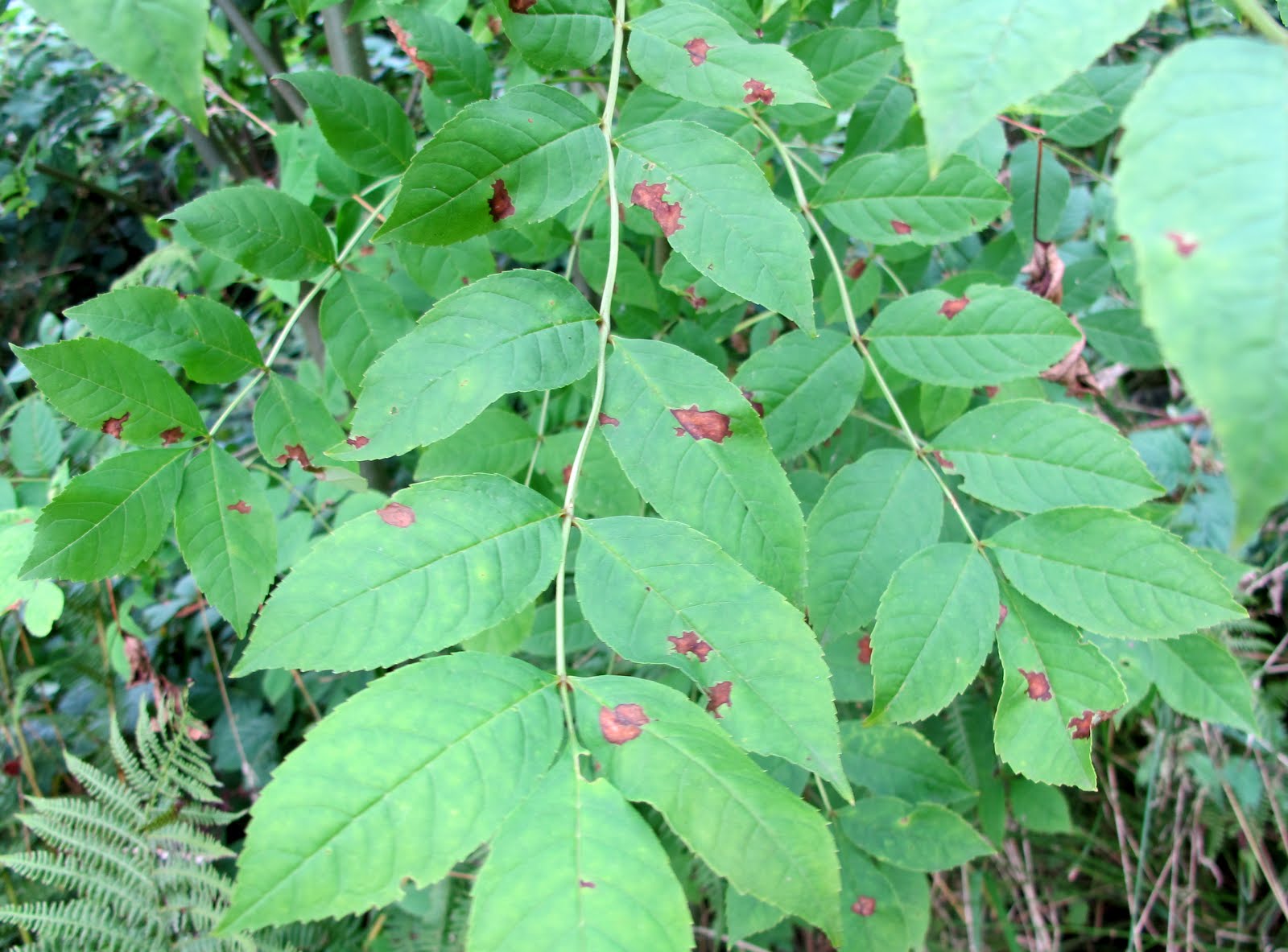
Ash Die-back disease

These photos show what may be signs of Ash Die-back in Todmorden. I understand that young saplings are more susceptible to the disease and they start showing signs of this from the top downwards.

Photos are of a dead sapling that died in a matter of weeks and the discoloured sapwood when the stem is cut. Nearby saplings showed purple coloured stems progressing downwards and long lesions. Leaves with brown dead bits. Only time will tell if it is the Ash disease but these symptoms are significant.

Best to look closely at the top length of young stems as the changes can be quite subtle.

This year I have seen a lot of mature Ash trees with most of their leaves eaten to the central vein. I think a saw-fly caterpillar may be the culprit but it is the first time I have ever seen Ash leaves eaten by anything. I wonder if the trees' natural defences are being weakened by the Ash disease before we can see any physical sign of it. Although Ash generally have had a very 'light' crown of leaves this year. Anyone else noticed similar?


Mushroom

I found this on a standing mature Beech tree where the bark is dead. I think it may be a Pleurotus but maybe someone can identify?

Saturday, 5 September 2015

Ash Dieback

Has anyone yet seen this Ash disease in the Calder Valley?

The fungus responsible is commonly called Chalara fraxinea but now officially named as Hymenoscyphus fraxineus.

According to Forestry Commission mapping, most of the Upper Calder Valley is within the zone where the disease has been confirmed, as is Brighouse, Elland and parts of Halifax. The FC say this means there is a high likelihood of other Ash trees/woodland in the same area also being infected. http://www.forestry.gov.uk/chalara

If you know of any old or historic Ash trees, now is a good time to photograph them and record them.

Sunday, 23 August 2015

Robin's Pin Cushion Gall

Robin's Pin Cushion is a gall found on Common Dog Rose (Rosa canina)
It is caused by the Bedeguar Wasp (Diplolepis rosae)
Several larvae overwinter in the gall, each in their own chamber.


This one I spotted in Elland


Earlier in the day
Steve and I went to look for the Sea Campion (Silene uniflora) in Godley Cutting.


A native of cliffs, it is quite at home on the steep sides of the cutting.


Then in the afternoon I came across this Bladder Campion (Silene vulgaris) on the tow-path.


I've recently found other interesting Silene species while surveying North Loop.


Small-flowered Catch-fly (Silene gallica var anglica)


Night-flowering Catchfly (Silene noctiflora)


The petals curl in during the day.

And just for good measure here is the Hybrid of Red and White Campion
Occasionally found where the two species grow together.


(Silene latifolia x dioica = S. x hampeana)

Wednesday, 19 August 2015

Monthly Walk Saturday 22nd August 10.30 am

This month's Scientific Society Walk is to Walshaw Dean.

Scene of a peaceful protest in 1907, when the shooting rights owner tried to close off all footpaths in the area.  As we can still legally walk there, it was obviously successful.

Well done to our grandparents and great grandparents generation, men and women who joined together for these mass trespasses around the turn of the 19th century, despite the danger of being locked up.

The area is quite good for birds, and we pass near a good lizard area; also near some prehistoric remains.

The walk is from Blake Dean to Middle Walshaw Dean Reservoir, then re-tracing the route. It is on a track the whole way. The distance is approx. 5 miles total. Bring a picnic lunch; we will stop to eat around 12.30, weather permitting.

Meet at 10.30 for 10.45 at the broad part of the road at Blake Dean above Hardcastle Crags. SD957314.

Share cars or reply to this to join the convoy. It is also on a bus route which starts from Hebden Bridge.

Friday, 7 August 2015

What's in a name

Who first gave the English common names to the different grasses and when was this? Perhaps you thought they had always had a name but in fact the word 'grass' was often also used to include other plant species growing in a meadow.
 
Before the time of scientific classification of plants and modern farming there was little knowledge of the identity or differentiation between the different grasses. There really was no reason to know them individually as grass seed for creating new pasture was collected from the hayloft or sweepings-up "The farmer takes his seed indiscriminately from his own foul hayrick".

The few grasses that farmers did recognise were visually distinctive, for example the Quaking Grass having many regional names such as 'Doddering Dickies', 'Cow Quakes' etc.

But all this changed following the publication of Linnaeus' "Species Plantarum" in 1753, which is counted as year zero for the naming of plants. It is often thought Linnaeus was the first botanist to use Latin binomials but this is not so; however he was the first to use them consistently and within a system.

6 years after this 'year zero' it was the Norfolk naturalist and dilettante Benjamin Stillingfleet (the original 'Blue Stocking') who in his 'Observations on Grasses' first published in 1759, gave English names to the grasses. He wrote "Our common people know scarce any of the grasses by names, as far as I could ever find by conversing with farmers, husbandmen etc, so that something may be done to remove this confusion".
 
He then went on to make English names for each species by translating the literal Latin meaning from Linnaeus' Species Plantarum.

Stillingfleet also encouraged the botanist and apothecary William Hudson to publish the first botany book to be published in England using the new Linnaean system. This was Flora Anglica in 1762, which also used Stillingfleet's new names for the grasses. 

Most of these common names we still use today but what Stillingfleet then called Cat's Tail we now know it as Timothy. But the reason why lies via an interesting story from another continent.

Friday, 31 July 2015

Writing Competition 2015 - on the Natural Environment in Calderdale.

Linda Kingsnorth has won the Field Guide of her choice in the writing competition. With many thanks to the other two entrants, whose pieces were excellent, giving us much food for thought.

You can read all three entries by scrolling down to my June 20th post.

Thursday, 30 July 2015

Unidentified Moth


Found at Baitings this evening. Closest  I can find is Heart and Club,  but . . .
that is 15 - 20mm, whereas this was 25 - 30mm.

Can any one help?

P.s. I'm thinking it can't be that - I read in Yorkshire Butterflies and Moths 2014 that it lives on dry calcareous areas.

Wednesday, 29 July 2015

Caterpillars found on the Archaeology Walk on 25/7/15


We saw two of these close together on Midgley Moor on Saturday.

They didn't immediately strike me as being like Oak Eggar Moth caterpillars, which I have identified before, but it seems that is what they are. 

The others were more uniformly brown as I remember.

There is a picture of an adult male Oak Eggar lower down. Our sub-species is apparently Northern Oak Eggar.

Thursday, 23 July 2015

Archaeology Walk this Saturday 25th July

See addition to the post below (with a picture of deer).

----------------------------------------------------------------------------

The following day on Sunday 26th July I will be leading  a walk at Cromwell Bottom Local Nature Reserve.

It is our Annual local Big Butterfly Count,
       
                  (but through the day, not for 15 minutes in your garden like David Attenborough's                                Big Butterfly Count, though that is well worth getting involved with too.)

Meet at the car park at 10.30 for 10.45. Bring a packed lunch and spare warm clothing. Insect repellent is strongly advised against the biting flies. The walk will go on till about 3.30pm.

This is a Wildside Walk in conjunction with Calderdale Countryside Department.

-----------------------------------------------------------------------------------------------------------


Report on the walks above.


They both went well. There were 7 on the Archaeology one on Midgley Moor. All men!
All the features that Dave Shepherd wanted to show us were found and were quite visible.
The witticism of the day was that if a feature in the landscape had no explanation, it was still "a good example of its kind".

The butterfly walk at Cromwell Bottom was surprisingly sunny and we got quite a few butterflies of 5 species in the morning. Gatekeeper (both sexes) Small Skipper, Ringlet, Meadow Brown and one Peacock. Probably about 35 to 40 individuals seen.

There were 21 of us on that, most having got the details out of the Wildside booklet. Quite a few children were there, bringing their excitement with them, including some with a young Polish family who were very interested. Three came down from the Todmorden (UCWN) group.

It rained as we were finishing the picnic at lunchtime and all wanted to go home, which was fair enough, as the forecast was for it to set in.

The grasses were not so spectacular this year, except the Reed Sweet-grass along the canal side. The flowering rush was not flowering as it has done before at this time.
Again we saw some of the red-listed Luronium natans, the Floating Water-plantain, uprooted by water traffic in the canal.

                                                                             The unique paired standing stones on Midgley Moor

Part of the group setting out to count butterflies at Cromwell Bottom

Female Gatekeeper Butterfly


Wednesday, 22 July 2015

A comment added to the post below, worth putting up as a post itself.

Blogger Finlay Duncan said...
Hi Philip, excellent resource for the Halifax area!
Was hoping your organisation and members can help us protect nature in Europe. The European Commission's looking at reviewing the Birds and Habitats Directives, the very laws that have increased the numbers of many at-risk bird and animal species in Europe and that have led to the creation of thousands of conservation sites around the EU.
We think these important laws should be safeguarded, not undermined! A public consultation on the issue closes this Friday and we're trying to get everyone to have their say. More information is available here: http://www.tiny.cc/naturealert - every voice counts!
22 July 2015 at 15:07