This Blog covers nature sightings and related news in the Calderdale area.
It includes all groups - Plants, animals and fungi with links to specialist sites.
Anyone wishing to become a member of this Blog and post sightings please contact us.
If you would like to join the Halifax Scientific Society either email me or come along to the next meeting.
All welcome:
calderdalewildlifeblog@gmail.com
Friday, 2 October 2015
Todmorden Crocus nudiflorus
It is a good year for them in the Halifax area.
There is just one showing in this picture in Centre Vale Park. (Recognise the Bandstand?) Click the picture to enlarge.
There were more on this bank, but they were getting crushed by football spectators, so myself, Phillip Marshall, Linda Kingsnorth and others moved most of them to the wild flower area to the left of the bandstand (looking in).
There was also a small colony in a field above Bacup Rd. which Portia reported to me, and I found in about 2008.
I am going to check these 2 colonies this evening Friday if anyone wants to join me. (Sorry for the short notice.) Meet at the park gates nearest the cricket ground at 6.00pm.
No one recently has seen them at Great House near Cross Stones. The fields are much altered with artificial fertilisers, but they could still be there. These location details are all I have.
Wednesday, 30 September 2015
Offering - any one interested in Natural History archives?
In the library we have a quantity (perhaps a brief case full) of duplicates of these from the early 20thC. It appears we inherited them from the Ovenden Naturalists when they folded.
We need funds, and would welcome purchase offers, or offers of help selling them.
Does anyone perhaps enjoy selling things on line?
Just like the HSS, the Yorkshire Naturalists Union was at this time interested in archaeology, and the only photographs in this edition are of bronze axes unearthed in Yorkshire. It was after all well before the era of wildlife photography.
They are a fascinating read, with birds, taxidermy, egg collecting, mammals and the problem of shooting much discussed.
Sunday, 27 September 2015
Aurora Borealis 17 03 2015.
Hi,sorry this is late,Managed to see Aurora Borealis this March gone.Seen from Flowerscar Road near Todmorden .Could see light green cast about 22 30 which intensified towards Midnight,i couldnt see any purplish colour with naked eye,which camera picked up,but certainly could see the Green ,amazing to see Locally ,all the conditions have to be perfect to have a chance,but it does happen occasionally.Regards Brian.
Our monthly Society walk took place on Sat 26th September.
Eleven of us did the popular Bradshaw-Ogden-Soil Hill- Strines Beck- Holdsworth-Bradshaw walk.
We had never seen so many Autumn Crocuses in Bradshaw Churchyard.
We all sat down on rocks for our picnic lunches on Soil Hill.
There was also a good showing of crocuses at the hollow sycamore down at Strines Beck.
A fast-moving Silver-y moth (a day-flying moth) was hovering around, obviously attracted to the crocuses.
It landed near the base of the purple part of the flowers each time. Peachysteve saw its long tongue probing, so maybe it was getting nectar. Very few insects have been noted visiting the local Autumn Crocus, and there's no record of anyone finding a seed capsule. These develope underground with crocuses, then push up and split at the soil surface.
A single Small Copper Butterfly on Creeping Thistle; the only thistle flower noticed to have a scent out of the species we find in Calderdale. The aroma is of honey.
Emma Hoyle, Bruce's daughter, discovered this.
An unidentified caterpillar, possibly feeding on nettle.
Non-members are welcome on walks, as they are at our monthly talks (click on tab at the top.) With thanks to Bruce for leading this one, and thanks to everyone for waiting (slowing down) for me as I went back about half a mile to get my binoculars I left on a wall! What a twit!
Tuesday, 22 September 2015
Consultations -
- with thanks to Hugh Firman for the links
Probably most know this already but here is the link if individuals wish to comment on Cromwell Bottom:
You probably know there is also a consultation for
Norland Moor and here is the link, you may wish to comment or mention
ways in which the moorland can be improved for birds.
Hugh.
---------------------------------------------------------------------------------------------------------------------
There is certainly a paucity of birds on Norland Moor. Our archives at Halifax Scientific Society show that in the 19thC there was a variety of waders to be found there (often they were shot). I don't think the shooting will be remembered by the birds today.
Also it is stated that Twite nests were easily found at Norland Moor, though the species is dependent on surrounding grassland having the right mixture of seed producing plants. There was also a lot more control of mammalian and avian predators.
Not that I am supporting any kind of shooting or other anti-social and inhumane ways of killing animals.
Steve
Wednesday, 16 September 2015
Petition to Ban Driven Grouse Shooting
Hi ,I've been out of the loop for a while,so not sure if People are aware of this Important Petition by Dr Mark Avery to Ban Driven Grouse Shooting.The sheer Mismanagement of Burning And Drainage of some of our Vitally Important Peat Uplands as previously reported by Ban The Burn Campaigners, in order to Artificially Boost Numbers of Red Grouse which are then Shot ! is going to have a Profound Impact on our Environment and Wildlife.Dr Mark Averys Book Inglorious ,Conflict of the Uplands,tells it as it is in a very matter of fact way.We have a real chance of doing something about this Victorian Practice
Link to Mark Avery's e-petition here: https://petition.parliament.uk/petitions/104441
Tuesday, 15 September 2015
Ash Die-back disease
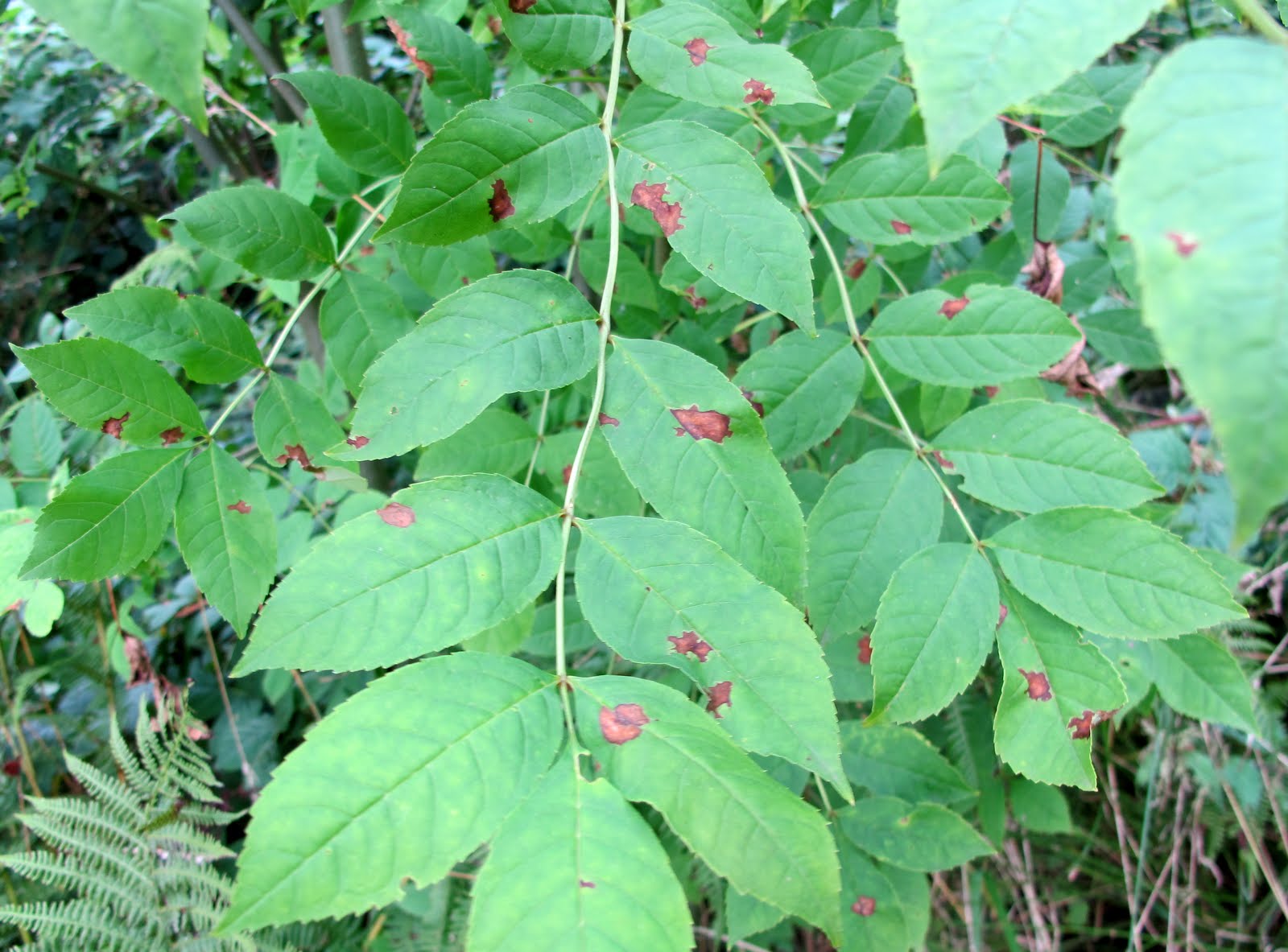
These photos show what may be signs of Ash Die-back in Todmorden. I understand that young saplings are more susceptible to the disease and they start showing signs of this from the top downwards.
Photos are of a dead sapling that died in a matter of weeks and the discoloured sapwood when the stem is cut. Nearby saplings showed purple coloured stems progressing downwards and long lesions. Leaves with brown dead bits. Only time will tell if it is the Ash disease but these symptoms are significant.
Best to look closely at the top length of young stems as the changes can be quite subtle.
This year I have seen a lot of mature Ash trees with most of their leaves eaten to the central vein. I think a saw-fly caterpillar may be the culprit but it is the first time I have ever seen Ash leaves eaten by anything. I wonder if the trees' natural defences are being weakened by the Ash disease before we can see any physical sign of it. Although Ash generally have had a very 'light' crown of leaves this year. Anyone else noticed similar?
Mushroom
I found this on a standing mature Beech tree where the bark is dead. I think it may be a Pleurotus but maybe someone can identify?
Saturday, 5 September 2015
Ash Dieback
Has anyone yet seen this Ash disease in the Calder Valley?
The fungus responsible is commonly called Chalara fraxinea but now officially named as Hymenoscyphus fraxineus.
According to Forestry Commission mapping, most of the Upper Calder Valley is within the zone where the disease has been confirmed, as is Brighouse, Elland and parts of Halifax. The FC say this means there is a high likelihood of other Ash trees/woodland in the same area also being infected. http://www.forestry.gov.uk/chalara
If you know of any old or historic Ash trees, now is a good time to photograph them and record them.
Sunday, 23 August 2015
Robin's Pin Cushion Gall
Robin's Pin Cushion is a gall found on Common Dog Rose (Rosa canina)
It is caused by the Bedeguar Wasp (Diplolepis rosae)
Several larvae overwinter in the gall, each in their own chamber.
This one I spotted in Elland
Earlier in the day
Steve and I went to look for the Sea Campion (Silene uniflora) in Godley Cutting.
A native of cliffs, it is quite at home on the steep sides of the cutting.
Then in the afternoon I came across this Bladder Campion (Silene vulgaris) on the tow-path.
I've recently found other interesting Silene species while surveying North Loop.
Small-flowered Catch-fly (Silene gallica var anglica)
Night-flowering Catchfly (Silene noctiflora)
The petals curl in during the day.
And just for good measure here is the Hybrid of Red and White Campion
Occasionally found where the two species grow together.
(Silene latifolia x dioica = S. x hampeana)
Wednesday, 19 August 2015
Monthly Walk Saturday 22nd August 10.30 am
This month's Scientific Society Walk is to Walshaw Dean.
Scene of a peaceful protest in 1907, when the shooting rights owner tried to close off all footpaths in the area. As we can still legally walk there, it was obviously successful.
Well done to our grandparents and great grandparents generation, men and women who joined together for these mass trespasses around the turn of the 19th century, despite the danger of being locked up.
The area is quite good for birds, and we pass near a good lizard area; also near some prehistoric remains.
The walk is from Blake Dean to Middle Walshaw Dean Reservoir, then re-tracing the route. It is on a track the whole way. The distance is approx. 5 miles total. Bring a picnic lunch; we will stop to eat around 12.30, weather permitting.
Meet at 10.30 for 10.45 at the broad part of the road at Blake Dean above Hardcastle Crags. SD957314.
Share cars or reply to this to join the convoy. It is also on a bus route which starts from Hebden Bridge.
Friday, 7 August 2015
What's in a name
Who first gave the English common names to the different grasses and when was this? Perhaps you thought they had always had a name but in fact the word 'grass' was often also used to include other plant species growing in a meadow.
Before the time of scientific classification of plants and modern farming there was little knowledge of the identity or differentiation between the different grasses. There really was no reason to know them individually as grass seed for creating new pasture was collected from the hayloft or sweepings-up "The farmer takes his seed indiscriminately from his own foul hayrick".
The few grasses that farmers did recognise were visually distinctive, for example the Quaking Grass having many regional names such as 'Doddering Dickies', 'Cow Quakes' etc.
But all this changed following the publication of Linnaeus' "Species Plantarum" in 1753, which is counted as year zero for the naming of plants. It is often thought Linnaeus was the first botanist to use Latin binomials but this is not so; however he was the first to use them consistently and within a system.
6 years after this 'year zero' it was the Norfolk naturalist and dilettante Benjamin Stillingfleet (the original 'Blue Stocking') who in his 'Observations on Grasses' first published in 1759, gave English names to the grasses. He wrote "Our common people know scarce any of the grasses by names, as far as I could ever find by conversing with farmers, husbandmen etc, so that something may be done to remove this confusion".
He then went on to make English names for each species by translating the literal Latin meaning from Linnaeus' Species Plantarum.
Stillingfleet also encouraged the botanist and apothecary William Hudson to publish the first botany book to be published in England using the new Linnaean system. This was Flora Anglica in 1762, which also used Stillingfleet's new names for the grasses.
Most of these common names we still use today but what Stillingfleet then called Cat's Tail we now know it as Timothy. But the reason why lies via an interesting story from another continent.
Friday, 31 July 2015
Writing Competition 2015 - on the Natural Environment in Calderdale.
Linda Kingsnorth has won the Field Guide of her choice in the writing competition. With many thanks to the other two entrants, whose pieces were excellent, giving us much food for thought.
You can read all three entries by scrolling down to my June 20th post.
Thursday, 30 July 2015
Unidentified Moth
Found at Baitings this evening. Closest I can find is Heart and Club, but . . .
that is 15 - 20mm, whereas this was 25 - 30mm.
Can any one help?
P.s. I'm thinking it can't be that - I read in Yorkshire Butterflies and Moths 2014 that it lives on dry calcareous areas.
Wednesday, 29 July 2015
Caterpillars found on the Archaeology Walk on 25/7/15
We saw two of these close together on Midgley Moor on Saturday.
They didn't immediately strike me as being like Oak Eggar Moth caterpillars, which I have identified before, but it seems that is what they are.
The others were more uniformly brown as I remember.
There is a picture of an adult male Oak Eggar lower down. Our sub-species is apparently Northern Oak Eggar.
Thursday, 23 July 2015
Archaeology Walk this Saturday 25th July
See addition to the post below (with a picture of deer).
----------------------------------------------------------------------------
The following day on Sunday 26th July I will be leading a walk at Cromwell Bottom Local Nature Reserve.
It is our Annual local Big Butterfly Count,
(but through the day, not for 15 minutes in your garden like David Attenborough's Big Butterfly Count, though that is well worth getting involved with too.)
Meet at the car park at 10.30 for 10.45. Bring a packed lunch and spare warm clothing. Insect repellent is strongly advised against the biting flies. The walk will go on till about 3.30pm.
This is a Wildside Walk in conjunction with Calderdale Countryside Department.
-----------------------------------------------------------------------------------------------------------
Report on the walks above.
They both went well. There were 7 on the Archaeology one on Midgley Moor. All men!
All the features that Dave Shepherd wanted to show us were found and were quite visible.
The witticism of the day was that if a feature in the landscape had no explanation, it was still "a good example of its kind".
The butterfly walk at Cromwell Bottom was surprisingly sunny and we got quite a few butterflies of 5 species in the morning. Gatekeeper (both sexes) Small Skipper, Ringlet, Meadow Brown and one Peacock. Probably about 35 to 40 individuals seen.
There were 21 of us on that, most having got the details out of the Wildside booklet. Quite a few children were there, bringing their excitement with them, including some with a young Polish family who were very interested. Three came down from the Todmorden (UCWN) group.
It rained as we were finishing the picnic at lunchtime and all wanted to go home, which was fair enough, as the forecast was for it to set in.
The grasses were not so spectacular this year, except the Reed Sweet-grass along the canal side. The flowering rush was not flowering as it has done before at this time.
Again we saw some of the red-listed Luronium natans, the Floating Water-plantain, uprooted by water traffic in the canal.
The unique paired standing stones on Midgley Moor
----------------------------------------------------------------------------
The following day on Sunday 26th July I will be leading a walk at Cromwell Bottom Local Nature Reserve.
It is our Annual local Big Butterfly Count,
(but through the day, not for 15 minutes in your garden like David Attenborough's Big Butterfly Count, though that is well worth getting involved with too.)
Meet at the car park at 10.30 for 10.45. Bring a packed lunch and spare warm clothing. Insect repellent is strongly advised against the biting flies. The walk will go on till about 3.30pm.
This is a Wildside Walk in conjunction with Calderdale Countryside Department.
-----------------------------------------------------------------------------------------------------------
Report on the walks above.
They both went well. There were 7 on the Archaeology one on Midgley Moor. All men!
All the features that Dave Shepherd wanted to show us were found and were quite visible.
The witticism of the day was that if a feature in the landscape had no explanation, it was still "a good example of its kind".
The butterfly walk at Cromwell Bottom was surprisingly sunny and we got quite a few butterflies of 5 species in the morning. Gatekeeper (both sexes) Small Skipper, Ringlet, Meadow Brown and one Peacock. Probably about 35 to 40 individuals seen.
There were 21 of us on that, most having got the details out of the Wildside booklet. Quite a few children were there, bringing their excitement with them, including some with a young Polish family who were very interested. Three came down from the Todmorden (UCWN) group.
It rained as we were finishing the picnic at lunchtime and all wanted to go home, which was fair enough, as the forecast was for it to set in.
The grasses were not so spectacular this year, except the Reed Sweet-grass along the canal side. The flowering rush was not flowering as it has done before at this time.
Part of the group setting out to count butterflies at Cromwell Bottom
Female Gatekeeper Butterfly
Wednesday, 22 July 2015
A comment added to the post below, worth putting up as a post itself.
Finlay Duncan said...
Hi Philip, excellent resource for the Halifax area!
Was hoping your organisation and members can help us protect nature in Europe. The European Commission's looking at reviewing the Birds and Habitats Directives, the very laws that have increased the numbers of many at-risk bird and animal species in Europe and that have led to the creation of thousands of conservation sites around the EU.
We think these important laws should be safeguarded, not undermined! A public consultation on the issue closes this Friday and we're trying to get everyone to have their say. More information is available here: http://www.tiny.cc/naturealert - every voice counts!
22 July 2015 at 15:07
Saturday, 18 July 2015
Himalayan Balsam
Does any one know if the seeds of Himalayan Balsam are spread by mammals (or birds)?
Yesterday I was pulling some Balsam from an area that has been mostly eradicated of it over previous years. The only ones left are not the usual individuals but widely separated clumps comprising individuals of up to a dozen within a few inches square of ground.
I have never seen it grow like this and it looked as though a rodent may have stashed quantities of seed. It certainly made it easy to pull the lot in one go!
This may be a reason why Balsam suddenly appears in new places where there is non nearby.
I have googled this query and can find no reference to animals or birds eating the seeds. I can't believe this doesn't happen--but why has it not been recorded?
Sunday, 12 July 2015
Magical Lecture this Tuesday 7.15pm
As a follow on from Dave's talk , (below) he is leading us on a walk on Midgley Moor to see signs of early occupation of the moor in the form of standing stones and earthworks. This is on Saturday 25th July.
Meet at 10.30 for 10.45 at Clough Cottages, on the end of High House Lane, Midgley. There is some parking, but not unlimited. Grid ref. SE028279. It will be over rough land off the paths. Bring packed lunch and spare warm clothing.
Dave Shepherd, our Archaeologist friend from Heptonstall, gave us an illustrated talk on Tuesday 14th July.
His subject was
BEFORE THERE WAS YORKSHIRE
My photo taken recently is a fawn and a doe Roe Deer at Hardcastle Crags.
Click to get a larger image.
Saturday, 4 July 2015
Luddenden Dean
I finally got round to a walk in the Dean today, a place I don't know at all. I was utterly captivated, there is so much of interest on so many levels. My walk began near Dry Carr and took in Booth, Bank House, Cat in th' Well (cracking pub), Saltonstall and Throstle Bower. I didn't see much in the way of birds, but there were lots of butterflies about, including common blues, meadow browns, my first large skipper of the year, speckled woods and ringlets - by far the commonest by a country mile, they were everywhere. I also saw a few chimney - sweeper moths (my first for a year or two) and what I think was a common green grasshopper.
Wednesday, 1 July 2015
Insect heaven . . .
These were about as we surveyed meadows and woodland for plants last week.
What is the validity of Northern Eggar as a specific name?
Eggar, Northern or Oak ? Near Mytholmroyd.
Best focus my camera could get as he shivered on my finger.
Common Blues mating. Luddenden Dean.
Saturday, 20 June 2015
Writing Competition 2015
The Competition is now closed, but blog readers can still send me articles/essays/comments on the subject below if they wish.
31st July, 2015. The Entries have been read and carefully thought about by members of Halifax Scientific Society Council.
While all of them were considered excellent, and it was hard to choose, most votes went to . . . . . Entry No. 2 written by Linda Kingsnorth, Mammal Recorder for HSS.
With many thanks to all who took part. Charlotte Weightman, also of HSS and Philip Marshall of Todmorden, a member of the Upper Calder Wildlife Network were the other two.
All three gave us much food for thought. Linda's is also a challenge to us to spring into action.
Do you have any thoughts on the way the Natural Environment is being looked after by the Authorities in Calderdale?
If so, why not enter this competition? It's free to enter and the prize is a field guide of your choice up to the value of £16.99. Entrants must be registered members of
HSS, UCWN, CBWG or CBCG, i.e the Calderdale Groups concerned with wildlife conservation.
Deadline for entries was mid-day tomorrow, 21st June, but as I have been busy, I have extended it to mid-day on Thursday 25th June. It can be short or long, but please refrain from any libelous or inflammatory statements. (Over long pieces might turn off the judges.) Please email them to me at steve.blacksmith@gmail.com.
It's not so much for the prize, but to encourage people to set down their thoughts and feelings about Wildlife and the Natural Environment in Calderdale. You can have your say about any part of Calderdale, not just Council owned land.
Entries will be read and the winner decided by the Hx.Sci.Soc. Council members. (NOT Calderdale Council Staff.) Prize allocated by end of July 2015.
This competition is prompted by the 10 -page document which dropped in to some of our inboxes on 21st April from Calderdale Council's Business and Economy Department outlining many new proposals for Cromwell Bottom Nature Reserve.
SB photo
Please see below three entries already received.
ENTRY No.1 (Name supplied which will be added after judging.)
31st July, 2015. The Entries have been read and carefully thought about by members of Halifax Scientific Society Council.
While all of them were considered excellent, and it was hard to choose, most votes went to . . . . . Entry No. 2 written by Linda Kingsnorth, Mammal Recorder for HSS.
With many thanks to all who took part. Charlotte Weightman, also of HSS and Philip Marshall of Todmorden, a member of the Upper Calder Wildlife Network were the other two.
All three gave us much food for thought. Linda's is also a challenge to us to spring into action.
Do you have any thoughts on the way the Natural Environment is being looked after by the Authorities in Calderdale?
If so, why not enter this competition? It's free to enter and the prize is a field guide of your choice up to the value of £16.99. Entrants must be registered members of
Deadline for entries was mid-day tomorrow, 21st June, but as I have been busy, I have extended it to mid-day on Thursday 25th June. It can be short or long, but please refrain from any libelous or inflammatory statements. (Over long pieces might turn off the judges.) Please email them to me at steve.blacksmith@gmail.com.
It's not so much for the prize, but to encourage people to set down their thoughts and feelings about Wildlife and the Natural Environment in Calderdale. You can have your say about any part of Calderdale, not just Council owned land.
Entries will be read and the winner decided by the Hx.Sci.Soc. Council members. (NOT Calderdale Council Staff.) Prize allocated by end of July 2015.
This competition is prompted by the 10 -page document which dropped in to some of our inboxes on 21st April from Calderdale Council's Business and Economy Department outlining many new proposals for Cromwell Bottom Nature Reserve.
Please see below three entries already received.
ENTRY No.1 (Name supplied which will be added after judging.)
Everyone Needs a Home by Charlotte Weightman
We have voices. We
can speak. We can discuss, put our point
of view, argue our case. Wildlife
can’t. But wildlife is the most
optimistic of living creatures – they want to live, to reproduce, to continue
their species, and will do their utmost to do so. Look at the way brownfield sites suddenly
spring into life with often the most extraordinary array of plants. But if the specific habitat of a specific
creature is taken away – by man’s intervention – then the optimism of a part of
our natural world will be extinguished.
We are fortunate to live in an extraordinary area of England
which has, within a relatively small area, a huge mixture of landscapes, and
thus of wildlife. You can be high on the
moors with its own environment, assemblage of birds and plants and yet within
10 minutes be down in a woodland and river area with a completely different environment
and range of species living there. We
have woods, wetlands, marshes, moors – all of which sustain very different
forms of wildlife. We in the South
Pennines have the only nesting colonies of Twite in England. We are also extraordinarily fortunate in
having an industrial past – and present.
This means that vehicles carrying goods from other parts of the UK as
well as abroad, bring into the area ‘hangers-on’ – seeds attached to vehicle
wheels, insects hitching a ride in a cab.
After all, this is the way that Oxford Ragwort reached all parts of the
UK when it escaped from the botanical gardens of Oxford, seeded near the railway
lines and from there in the late 1800s, was carried to all corners of the UK. No other Borough has this breadth of
diversity within such a relatively small area.
It is vital that we keep it.
A respect and interest in wildlife has to be generated very
early on in life. A friend of mine is
very knowledgeable about wild flowers – her grandmother taught her the names
and species when she was a little girl.
Another friend learnt all the names of British butterflies – and in
Latin too! – when he was 14, and now, over the age of 50, he still remembers
them. My own family of brother and
cousins all love gardening – our maternal grandmother was a keen and
experienced gardener and delighted to share her knowledge with us when we were
children.
It often takes a situation – or a person – to make you
realise that you are living in an area of very special and unique wildlife
interest. For years, I would drive down motorways
and catch trains to urban environments for work and spend my free time walking
and cycling, but only relatively recently did I realise how many thousands of
different types of grasses there are, or
what a shrew sounds like when scuffling through the undergrowth. For me, my eyes were opened through a change
in career, but not everyone can do that.
We have to have respect for the countryside, but we needn’t
necessarily know everything about it. We
can have respect for a surgeon, but we needn’t necessarily understand
absolutely everything about the operation he or she is about to perform – we just
want to know that it is being done properly.
And so with a refuge for wildlife. At Cromwell Bottom, a team of experienced and
dedicated volunteers, along with key members of the Calderdale Countryside
Services, have put in a tremendous amount of energy and work into making
Cromwell Bottom and especially the North Loop into an area which nurtures and
safeguards wildlife – some of which is unique to this area, through its
previous associations with brickwork factories and the conditions to the soil
that these produced. It is a Nature Reserve,
not a park – and should not be turned into a park.
Create a climate of
pride
Success breeds success.
Be proud of the fact that we do have this extraordinary landscape within
Calderdale and thus a unique assemblage of wildlife. Too often, we are fed dire stories of imminent
extinction, but if the general public is told and shown how things can be
improved, how they should act around wildlife and how, as Yorkshire people, we
are ensuring that our wildlife does have a chance, then we can all take
ownership and pride in what we have achieved.
But it has to be explained why it is so essential to have an area which
isn’t basically a park, and which respects the needs of wildlife. Wildlife and its intrinsic relationship with
ourselves also has to be very clearly explained – why it is so necessary to
preserve and nurture what we are fortunate enough to have in our locality.
Generational gifts of
knowledge
An inspirational teacher, a grandparent or uncle or aunt, a
family friend, can help stimulate the lasting interest of a young person in
wildlife, its history and culture and why we need to care for it. Through the proposed educational recourses
for Cromwell Bottom, this could be achieved – through organised safaris
(looking for different plants can be an adventure in itself!) and open days for
clubs, schools, grandparents. But it
does have to be carefully managed so as not to overwhelm the wildlife
inhabitants. The Cromwell Bottom group already work with young people, and this
could be extended through Champions for Wildlife who could visit individual schools
to tell them about specific aspects of wildlife. Resources permitting, an inter-school
competition could be set up to create their own ideal nature reserve.
A case for studying
University departments, including PhD students, frequently
need to carry out quite lengthy experiments and observations – I am currently
involved with one for the University of Sussex on pollination – and make great
use of so-called Citizen Science – i.e. they get the interested general public
to do the tasks which need a wide range of data collection. The Cromwell Bottom site could have a
university or agricultural college link up which would ensure that areas of the
site were kept specifically for the nurture of wildlife and thus gain the
accreditation of being linked with a seat of learning and research.
Healthier lifestyles
using the countryside
Whilst the inclusion of cycle paths, more footpaths and a general
wish to get the public into the Great Outdoors can only be applauded, this must
not be to the detriment of the fragile but intensely important wildlife that
lives there. By alerting the public to
what they are passing through, they can be made aware of the fragile but optimistic
mosaic of wildlife beneath their feet, around them and above their heads. But just as you would not want the general
public to have unlimited access to, for instance, a crèche, or an intensive
care ward or a workplace carrying out sensitive work, so to should this apply
to a nature reserve, and one which has been specifically created to care for
and encourage delicate and sensitive organisms who have no voice of their own
to state their case.
The Star of the
Reserve
One species could be made into the ‘star’ of the Reserve –
it could be the means of communicating messages to the general public –e.g. ‘The Tawny Owl says……’ – in much the same way
that other organisations use fictional creatures to get over their point about
nature conservation.
Shout it from the
treetops!
Just as plants in some garden centres include bee friendly
stickers, so too could local businesses endorse the Nature Reserve as a very
special place to be treated with enormous respect. Regular articles could be written (by
volunteers) for local magazines such as Go Local! to keep the Reserve to the
forefront of people’s minds. Social
media could be used to a much greater extent – putting out good news
stories. A celebrity (who knows, Chris
Packham could be asked – he can only say no!) could be used whenever there was
an especially newsworthy story to promote.
Everyone needs a home
We all need a home, and that includes not just humans, but
wildlife. And like humans, wildlife has
different needs, different requirements, different criteria. And, like us, they don’t take kindly to
people just barging in and sitting in their back yard, making a noise and
disturbing the arduous task of bringing up a family. Let the wildlife have their undisturbed area,
and let us humans have ours with cafes and coach parks, but with the privilege and opportunity to observe the
wildlife home in a very controlled manner – through guided walks, through
specific study times, through education.
In summary
We have a voice.
Wildlife doesn’t. Let us speak on
behalf of wildlife – we want the Cromwell Bottom site to be used sensitively
for the benefit of wildlife and kept as a Nature Reserve with limited,
controlled access for educational purposes to the general public - and not turned
into a park which benefits humans, but not the wildlife which shares our
landscape.
_________________________________________________________________________________
Entry No.2 (Name supplied which will be added after judging.)
_________________________________________________________________________________
Entry No.2 (Name supplied which will be added after judging.)
CALDERDALE - A BETTER PLACE ALL ROUND
Linda Kingsnorth
Linda Kingsnorth
Calderdale is a
beautiful part of Britain and we should be proud to live here, however, there
are ways we could improve it and make it a showcase area for all its residents
- and at little cost.
We are already lucky
enough to have some rare species, wild areas, moors, nature reserves and open
spaces, but we could lead by example by adding to this and creating a valley
with a difference.
With climate change
being a huge challenge for the world and with the decline of many species, not
least of all the bee, who we rely on so heavily, there are changes Calderdale
could make which would help both and which we could pride ourselves on.
Todmorden has
‘incredible edible’, which is an amazing project bringing plants, flowers,
seeds and food to birds, bees and humans, what a good start.
Something that could
be considered to add to this throughout Calderdale could be the making of a bee
friendly corridor stretching along the valley from Todmorden to Elland. It’s a
big challenge but is it too big? Not for us surely.
Areas of bee friendly
flowering plants - bee worlds - could be created along canal side, in gardens,
parks, nature reserves, community centres, roundabouts, cycle tracks, in window
boxes, on bus shelter roofs - green roofs - stations, farms - this is only
limited by people’s imagination and creativity - we could show other areas what can be done if
you care and council and people work together.
In addition to this,
reducing our contribution to the climate problem and air pollution, which is a
rising, worrying problem, needs serious consideration. Maybe Calderdale Council
could reduce their use of petrol/diesel driven equipment for cutting verges
etc. Not only are they polluting and emission giving they add to noise
pollution in peaceful areas. Let’s go back to the traditional methods in some
areas, back to scythes and sickles - healthier all round. Reducing verge side
cutting and the cutting of grass in parks to 1m from the path/road side and
leaving areas to grow for wildlife and flowers would enable this to be less
arduous.
Encouraging farmers to
reduce their use of harmful neonics which are harmful to insects, wildlife and
more would be a helpful thing to do if possible.
We have a chance to
shine nationally as a ‘green’ area that cares about the environment it supplies
to its residents - and not just the human variety.
Set a standard for
others to follow - lead the way Calderdale!
contacts:
_________________________________________________________________________________
Entry No.3 (Name supplied, which will be added after judging.)
From Phillip Marshall
-----------------------------------------------------------
Can
I suggest the places with the most potential for wildlife enhancement
are our local woodlands, of which I believe 30% are owned by Calderdale
Council. The reason we have wildflower meadows is because we fenced them
round and called them 'fields'. There is no reason why these
wildflowers should not be a part of our woodlands, which is where many
came from originally. But first of all we have to realise that our
modern concept of 'woodland' is far removed from any version that has
existed for millennia.
We have lost the plot
on what a woodland should look like. After thousands of years of
frequent disturbance by people and large wild animals, we now have a
situation where it is officially recognised that our woodlands are
shadier than at any time in history. Not only that, they are also static
and lacking in the disturbance that a wood requires in order to thrive
and regenerate. Calderdale Council commissioned a report 30 years ago
from the Institute of Terrestrial Ecology, which advised that
Calderdale's woodlands were derelict, even aged, excessively
shaded, with poor habitats and urgent action was needed if they were
to survive long term.
I have yet to see much
happening in the woods since then and I doubt any present Councillor has
even heard of this commissioned report. Where some management has
occurred it has been done in a half-hearted manner and lacks the
optimism that you can have trees as well as wildlife. With woodland
management it is necessary to do enough to make a difference, to avoid
the perception that trees are removed but nothing has changed.
The
disappearance of flora and wildlife from our valley is not helped by
obsessive tree planting in areas that are already good habitats. Many of
these new 'woodlands' will end up emulating and perpetuating the
present derelict ones, when the new trees are planted too close together
without any design, or future purpose. Soils will be shaded and
wildlife and flowers inhibited. Déjà vu all over again!
Opening
up existing woodlands by creating gaps and clearings, by coppicing and
pollarding suitable trees, is a quick way to get birds, butterflies,
bees and flowers as well as good tree regeneration. The whole process
provides good differential age structure within a wood. There is far too
much 'up there' in our local woods which oppresses life on the ground.
It is also bad for the trees. You look at any woodland edge habitat of
trees grading into scrub and grasses; it is here you will find the most
species. If birds and butterflies don't like it, you can be sure
something is wrong. We need this woodland edge within. Also, don't
forget that most woodland soils have not been disturbed by deep
ploughing, or had any inputs such as nitrogen, or sprayed with
chemicals. This is unusual for any soil in modern times and they will
have dormant undisturbed seeds just waiting for more light to appear
once again.
The reason why wildlife numbers and
species are declining is because we have made them homeless and starved
them to death. Create the conditions within our woods and within a few
years the difference is amazing and believe me you would be amazed.
With
the vast increase in numbers of deer, from near extinction a couple of
centuries ago to now having more deer than at anytime in history, it is
time for the old practice of pollarding to be brought back from near
extinction. Most of our ancient trees have lasted so long and create
such impressive living monuments because of this practice. The browsing
teeth of innumerable deer cannot reach the re-growth and their lower
crowns are just the right height for nesting birds and the decay is good
for beetles and fungi. Fungi are not necessarily bad for a tree and
most are of benefit or even essential for the health of a tree.
If
people wish to plant trees, then concentrate on putting feature trees
back in the landscape to replace all those ghosts that are quickly
disappearing. You don't find ancient trees within ancient woods. Our
Valley's old landscape trees are not thought about and are often treated
shamefully but we will miss them when they are gone.
If it
is thought a new wood is essential, leave trees out of the scheme and
instead plant Hawthorn, Blackthorn and Brambles----all else will follow
in a succession of species and age groups that cannot be done by
planting a 'Tubeville'.
Finally, just think of
the huge areas of valley woodland in Calderdale, 30% of which is
Council owned, and then consider the potential for a corridor of trees,
woodland, shrubs, birdsong, butterflies and flowers along the whole
length. Just get on with it.
Thursday, 18 June 2015
Beech Tree in Gorpley Clough
Further to my post about the unusual shaped leaves of a common Beech; Steve's mention of different varieties prompted me to look in my copy of Bean's Trees and Shrubs, in which he describes one called 'Grandidentata'
I looked on the web and found this illustration of 'Grandidentata' which does look very similar to the one in Gorpley Clough. According to Krussman's book on trees, this variety originated in 1810.
The hooded leaves and cuneate base do suggest it is close to this variety, even though the edges are not quite as wavy. I will have a closer look at the whole tree in Gorpley Clough, which is maybe 170 years old, to see if there is any variation throughout the tree.
If it is a 'Grandidentata' it may be one of the earliest planted and largest in the country---by whom I wonder? It maybe growing on land owned by Calderdale Council or Yorkshire Water, I'm not sure where the dividing line is.
The photo below is from the National Botanic Garden in Belgium via Wikimedia. Check it out with my photo beneath this one--do they look similar?
Belgium
Gorpley Clough
Wednesday, 17 June 2015
Beech Tree
In Gorpley Clough at Todmorden there are quite a few old Beeches but one of them stands out as 'different'. It is quite obviously a common Beech, Fagus sylvatica but its leaves appear longer and more pear shaped, with the leaf base tapering for longer into the stem. Also the 'hooded' sides to the leaf. I suppose there is natural variation among Beech as in most plants but I can't say I have noticed one with leaves quite like this before.
Saturday, 13 June 2015
Plants and a Flycatcher
This Pied Flycatcher (female) was easier to photo than a Spotted Flycatcher which was at the same site in a local wood. Thanks to DJS for giving me directions. Pied flycatchers have been seen at two sites now, so could be anywhere in larger mature woodlands.
Easier because it stopped to preen quite a lot, but less sharp than some over on the Bird Blog due to low light levels.
click to enlarge
This white substance on some Yorkshire Fog Grass at Cromwell Bottom puzzled me.
Could it be a rust or a gall ? (It's a fungus spread by a fly - see Phillip's 2 comments.)
Common Whitlow-grass at the lock on the canal, on the cobbles of the bridge below Freemans Bridge, where chemical weed control actually seems to help it.
Only recorded here where I found it several years ago, and in the cobbles on Lion St., Todmorden.
One of the smallest of flowering plants.
These are the normally bottom-rooted "Starfish" shaped linear leaves of the Floating Water-plantain, or Luronium natans, I am informed by an officer with the Canals and Rivers Trust. It is one of the most protected plants in the UK. These are loose having been dislodged by (probably) canal boating; but this may inadvertently help to spread it. On 25th June last year the very oval, floating leaves on long slender stalks had come to the top at this site. I've never seen the flowers, which are white with three petals, each with a yellow spot.
Subscribe to:
Posts (Atom)