This Blog covers nature sightings and related news in the Calderdale area.
It includes all groups - Plants, animals and fungi with links to specialist sites.
Anyone wishing to become a member of this Blog and post sightings please contact us.
If you would like to join the Halifax Scientific Society either email me or come along to the next meeting.
All welcome:
calderdalewildlifeblog@gmail.com
Sunday, 6 October 2013
Tuesday, 1 October 2013
Brumation--have you heard it before?
I have just received the Woodland Trust e-newsletter and I quote this---
"Amphibians… Frogs and toads enter brumation as the temperature drops. They seek out spots at the bottom of ponds, under stones or logs or bury themselves in leaf litter."
Brumation is a new word for me. A lesser state of hibernation apparently.
"Amphibians… Frogs and toads enter brumation as the temperature drops. They seek out spots at the bottom of ponds, under stones or logs or bury themselves in leaf litter."
Brumation is a new word for me. A lesser state of hibernation apparently.
Tree Bumblebee nest
Tree Bumble Bee Bombus hypnorum, which arrived from Europe and was first discovered in Wiltshire in 2001, is one of the commonest in Calderdale Gardens, having spread from the south.Found in a bird box in Holywell Green at the home of Christine Eves, Scientific Society Treasurer, this Tree Bumblebee nest. They seem to like bird boxes as we have seen others this year in other gardens. This one had a solitary live bee in it.
You can see the typical bumble bee nectar cups they fill when they're working the
flowers. They don't thicken the nectar into honey by fanning it with their wings, as honey bees do.
Saturday, 28 September 2013
And Still More
These are by the side of Strines Beck, Bradshaw. The field corner is carpeted with Crocus nudiflorus
At a guess 300 to 400 blooms. There is a walk to that location on Sunday October 6th - See Header above.
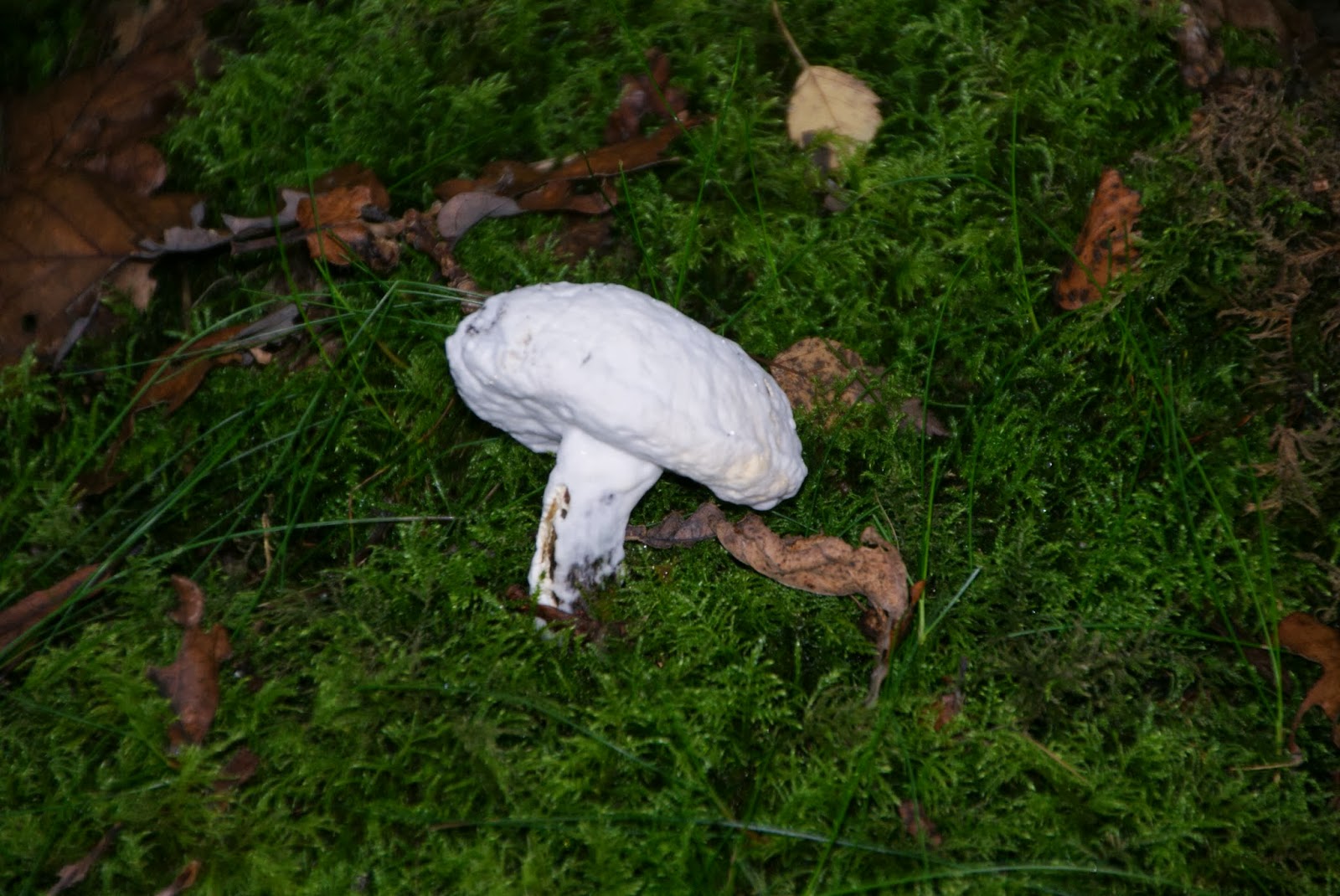
This unidentified fungus is nearby
And even more...
Michael saw these at Withens, Halifax
A good year for these little beauties.
Autumn Crocus excellent year 2013
I just had a call from Sim at Cold Edge to let me know that the crocus up there are excelling themselves this year. He says they are a sheet of purple. They are in the field on the left going up below Withens Gap Farm and visible from the road. Please consider local residents if parking near there.
Autumn Crocus Crocus nudiflorus at Soyland
3 stamens below the Feathery Stigmas
If you think you've found Autumn Crocus, especially if it's in a garden, check that it has 3 stamens ( the straight club-shaped organs below the feathery stigmas, )
If it has six it will be Meadow Saffron Colchicum autumnale, a lily-relative sold by garden centres as "Autumn Crocus", which is poisonous and not to be used for saffron.
There are 37 known sites where the true Autumn Crocus grows, mostly in fields and along riversides in Calderdale.
They are spread between Elland, along the Ryburn valley, North Halifax, the mid-Calder area, especially Luddenden Dean, and then, after what appears to be a gap around Hebden Bridge, they pop up again at Todmorden. Many were re-found or newly-discovered recently with the help of HSS survey volunteers and members of the public.
We've lost some at Brearley, near the river Calder, which could still be there; also there are several other missing patches.
The 2010 booklet, with history of the plant and map-references to sites, is available from Halifax Scientific Society. ( See panel at the top.)
Any better photos than mine would be very welcome - I could put them on this blog.
Friday, 27 September 2013
Thursday, 26 September 2013
Seen locally
| This caterpillar was on Buddleia |
| Bracket fungi at Ogden |
| Autumn Crocus Crocus nudiflorus - Bradshaw |
All seen yesterday near home.
The Caterpillar was on Buddleia in my garden and the Autumn Crocus was at Bradshaw Church. There were at least 14 spikes, some had gone over, most were still in bud.
The fungus was in large numbers on decaying wood at Ogden L.N.R.
A reminder that we will be visiting these crocus, possibly hundreds, nearby in Holmfield - on Sunday October 6th. See Header notice.
Friday, 20 September 2013
Wednesday, 18 September 2013
At Last, my first for the year.
Sunday, 15 September 2013
Great view of a Common Lizard
On the last warm sunny afternoon the day before this first "blow" of the autumn brought wind and rain across the UK, some of us were inWithens Clough and Nigel spotted this Common Lizard basking on a wall, mid-afternoon. (Zootaca vivipara, formerly Lacerta vivipara.)
They seem to be on most of our uplands / upland fringes. No records come from woodland or valley bottoms, though sometimes people mistake newts in the valleys for lizards.
The area most records of lizards come from is around Blake Dean, but this could be partly due to the area being popular for days out.
We don't get the other native lizard, Sand Lizard Lacerta agilis, in Calderdale. The nearest site for that is Ainsdale Dunes, on the west coast. It's on my list of native species to see, as I've only seen it abroad, and in an open-air reptilarium in the New Forest, Hampshire.
I'd love to receive any reptile, newt / amphibian records as I am Herptile Recorder for Halifax Scientific Society. Thanks to Nigel for spotting this as we were all about to pass it, weary after a day in the field looking for mosses and liverworts with Johnny Turner.
Nigel is off to Malta today to help in the human shield protecting migrating raptors, etc from the law-breaking Maltese shooters who carry on with impunity while their government turns a blind eye.
Wednesday, 11 September 2013
Garden Produce
Had lettuce and tomatoes home grown here for lunch, and as I was cooking courgettes and peas also from outside this evening, I was distracted by this very active moth inside the window.
Looks like a Garden Carpet Xanthoroe fluctuata according to my Complete British Insects ( Chinery 2005 in Collins Books ). It attracted me by its smart contrasting markings. Would have found it quicker if I'd known to look in the 'carpet' group! It was quite a small moth, and when I released it on the outside of the window, there was another, this one a bit less 'contrasty.'
Its food plants are crucifers, cultivated and wild. I've got plenty of those - cabbages and brocolli full of holes - rocket helpfully self-seeding all over, and weeds like Thale Cress. I don't fuss about weeds too much these days. Crucifer comes from 'cross'. All the plants in this huge family have four-petalled flowers, making a cross shape.
Above - Garden Carpet ? - Halifax
You don't often get an apple with a 'worm' in it these days, probably because the growers spray everything that flies and crawls. These tunnels in my crab-apples might have been made by Codlin Moth larvae? (Cydia pomonella.) They were the first to fall off the tree. I'll have a look on the tree tomorrow and see if I can spot any mis-shapen ones that might still have a larva inside.
I'm prepared to be corrected on my identifications. . . . . .
Monday, 9 September 2013
Wildlife photography
Wildlife photography competition
Single Image Display
Your chance to have your photograph displayed at Leeds City Museum AND win some great prizes.
Earlier this year Sara Porter photographed our taxidermy, insect, egg and skull collections for the ‘Natural Beauty, Part 1’ display at Leeds City Museum. We now want to put your wildlife photographs on display at the museum.
Any age, any camera, any ability… everyone’s welcome.
LINK FOR FULL DETAILS
Thursday, 5 September 2013
Ryburn Valley -Fruits of the morning 05-09-13
Michael and I had a walk up the valley and these were a few of the things we found!
Acorns with a species of gall.
A pretty frame of fungi around an Autumn Crocus.
Autumn Crocus (Crocus nudiflorus).
Michael's photos above and mine of the Shield Bug below.
I think this may be a Red-Cross Shield Bug (Elasmostethus cruciatus) which I found at home later.
Wednesday, 28 August 2013
Ring-necked Parakeet
I have also had reports of a small flock of them feeding in gardens in the Greetland Valley.
They breed in nest boxes in the south, especially round London, where they're often not welcomed. They eat a lot, being as big as pigeons, and are dominant at feeders.
They're feral in Amsterdam as well.
They attract attention by their raucous calls.
Silver-Y Moth
These are day-flying and hover around flowers as they feed on nectar.
It gets its name from the small y shape on each wing. The specialists recognise different species of Silver-Y.
Haven't seen or heard of any Painted Ladies this year, but there were seven Peacocks together on the Buddleia where I found this moth at Barkisland.
Tuesday, 27 August 2013
Water Beetle
This water beetle (c 8mm long) is in my bird bath. I have had a go at identifying it but they look pretty difficult by picture alone. Can anyone I.D. this?
Saturday, 24 August 2013
Knotgrass - June 2013.
I've only just learned to do this as I'm in no way a lepidoptera specialist.
The Knotgrass plant is in the same family as the sorrels - the dock family - and like Common Dock Knotgrass plant has a strong root. It grows as a weed among stones often in gardens and seems as if it has a root as strong as string tied fast to something underground. I suppose that's where its name comes from. I'll try to get a pic of a plant and post it. Its wonderful scientific name is Polygonum aviculare.
Thursday, 15 August 2013
Knot Grass acronicta rumicis
Found this yesterday at Northowram on creeping Thistle...must be around in numbers at the moment..: ))
Caterpillar to I.D. Please
Hi all
A blog reader has sent me this picture of a caterpillar. No location yet. It was
found on a lavender bush at 850'
Looks like my question is answered. See above post.
Thanks Andy
A blog reader has sent me this picture of a caterpillar. No location yet. It was
found on a lavender bush at 850'
Looks like my question is answered. See above post.
Thanks Andy
Wednesday, 14 August 2013
Lesser Bulrush
Found this in a tiny pond near "The Barn" beside Thornhill Beck Lane, Clifton. It was probably brought in from a garden centre, but still interesting. There is only one record for Calderdale in West Yorkshire Plant Atlas - at Clifton ! This was reported by Jill Lucas of the YNU before 1994. Must find out if it was in the same pond. It's possible it could be a hybrid between Bulrush and Lesser Bulrush.
Bur-reed is here in the tiny pond also; another rarity but with more records. It has spiky green balls for flowers.
Also on the walk :
Road-killed toad at "The Barn". The lane might be a candidate for a toad patrol to be set up as many were said to have been killed last spring.
12 Stock Doves together at "The Barn"
10 Mistle Thrushes together in a field at the top of Jay House Lane
Curlew calling near Whitaker Pits Farm - (present since late winter and thought to have bred.)
30 Goldfinches together feeding on Thistle seeds.
No Tree Sparrows seen but core area not visited - only a few House Sparrows around.
About 4 chiff-chaffs in various places.
A Moorhen with a fairly young juvenile at the big dam above the railway.
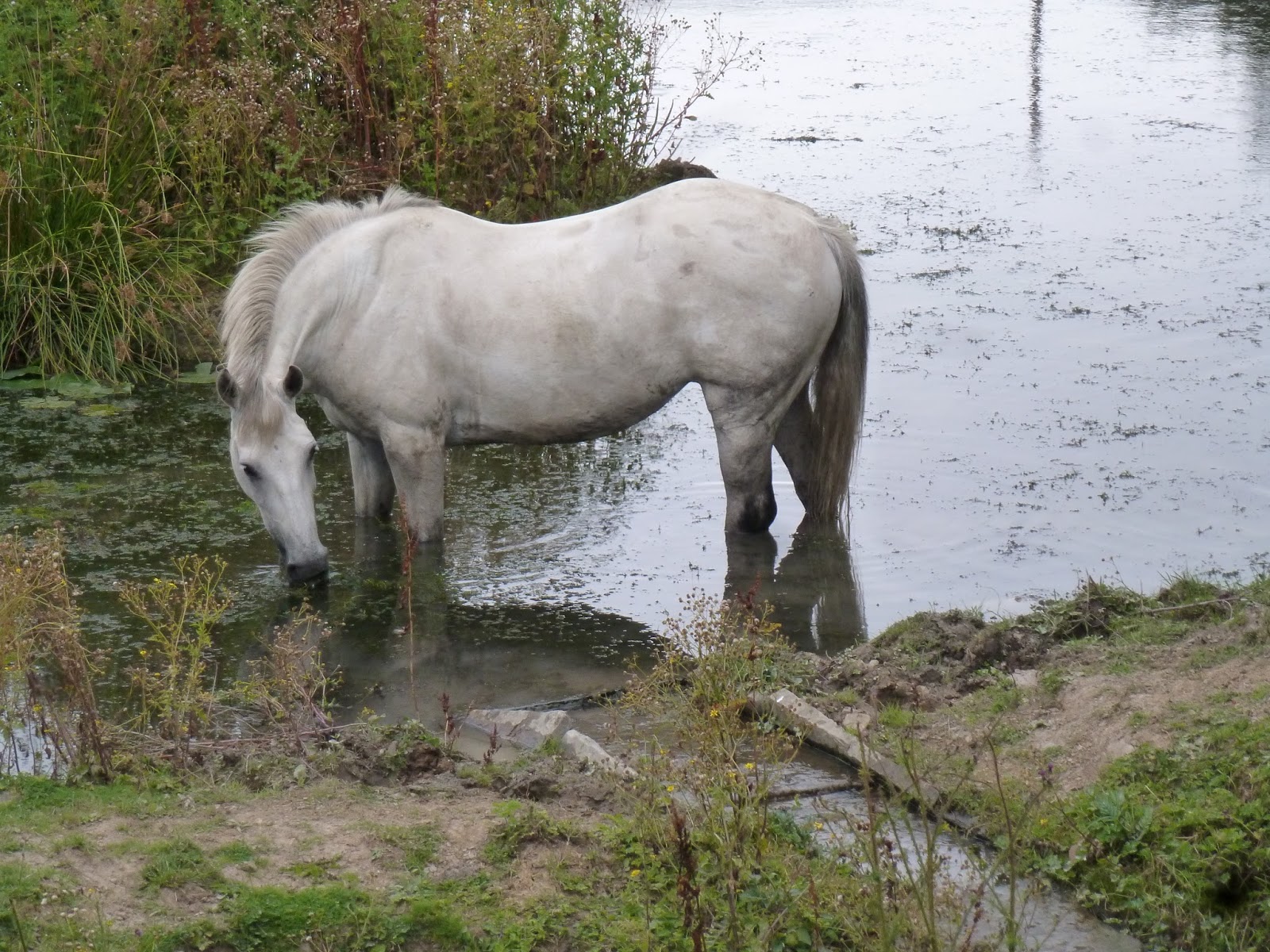
At the dam lower down, just above the old railway, this horse had waded right in to graze on the submerged water plants. It was pulling big bunches out, shaking a lot of the water off, then munching them down. It's not surprising that many parasites of large mammals have an aquatic stage.
Bur-reed is here in the tiny pond also; another rarity but with more records. It has spiky green balls for flowers.
Also on the walk :
Road-killed toad at "The Barn". The lane might be a candidate for a toad patrol to be set up as many were said to have been killed last spring.
12 Stock Doves together at "The Barn"
10 Mistle Thrushes together in a field at the top of Jay House Lane
Curlew calling near Whitaker Pits Farm - (present since late winter and thought to have bred.)
30 Goldfinches together feeding on Thistle seeds.
No Tree Sparrows seen but core area not visited - only a few House Sparrows around.
About 4 chiff-chaffs in various places.
A Moorhen with a fairly young juvenile at the big dam above the railway.
Typha angustifolia
Sparganium
interest, just for the "aah".
Sunday, 11 August 2013
Snake Slough from Ogden
Snakes are very much a declining group of animals in the UK, and it would be very exciting if we could prove we have a small relict population in Calderdale.
This piece of a slough is going off to Matt Wilson at Manchester University to hopefully be identified.
Unfortunately it hasn't got the head part.
There have been a few reports of adder bites on dogs above the Lodge at Ogden, where this was found by J. Ball on 20.7.13
Also there was a Courier report a few years back of a gardener being bitten on his leg somewhere in the Ogden area. He was wearing shorts while strimming long grass! He needed slight hospital treatment.
Regrettably, there has also been a series of sightings of exotic snakes near here; obviously unwanted pets set free. Poisonous snakes are not often kept as pets.
If anyone is not familiar with the way snakes grow and shed their skin - they often manage it one go, starting with fraying around their mouth, then peeling the outer, semi-transparent layer off, which ends up inside out ; often tangled among twiggy plants.
I have a near perfect four-foot long one from the South of France ( pulled in two by the kids!)
Please all look out for sloughs and show them to us and Matt.
A complete adder slough apparently still shows some of the colour and you can make out the zig-zag markings they usually have.
Also please spread the word that snakes need friends, and are worth conserving. This slough and my bigger one will be available to handle at the indoor meeting on Tuesday 13th at 7.00pm at the Central Library. (See above the blog.)
Saturday, 10 August 2013
Honeysuckle
I cut a honeysuckle last winter and the regrowth is vigorous as expected but I'm surprised at the leaf shapes. The books describe Lonicera periclymenum leaves as oval to elongated but look at the photos to see how some are more like oak leaves. Is this usual on young vigorous growth?
Honeysuckle leaves, showing variation in shape
Thursday, 8 August 2013
Small tortoiseshell....................en mass.........
With a count of over 1,200 around the Cold Edge Dams complex (thanks Pete Smith and Dave Sutcliffe ) today and at least 200 + around Northowram last week it looks like its fortunes have changed this year at least., if any one else has any counts of over 50 + I would like to hear from them,, a number (50+) and where they were seen will be fine. Areas of creeping thistle or buddleia are good areas to check..................Also today at least,55 Small whites, 20+ Peacocks and 10 Comma around Northowram.........
Tuesday, 6 August 2013
Moth Night this Friday August 9th
All being well with the weather,,,,etc I will be running a trap or two at Cromwell Bottom on the 9th August to celebrate National Moth Night.......usual spot by the lagoon.........all welcome...would be nice to see you all.
Full details
AndyC
Full details
AndyC
Subscribe to:
Posts (Atom)