This Blog covers nature sightings and related news in the Calderdale area.
It includes all groups - Plants, animals and fungi with links to specialist sites.
Anyone wishing to become a member of this Blog and post sightings please contact us.
If you would like to join the Halifax Scientific Society either email me or come along to the next meeting.
All welcome:
calderdalewildlifeblog@gmail.com
Please contact us about any sensitive records before posting on the blog

Sunday, 29 May 2016

Medlar/Midland Hawthorn

The natural hybrid between Medlar and Midland Hawthorn is now in full flower in Centre Vale Park Todmorden. It was previously 'lost' within Rhododendron which has since been cleared.

It has variable shaped leaves, some lobed some entire but the flowers are large and very attractive; not in clusters but single. Originally called Smiths Medlar when the hybrid was discovered in 1800 but now known as xCrataemespilus grandiflora.

Tod's flower has 3 styles, the same as Midland Hawthorn. I have never seen another of this hybrid. Edward Kemp planted some at Dobroyd Castle in 1869 under the name Crataegus grandiflora, which is considered to be the same hybrid under an earlier name. Kemp also did some landscaping at Centre Vale, so could it be one of his plantings?


Thursday, 26 May 2016

Our Monthly Scientific Society Walk, May 2016.

 Emma Baker, our Geology Recorder, is leading a walk this Saturday, 28th May, 2016.                     The plan is to walk on the Todmorden Geology Trail.
 The meeting place is OL14 7JA (SD 918 247). At the crossroads of Sourhall Rd, Parking Lane, Flower Scar Road/Tower Causeway. There is some but limited parking.
Meeting at 10.30 am for 10.40 am.
Bring a picnic and a layer to sit on. Dogs are welcome if controlled as it is lambing and ground-nesting bird time. We will probably see and hear the haunting calls of curlews.
 Families welcome.

Any lifts needed from Halifax? I will leave town centre at 9.30am.

Tuesday, 24 May 2016

Coppiced Oak

This picture of a lapsed coppiced Oak was taken in Knotts Wood Todmorden. It is likely to be a very old tree looking at the size of the boulder shaped base. It needs more light to stimulate epicormic shoots from the base but unfortunately it is getting shaded out by other saplings.

Saturday, 21 May 2016

Cult of the named tree

Not our area but still interesting for what it reveals about our blinkered sense of trees.

This is the New Forest and on the O/S map there is indicated the "Knightwood Oak", the biggest Oak in the New Forest at 25ft in girth and estimated at 600 years old. It has its own car park nearby and is specially ring fenced (a bit garden fence-ish) with historical notices. It is impressive and is obviously a lapsed pollard.


Knightwood Oak
 
 
Yet not 100 yards away there is this ancient centuries old tree, not named so not regarded, but just as interesting as the Knightwood Oak. It is hidden away and can only be sensed and not seen.
But if you look beyond the smokescreen of garden fences and nameboards, there are plenty of these other wonders in the woodland. This particular Oak was an open grown pollard in wood pasture until its space has been allowed to be invaded by young conifers.

Find the Ancient Oak
 
Here it is
 
Haloing round the Oak by removing conifer and Beech saplings will help it survive. Without any intervention its death will be premature. I always find it useful to look in the opposite direction to signboards and notices, where there is often far more interesting things to discover. Such as this Beech and Oak, again only yards away from Knightwood Oak but with no information board informing anyone what is going on. Yet the page from a 30 year old booklet describes it well.
 
Inosculation--a new word for me

Old booklet describes it.
 
It's an interesting world out there

Tuesday, 17 May 2016

Lousewort

Today I visited a meadow in the Holywell Green area,
it's a short grazed unimproved meadow with a great variety of species.

As I scanned around I totalled 26 points on the LWS Meadow Criteria List.
12 is considered good.

The highlights for me were Lousewort (Pedicularis sylvatica)
This is the third site I've been to in Calderdale with Lousewort.


Very clear in the short grass


Changing Forget-me-not (Myosotis discolor)


Now a common component of Wild Meadow Mixes
I rarely see it growing naturally but here it appeared en masse.


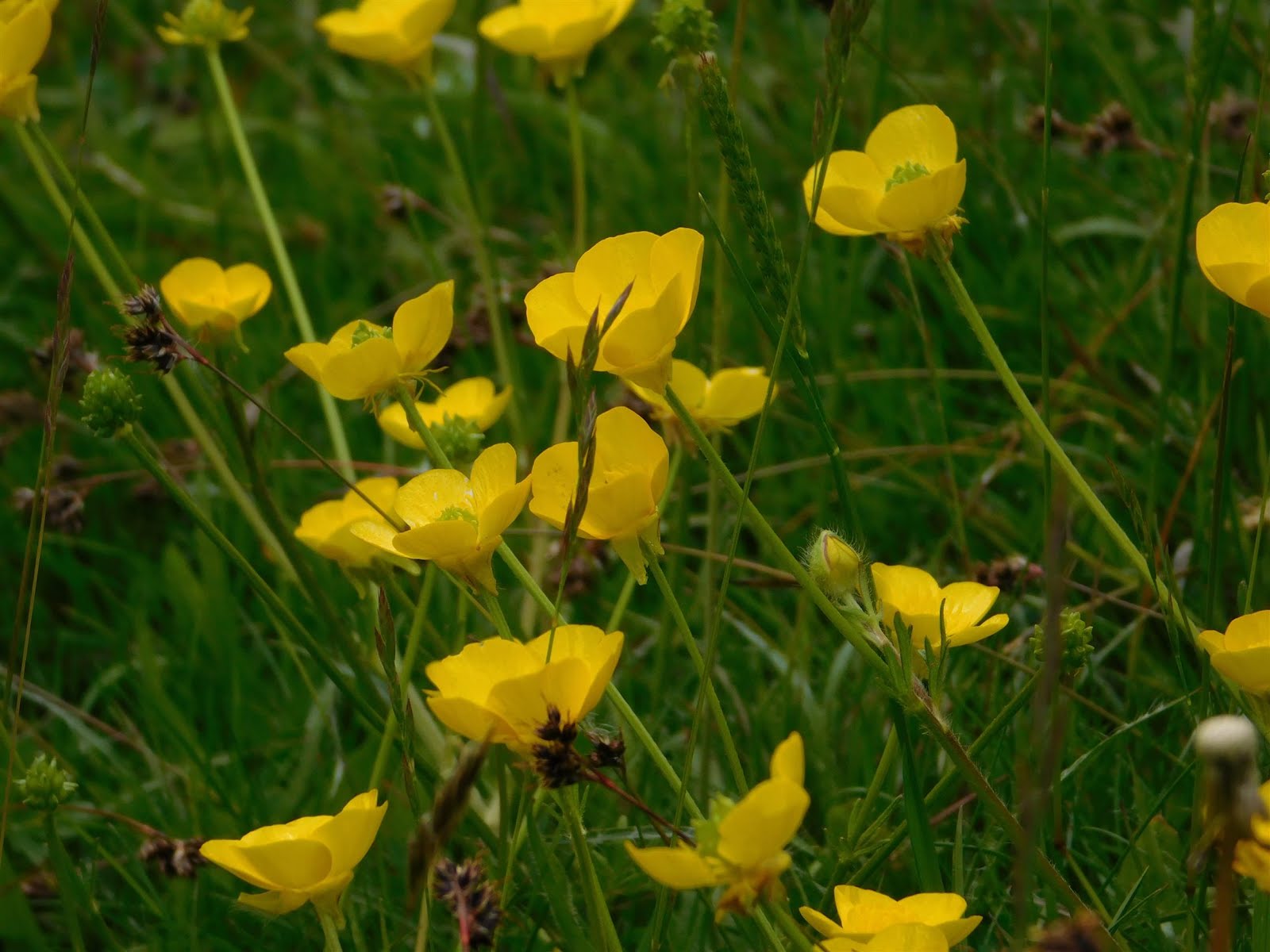
Bulbous Buttercup (Ranunculus bulbosus)
Our least common Buttercup which is usually scattered but here was abundant


Note the reflexed sepals below


There was also Heath Milkwort, Barren Strawberry, Bitter Vetch, Carnation Sedge and many more.
If you know of any hidden gems like this then please let me know.


Saturday, 14 May 2016

White Holme and Turley Holes and Higher House Moor

On a walk along White Holme Drain, mainly looking for the beetle Carabus nitens (which at the second attempt this spring, I didn't see again), I did see several green tiger beetles and I'm fairly certain my first ever emperor moth.  It flew by at great speed as I walked along the track between Turvin Road and White Holme Res'.  I half - heartedly chased after it but it was soon lost over the moor.

Regards, Chris


Sunday, 8 May 2016

This Month's Talk and walks - May 2016

AM poster
-----------------------------------

Weds 11th May. There is a Woodland Visit to survey for species with a view to creating a new Local Wildlife Site. The planned Grassland survey is cancelled, possibly to be  re-scheduled, as the meadow flowers are late.
This is to Parrock Wood, and Height Wood, west of  Hebden Bridge. Meet just off the A646 main road just after the Eastwood Sewage works on the bridge that  crosses the Rochdale Canal a few miles west of Hebden Bridge. Grid ref. SD968261. Park on the main road. 
Time 10.30 am for 10.40. Bring a packed lunch.
 Hugh Firman, Calderdale Conservation Officer, leading. Tel.07712867610

------------------------------

Saturday 14th May. The annual HSS ramble to Rishworth to see the very reliable Little Owl (sometimes the pair) and the Native Daffodils. Unfortunately the daffodils were in full flower a few weeks ago and are probably mostly over. This was due to a very mild early winter.
Many other interesting species to see and beautiful scenery.
Bring a packed lunch. We eat outside so a damp-proof sitting layer is useful.
 Meet at Mill Fold (Bowling Green) Car Park off the B6113 at Ripponden. 
10.30 for 10.40. Steve Blacksmith leading. Tel 07715005379

Friday, 29 April 2016

Tree Planting --- some reasons why

I have written this here rather than in "comments" to my other post on Tree Planting as things can get a bit lost in there.

I recognise there are many good new tree planting schemes done by organisations and individuals. But I think there is a need for debate and reflection, which is what I present below.

There is a scheme called "Keeping Rivers Cool"

http://www.woodlandtrust.org.uk/mediafile/100814410/pg-wt-060216-keeping-rivers-cool.pdf?cb=a8aa1f98391e4baa94a9fd973345c879 

which is designed to protect certain rivers from the effects of climate change, particularly the salmon and brown trout. The River Ribble is one of these, including all its headwaters and streams, which is why the little Wycoller Beck has been blizzard planted as in my previous photo.

Also this EA link is very good:-

http://www.asfb.org.uk/wp-content/uploads/2012/09/Keeping-Rivers-Cool_Guidance-Manual_v1.-23.08.12.pdf

If you read the above pamphlet by the Woodland Trust it does explain how this should be carried out. There is really good advice about leaving glades, self-seeding via fencing-off, avoiding flower rich habitats etc.

It also contains the recommended planting distances of 2 to 3 metre spacing. This is for quick canopy closure to gain 'control' (i.e. vegetation suppression) quickly. This spacing seems to be a general recommendation for most tree planting schemes. I don't know where this originated, unless it is a throwback to commercial FC conifer plantations but it seems very wasteful in terms of resources and labour.

And there lies the problem. This 'control' of vegetation on many sites is so complete it goes extinct, particularly when the planting body has no rights over the land and what the private owner may do (or not) after a few years. The planting scheme might have pleasant visions for the future but the actual landowner have none.

It may be better to recognise this probability and space the trees out in the first place.

Oak saplings don't need weed control, they will grow strongly through grass. The acorn is designed to do this for when Jays plant them outside existing woods, or in very open woodland glades.

Oak is a pioneer species, more so than Birch which prefers bare ground or is an opportunist in existing woodland. Paradoxically you won't get Oak saplings in an Oak wood. Just as you don't get Ancient Trees in Ancient Woodland.

What seems to happen on the ground, however much prior ecological surveying is done, is the usual uninspired close planting. The numbers of saplings are ruled by the Grant system.

There must be a way of designing (and paying) for new woodlands that will last for the future and actually work for people and wildlife--or what is the point in them?

Having said all this---- the most important thing for any woodland, new or old, to exist long term is to keep the sheep out.


Walshaw Moor Burning Off 10 15 to 03 16


Heres just a sample of the New Intensity of Burning Off on the Walshaw Moor Estate from Oct 15 to March 16,all for the sake of artifically boosting the numbers of Red Gouse which then can be Blasted Out of the Sky, for  so called Sport !!How this benefits Our Climate,and environment is totally beyond words.This victorian Practice needs consigning to the History Books Now,before there is nothing left !!  

Thursday, 28 April 2016

Ramble this Saturday

There will be a walk this Saturday 30th April 2016 in the Tenterfield and Friendly area of Sowerby Bridge.

It is Peachysteve's "Friendly" flower identification ramble. Meet outside Sowerby Bridge Cricket Club at 10.30 for 10.40. HX6 1AN

Easy walk; families welcome; no picnic needed and no charge. Dogs will be attending so others welcome.


 Butterbur at Cromwell Bottom Nature                                                                                                              Reserve this week.

Tuesday, 26 April 2016

TREE PLANTING---IS IT TIME FOR A RE-THINK?

These newly planted trees are by the river in the Forest of Bowland. Not sure what to make of it really but it is very similar to many such tree planting schemes taking place everywhere. The other photo is of a similar blizzard of trees by the beck near Wycoller, planted amongst lovely wild flower riparian habitat.
 
One needs to ask what is the point of all these cheek by jowl trees; is there a management plan or a purpose in mind. As far as this scheme by the Hodder, I would guess there are upwards of 500 saplings planted in a small area that would support perhaps 30 mature trees to leave the necessary space for flora and understory.

It may be that 470 of these saplings will be coppiced as time goes on. But even that would be an excessive amount of coppice for a small area and the multi-stemmed stools would impinge on each other with no room for anyone to stand up, never mind wield a billhook. It will be interesting to see how it develops. Look at the attractive mature tree in the background; will any of these saplings ever provide a future replacement?

I have come across many such plantations before and it is never a pleasant experience. Umpteen years on the forgotten saplings have grown like tall matchsticks; the previous ground flora extinct because of the deep shade.

But worse than all that is the waste of time, because if the matchsticks are belatedly thinned out, the remainder bow to the ground in shame. All that can then be done is cut the lot down, throw all the supposedly bio-degradeable plastic tubes in the waste skip and start again.

Blizzards of trees don't make a woodland; space them out and you can have characterful trees with branches, as well as a ground flora. Also don't forget to create new pollards--these are the trees that have the potential to remain for centuries--long after the others have gone out of memory.
 
The old motto is wrong; it should read "You can't see the trees for the wood".
 
                                               By the Hodder
 
 
Wycoller Beck   


Thursday, 21 April 2016

Request for the toad records and a joyful re-find!

I got just four toads last night at Boulderclough site. It seems to be coming to an end, but don't take my word for it - check the thermometer and your stretches of road. I'll be going out later tonight.

When you are convinced the migration is over the Hx. Sci Soc would greatly value your counts, including dead amphibians. Just basic numbers and species is OK, dates being very important.

I am named organiser only for Bolderclough Dam with Froglife; you can register with them and send in your own records, or I can send them to Froglife with my Bouderclough counts.
If you look on their website you will see they collect slightly more detailed records if you use their form. I only send fairly basic records as I don't have time to do everything they ask; I am recorder of birds with HSS as well !

I was unable to find a volunteer for the Thornhills Beck Lane site after Margaret had to go on holiday. But thanks for saving those you did, Margaret.

I offered to show people toadspawn who weren't lucky enough to spot any, and have some in a bucket here. Sunday 24th April late afternoon/ evening is a good time for me. I can bring it to Boulderclough, then to Woodhouse Rd. Todmorden, as a suggestion of possible arrangements. Or in Halifax if you're passing. Leave your comments below if anyone is interested.

________________________________________________________________________________

Daffodils, native and unplanted ones, were recorded at Hippins Clough, near Blackshaw Head.  This is in the Halifax Naturalist, which only ran until 1908, so the record is at least that old.

I've looked without success for several springs, and we found them on Sunday 17th April!  I spotted a clump of five, and Annie Honjo added another seven scattered about.

They are in the upper part of Jumble Hole Clough ( it becomes Hippins Clough at some point ) about 150 metres below the ruined Staups Mill.

They are half way up the steep slope on the side opposite the footpath. There are dandelions, Lesser Celandines and other woodland flowers around there. You need binoculars to be sure of the ID.

Perhaps they only escaped the collectors by the steep and wet situation they grow in.

There are about another half dozen sites, mostly around Halifax, in the old records.

Wednesday, 20 April 2016

Spring update

A brief update on a wood in Todmorden.

Couple of weeks ago 6 small tortoiseshell and 1 Comma, also Chiff-Chaff. Today a speckled Wood, male Blackcap, Nuthatch and Long Tailed tits and a few Swallows overhead and a Buzzard.

Only the odd few Meadow Foxtail in flower--very late for this grass and is beaten this year by Sweet Vernal, which rarely happens.

Mountain Melic in flower today, as are Kingcups. Lots of Tortrix moths flying about, which suggests the Oak buds are swelling.

Wednesday, 13 April 2016

Whiteholme and Turley Holes and Higher House Moor

With the sun out I thought I might try the moor in the slim chance of an early emperor moth and/or  the beetle Carabus nitens.  It was still rather chilly and damp up here and I didn't see either.  There weren't many birds about either, apart from red grouse, curlews, meadow pipits, a lone swallow heading west and a redshank was heard.  I did however find four species of sphagnum moss, including S. fallax, S. denticulatum, S. capillifolium and possible S. palustre.  There were also some (recent) significant carvings on Closet Stone (or thereabouts).

 S. denticulatum
 S. capillifolium
 S. palustre?


Sunday, 10 April 2016

Native Daffodils and equally beautiful (interesting?) Toads on the Roads to their ancestral breeding ponds.


 The Native Daffodils are well out at their only known local site. It's hopeless to think they might still be in bloom on the programmed Daffodil Walk on 14th May. If anyone would like to take a walk out to see them this Wednesday 13th April, I am willing to lead a group. Please show interest by leaving a comment below. I am thinking about 5.30 pm, but that's open to adjustment. Confirmed: Meet at this time on the side road down to Rishworth Palace Flats. (Not in the flats car park.) Lifts available.
The turn-off is easy to find; left opposite the Rishworth bus turning circle, which is just beyond Rishworth School on the Oldham Rd a few miles beyond Ripponden.


Common Toad, much more widespread in Calderdale than the old records suggest, but amphibians were not much mentioned, and maybe were taken for granted.

It is a Calderdale priority action species, as the deep ponds and old dams it needs to breed in are often drained for housing. Malcolm Smith in his British Reptiles and Amphibians (New Naturalist Series - available to borrow from our library) maintains they are site-faithful, and can walk up to 5 miles when they disperse, and come all the way back when old enough to breed. 

This fact alone makes them a fascinating animal to me, and when we see that so many individuals get run over crossing roads near their journey's end, they deserve our attention.
Several of us in the Hx Sci Soc go out in the evenings in March and April to rescue them on the roads and put them into or on the edges of their ponds. The rush happens just after dark, so we generally only stay out about an hour.

They started appearing on 12th March this year, but the big night at Boulderclough was 3rd April, when four of us rescued 113. There were several sites for which we had only one volunteer or none.
There may be a few more nights of movement, as the cold spell on Friday/ Sat 8th and 9th has put a stop to toading. I have just heard that there were 2 toads tonight (Sunday) and a Palmate Newt, equally worthy of saving from the tyres.

Well done to all the volunteers throughout Calderdale ! (there are several sites and an active group that co-ordinate with the help of Facebook in the Upper Valley.)

The toads seem to move when the temperature reaches 8C, and a rush occurs when it reaches 10C or warmer. They must respond, I think, to a combination of temperature and day length. 

In June and July you may notice while out on walks near water that the ground is studded with hundreds of tiny toads, often mixed with tiny frogs. Many of these will be eaten by birds and animals, making them an important part of the food chain; another reason to preserve them and their ponds.


Female Common Scoter at Ringstone last Sunday 3rd, and possible White Wagtail today

with thanks to AT for texting the alert to DJS


this was following a male Pied Wagtail - 
could it be a female White ?
Mankinholes today.

Friday, 1 April 2016

Beech anomalies

The lovely Fern Leaved Beech in Centre Vale Park Todmorden was felled today. It was a victim of Phytopthora ramorum disease, which is a very serious fungal like pathogen.
 
Shame to lose this tree as there are now only two Fern leaved Beech in Todmorden--one near Holebottom and the other at Dobroyd.


Also felled was this common Beech, about 175 years old, which was dying from Phytopthora symptoms. I was intrigued by the unusual growth pattern which had created these isolated growth columns, separated by included bark reaching to the centre.
 
It almost looks as though it could have been a bundle planted tree, ie one where numerous individual saplings are planted in the same hole. This was sometimes done on boundaries and as the saplings grow they fuse together and create a more spreading crown and large feature tree.


Tuesday, 29 March 2016

Amphibian watch at Cromwell Bottom

On 26th March we made our annual survey of  amphibians at Cromwell Bottom Local Nature Reserve.
Having the walk listed in the Calderdale Council's Wildside booklet usually ensures a good group of children; Easter school holidays also helps bring them out.
We had a brilliant total of 19 people including four children plus two dogs.

The kids are so enthusiastic, it brings out the energy in us big kids.

Many thanks to the members of Cromwell Bottom Wildlife Group who attended the walk with us or stayed back in the cabin with the kettle on ready for our mid-day break, a welcome innovation.
They also lent us some lovely new pond-dipping equipment which saw good use.

CBWG had been called on to rescue some frogspawn from Lloyds Bank Copley Data Centre, where it looked like it was going to dry out. They had placed some of this in various ponds on the reserve. There was also plenty of naturally appearing frogspawn clumps, though I didn't get a count of these. I'm relying on Allan, as he knows where the Copley spawn was put.

No adult newts were spotted despite much staring into ponds. We saw plenty last year on 28th March. However, when we got to Tip Pond, one of the boys, Dylan, made a sweep with his net and tipped the wet and weedy contents into one of the white trays being carried by an adult. What was at first thought to be a leech, then a small fish, turned out to be an immature newt, about 1.5 inches (4cm) long.

It had its four limbs (very filamentous) and still had its external feathery gills that newt larvae have. (See picture.) Annie commented on its similarity to a tiny Axalotl, which is after all, just a large amphibian. Dylan's newt would not yet have left the pond it developed from the egg in.

SB


The species of newt that have been identified at Cromwell Botton NR are Smooth and Palmate, but no-one was prepared to have a stab at identifying this little one.

No frogs were seen, but when four us went to look at how the Sphagnum Bog had fared after the Boxing Day Floods, we found a dead Common Toad. I think it had possibly been crushed underfoot, as its tongue was  exposed, as when they are run over on the road. Another was spotted, very still, halted in mid-crawl and covered in white fly-ash.

At first we thought it had been poisoned by the alkaline ash and petrified, but I noticed its eyes were not covered, and it was slowly blinking occasionally. I took it to clear water at the nearby Wet Woodland and washed it, when after being photographed (see picture,) it swam away perhaps soon to find a mate.


The floods had poured into the Sphagnum Bog via Pixie Wood, disturbing the fly ash, and covering everything in a thick white layer. Some of the "quaking bog" effect had returned, long remembered by local kids, now grown up, as the "Wibbly Wobbly".

It was a very successful amphibian walk, with two species seen, and another seen to be present by its spawn.

Species mentioned: Common Frog Rana temporaria
                                Common Toad Bufo bufo
                                Smooth Newt   Lissotriton vulgaris (also called Common Newt, but scarce here.)
                                Palmate Newt  Lissotriton helveticus (this is the one we usually encounter in                                                                                                                           Calderdale.)


Thursday, 24 March 2016

Growing wild seed

This from Calderdale council's News Centre has just been issued. Large trays of wild flower seed are being given away for planting out; "Council is making sure that parks and grass verges will benefit too – especially in areas that have become overgrown or unused."
 
Are overgrown areas a good place for wild flower seed? I thought they needed minimum competition. I do hope there aren't disappointed people.  Like many things--the success is in the detail not the hype.