This Blog covers nature sightings and related news in the Calderdale area.
It includes all groups - Plants, animals and fungi with links to specialist sites.
Anyone wishing to become a member of this Blog and post sightings please contact us.
If you would like to join the Halifax Scientific Society either email me or come along to the next meeting.
All welcome:
calderdalewildlifeblog@gmail.com
Please contact us about any sensitive records before posting on the blog

Wednesday, 22 July 2015

A comment added to the post below, worth putting up as a post itself.

Blogger Finlay Duncan said...
Hi Philip, excellent resource for the Halifax area!
Was hoping your organisation and members can help us protect nature in Europe. The European Commission's looking at reviewing the Birds and Habitats Directives, the very laws that have increased the numbers of many at-risk bird and animal species in Europe and that have led to the creation of thousands of conservation sites around the EU.
We think these important laws should be safeguarded, not undermined! A public consultation on the issue closes this Friday and we're trying to get everyone to have their say. More information is available here: http://www.tiny.cc/naturealert - every voice counts!
22 July 2015 at 15:07

Saturday, 18 July 2015

Himalayan Balsam

Does any one know if the seeds of Himalayan Balsam are spread by mammals (or birds)?

Yesterday I was pulling some Balsam from an area that has been mostly eradicated of it over previous years. The only ones left are not the usual individuals but widely separated clumps comprising individuals of up to a dozen within a few inches square of ground.
I have never seen it grow like this and it looked as though a rodent may have stashed quantities of seed. It certainly made it easy to pull the lot in one go!

This may be a reason why Balsam suddenly appears in new places where there is non nearby.

I have googled this query and can find no reference to animals or birds eating the seeds. I can't believe this doesn't happen--but why has it not been recorded?

Sunday, 12 July 2015

Magical Lecture this Tuesday 7.15pm

SB Photo

As a follow on from Dave's talk , (below) he is leading us on a walk on Midgley Moor to see signs of early occupation of the moor in the form of  standing stones and earthworks.                                                 This is on Saturday 25th July.
Meet at 10.30 for 10.45 at Clough Cottages, on the end of High House Lane, Midgley. There is some parking, but not unlimited. Grid ref. SE028279. It will be over rough land off the paths. Bring packed lunch and spare warm clothing.

Dave Shepherd, our Archaeologist friend from Heptonstall, gave us an illustrated talk on Tuesday 14th July.

His subject was

                                     BEFORE THERE WAS YORKSHIRE


My photo taken recently is a fawn and a doe Roe Deer at Hardcastle Crags.
Click to get a larger image.

Saturday, 4 July 2015

Luddenden Dean

I finally got round to a walk in the Dean today, a place I don't know at all.  I was utterly captivated, there is so much of interest on so many levels.  My walk began near Dry Carr and took in Booth, Bank House, Cat in th' Well (cracking pub), Saltonstall and Throstle Bower.  I didn't see much in the way of birds, but there were lots of butterflies about, including common blues, meadow browns, my first large skipper of the year, speckled woods and ringlets - by far the commonest by a country mile, they were everywhere.  I also saw a few chimney - sweeper moths (my first for a year or two) and what I think was a common green grasshopper.


Wednesday, 1 July 2015

Insect heaven . . .

These were about as we surveyed meadows and woodland for plants last week.

What is the validity of Northern Eggar as a specific name?


Eggar, Northern or Oak ? Near Mytholmroyd.
Best focus my camera could get as he shivered on  my finger.


Common Blues mating. Luddenden Dean.


Saturday, 20 June 2015

Writing Competition 2015

The Competition is now closed, but blog readers can still send me articles/essays/comments on the subject below if they wish.

31st July, 2015. The Entries have been read and carefully thought about by members of Halifax Scientific Society Council.
While all of them were considered excellent, and it was hard to choose, most votes went to . . . . . Entry No. 2 written by Linda Kingsnorth, Mammal Recorder for HSS.
With many thanks to all who took part. Charlotte Weightman, also of HSS and Philip Marshall of Todmorden, a member of the Upper Calder Wildlife Network were the other two. 
All three gave us much food for thought. Linda's is also a challenge to us to spring into action.

Do you have any thoughts on the way the Natural Environment is being looked after by the Authorities in Calderdale?

If so, why not enter this competition? It's free to enter and the prize is a field guide of your choice up to the value of £16.99. Entrants must be registered members of
HSS, UCWN, CBWG or CBCG, i.e the Calderdale Groups concerned with wildlife conservation.

Deadline for entries was mid-day tomorrow, 21st June, but as I have been busy, I have extended it to mid-day on Thursday 25th June. It can be short or long, but please refrain from any libelous or inflammatory statements. (Over long pieces might turn off the judges.) Please email them to me at steve.blacksmith@gmail.com.

It's not so much for the prize, but to encourage people to set down their thoughts and feelings about Wildlife and the Natural Environment in Calderdale. You can have your say about any part of Calderdale, not just Council owned land.

Entries will be read and the winner decided  by the Hx.Sci.Soc. Council members. (NOT Calderdale Council Staff.) Prize allocated by end of July 2015.

This competition is prompted by the 10 -page document which dropped in to some of our inboxes on 21st April from Calderdale Council's Business and Economy Department outlining many new proposals for Cromwell Bottom Nature Reserve.


                                   SB photo

Please see below three entries already received.

ENTRY No.1 (Name supplied which will be added after judging.)
Everyone Needs a Home by Charlotte Weightman
We have voices.  We can speak.  We can discuss, put our point of view, argue our case.  Wildlife can’t.  But wildlife is the most optimistic of living creatures – they want to live, to reproduce, to continue their species, and will do their utmost to do so.  Look at the way brownfield sites suddenly spring into life with often the most extraordinary array of plants.  But if the specific habitat of a specific creature is taken away – by man’s intervention – then the optimism of a part of our natural world will be extinguished.
We are fortunate to live in an extraordinary area of England which has, within a relatively small area, a huge mixture of landscapes, and thus of wildlife.  You can be high on the moors with its own environment, assemblage of birds and plants and yet within 10 minutes be down in a woodland and river area with a completely different environment and range of species living there.  We have woods, wetlands, marshes, moors – all of which sustain very different forms of wildlife.  We in the South Pennines have the only nesting colonies of Twite in England.  We are also extraordinarily fortunate in having an industrial past – and present.  This means that vehicles carrying goods from other parts of the UK as well as abroad, bring into the area ‘hangers-on’ – seeds attached to vehicle wheels, insects hitching a ride in a cab.  After all, this is the way that Oxford Ragwort reached all parts of the UK when it escaped from the botanical gardens of Oxford, seeded near the railway lines and from there in the late 1800s, was carried to all corners of the UK.  No other Borough has this breadth of diversity within such a relatively small area.  It is vital that we keep it.
A respect and interest in wildlife has to be generated very early on in life.  A friend of mine is very knowledgeable about wild flowers – her grandmother taught her the names and species when she was a little girl.  Another friend learnt all the names of British butterflies – and in Latin too! – when he was 14, and now, over the age of 50, he still remembers them.  My own family of brother and cousins all love gardening – our maternal grandmother was a keen and experienced gardener and delighted to share her knowledge with us when we were children.
It often takes a situation – or a person – to make you realise that you are living in an area of very special and unique wildlife interest.  For years, I would drive down motorways and catch trains to urban environments for work and spend my free time walking and cycling, but only relatively recently did I realise how many thousands of different types of grasses there are,  or what a shrew sounds like when scuffling through the undergrowth.  For me, my eyes were opened through a change in career, but not everyone can do that.
We have to have respect for the countryside, but we needn’t necessarily know everything about it.  We can have respect for a surgeon, but we needn’t necessarily understand absolutely everything about the operation he or she is about to perform – we just want to know that it is being done properly.
And so with a refuge for wildlife.  At Cromwell Bottom, a team of experienced and dedicated volunteers, along with key members of the Calderdale Countryside Services, have put in a tremendous amount of energy and work into making Cromwell Bottom and especially the North Loop into an area which nurtures and safeguards wildlife – some of which is unique to this area, through its previous associations with brickwork factories and the conditions to the soil that these produced.  It is a Nature Reserve, not a park – and should not be turned into a park.
Create a climate of pride
Success breeds success.  Be proud of the fact that we do have this extraordinary landscape within Calderdale and thus a unique assemblage of wildlife.  Too often, we are fed dire stories of imminent extinction, but if the general public is told and shown how things can be improved, how they should act around wildlife and how, as Yorkshire people, we are ensuring that our wildlife does have a chance, then we can all take ownership and pride in what we have achieved.  But it has to be explained why it is so essential to have an area which isn’t basically a park, and which respects the needs of wildlife.  Wildlife and its intrinsic relationship with ourselves also has to be very clearly explained – why it is so necessary to preserve and nurture what we are fortunate enough to have in our locality.
Generational gifts of knowledge
An inspirational teacher, a grandparent or uncle or aunt, a family friend, can help stimulate the lasting interest of a young person in wildlife, its history and culture and why we need to care for it.  Through the proposed educational recourses for Cromwell Bottom, this could be achieved – through organised safaris (looking for different plants can be an adventure in itself!) and open days for clubs, schools, grandparents.  But it does have to be carefully managed so as not to overwhelm the wildlife inhabitants. The Cromwell Bottom group already work with young people, and this could be extended through Champions for Wildlife who could visit individual schools to tell them about specific aspects of wildlife.  Resources permitting, an inter-school competition could be set up to create their own ideal nature reserve.
 A case for studying
University departments, including PhD students, frequently need to carry out quite lengthy experiments and observations – I am currently involved with one for the University of Sussex on pollination – and make great use of so-called Citizen Science – i.e. they get the interested general public to do the tasks which need a wide range of data collection.  The Cromwell Bottom site could have a university or agricultural college link up which would ensure that areas of the site were kept specifically for the nurture of wildlife and thus gain the accreditation of being linked with a seat of learning and research.
Healthier lifestyles using the countryside
Whilst the inclusion of cycle paths, more footpaths and a general wish to get the public into the Great Outdoors can only be applauded, this must not be to the detriment of the fragile but intensely important wildlife that lives there.  By alerting the public to what they are passing through, they can be made aware of the fragile but optimistic mosaic of wildlife beneath their feet, around them and above their heads.  But just as you would not want the general public to have unlimited access to, for instance, a crèche, or an intensive care ward or a workplace carrying out sensitive work, so to should this apply to a nature reserve, and one which has been specifically created to care for and encourage delicate and sensitive organisms who have no voice of their own to state their case.


The Star of the Reserve
One species could be made into the ‘star’ of the Reserve – it could be the means of communicating messages to the general public –e.g.  ‘The Tawny Owl says……’ – in much the same way that other organisations use fictional creatures to get over their point about nature conservation.
Shout it from the treetops!
Just as plants in some garden centres include bee friendly stickers, so too could local businesses endorse the Nature Reserve as a very special place to be treated with enormous respect.  Regular articles could be written (by volunteers) for local magazines such as Go Local! to keep the Reserve to the forefront of people’s minds.  Social media could be used to a much greater extent – putting out good news stories.   A celebrity (who knows, Chris Packham could be asked – he can only say no!) could be used whenever there was an especially newsworthy story to promote.
Everyone needs a home
We all need a home, and that includes not just humans, but wildlife.  And like humans, wildlife has different needs, different requirements, different criteria.  And, like us, they don’t take kindly to people just barging in and sitting in their back yard, making a noise and disturbing the arduous task of bringing up a family.  Let the wildlife have their undisturbed area, and let us humans have ours with cafes and coach parks, but with the  privilege and opportunity to observe the wildlife home in a very controlled manner – through guided walks, through specific study times, through education.
In summary

We have a voice.  Wildlife doesn’t.  Let us speak on behalf of wildlife – we want the Cromwell Bottom site to be used sensitively for the benefit of wildlife and kept as a Nature Reserve with limited, controlled access for educational purposes to the general public - and not turned into a park which benefits humans, but not the wildlife which shares our landscape.

_________________________________________________________________________________


Entry No.2 (Name supplied which will be added after judging.)

CALDERDALE - A BETTER PLACE ALL ROUND
Linda Kingsnorth


Calderdale is a beautiful part of Britain and we should be proud to live here, however, there are ways we could improve it and make it a showcase area for all its residents - and at little cost.

We are already lucky enough to have some rare species, wild areas, moors, nature reserves and open spaces, but we could lead by example by adding to this and creating a valley with a difference.

With climate change being a huge challenge for the world and with the decline of many species, not least of all the bee, who we rely on so heavily, there are changes Calderdale could make which would help both and which we could pride ourselves on.

Todmorden has ‘incredible edible’, which is an amazing project bringing plants, flowers, seeds and food to birds, bees and humans, what a good start.

Something that could be considered to add to this throughout Calderdale could be the making of a bee friendly corridor stretching along the valley from Todmorden to Elland. It’s a big challenge but is it too big? Not for us surely.

Areas of bee friendly flowering plants - bee worlds - could be created along canal side, in gardens, parks, nature reserves, community centres, roundabouts, cycle tracks, in window boxes, on bus shelter roofs - green roofs - stations, farms - this is only limited by people’s imagination and creativity -  we could show other areas what can be done if you care and council and people work together.

In addition to this, reducing our contribution to the climate problem and air pollution, which is a rising, worrying problem, needs serious consideration. Maybe Calderdale Council could reduce their use of petrol/diesel driven equipment for cutting verges etc. Not only are they polluting and emission giving they add to noise pollution in peaceful areas. Let’s go back to the traditional methods in some areas, back to scythes and sickles - healthier all round. Reducing verge side cutting and the cutting of grass in parks to 1m from the path/road side and leaving areas to grow for wildlife and flowers would enable this to be less arduous.

Encouraging farmers to reduce their use of harmful neonics which are harmful to insects, wildlife and more would be a helpful thing to do if possible.

We have a chance to shine nationally as a ‘green’ area that cares about the environment it supplies to its residents - and not just the human variety.

Set a standard for others to follow - lead the way Calderdale!

contacts:


_________________________________________________________________________________


Entry No.3 (Name supplied, which will be added after judging.)
From Phillip Marshall
-----------------------------------------------------------

Can I suggest the places with the most potential for wildlife enhancement are our local woodlands, of which I believe 30% are owned by Calderdale Council. The reason we have wildflower meadows is because we fenced them round and called them 'fields'. There is no reason why these wildflowers should not be a part of our woodlands, which is where many came from originally. But first of all we have to realise that our modern concept of 'woodland' is far removed from any version that has existed for millennia.

We have lost the plot on what a woodland should look like. After thousands of years of frequent disturbance by people and large wild animals, we now have a situation where it is officially recognised that our woodlands are shadier than at any time in history. Not only that, they are also static and lacking in the disturbance that a wood requires in order to thrive and regenerate. Calderdale Council commissioned a report 30 years ago from the Institute of Terrestrial Ecology, which advised that Calderdale's woodlands were derelict, even aged, excessively shaded, with poor habitats and urgent action was needed if they were to survive long term.

I have yet to see much happening in the woods since then and I doubt any present Councillor has even heard of this commissioned report. Where some management has occurred it has been done in a half-hearted manner and lacks the optimism that you can have trees as well as wildlife. With woodland management it is necessary to do enough to make a difference, to avoid the perception that trees are removed but nothing has changed.

The disappearance of flora and wildlife from our valley is not helped by obsessive tree planting in areas that are already good habitats. Many of these new 'woodlands' will end up emulating and perpetuating the present derelict ones, when the new trees are planted too close together without any design, or future purpose. Soils will be shaded and wildlife and flowers inhibited. Déjà vu all over again!

Opening up existing woodlands by creating gaps and clearings, by coppicing and pollarding suitable trees, is a quick way to get birds, butterflies, bees and flowers as well as good tree regeneration. The whole process provides good differential age structure within a wood. There is far too much 'up there' in our local woods which oppresses life on the ground. It is also bad for the trees. You look at any woodland edge habitat of trees grading into scrub and grasses; it is here you will find the most species. If birds and butterflies don't like it, you can be sure something is wrong. We need this woodland edge within. Also, don't forget that most woodland soils have not been disturbed by deep ploughing, or had any inputs such as nitrogen, or sprayed with chemicals. This is unusual for any soil in modern times and they will have dormant undisturbed seeds just waiting for more light to appear once again.

The reason why wildlife numbers and species are declining is because we have made them homeless and starved them to death. Create the conditions within our woods and within a few years the difference is amazing and believe me you would be amazed.

With the vast increase in numbers of deer, from near extinction a couple of centuries ago to now having more deer than at anytime in history, it is time for the old practice of pollarding to be brought back from near extinction. Most of our ancient trees have lasted so long and create such impressive living monuments because of this practice. The browsing teeth of innumerable deer cannot reach the re-growth and their lower crowns are just the right height for nesting birds and the decay is good for beetles and fungi. Fungi are not necessarily bad for a tree and most are of benefit or even essential for the health of a tree.

If people wish to plant trees, then concentrate on putting feature trees back in the landscape to replace all those ghosts that are quickly disappearing. You don't find ancient trees within ancient woods. Our Valley's old landscape trees are not thought about and are often treated shamefully but we will miss them when they are gone. 

If it is thought a new wood is essential, leave trees out of the scheme and instead plant Hawthorn, Blackthorn and Brambles----all else will follow in a succession of species and age groups that cannot be done by planting a 'Tubeville'.


Finally, just think of the huge areas of valley woodland in Calderdale, 30% of which is Council owned, and then consider the potential for a corridor of trees, woodland, shrubs, birdsong, butterflies and flowers along the whole length. Just get on with it.

Thursday, 18 June 2015

Beech Tree in Gorpley Clough

Further to my post about the unusual shaped leaves of a common Beech; Steve's mention of different varieties prompted me to look in my copy of Bean's Trees and Shrubs, in which he describes one called 'Grandidentata'

I looked on the web and found this illustration of  'Grandidentata' which does look very similar to the one in Gorpley Clough. According to Krussman's book on trees, this variety originated in 1810.

The hooded leaves and cuneate base do suggest it is close to this variety, even though the edges are not quite as wavy. I will have a closer look at the whole tree in Gorpley Clough, which is maybe 170 years old, to see if there is any variation throughout the tree.

If it is a 'Grandidentata' it may be one of the earliest planted and largest in the country---by whom I wonder? It maybe growing on land owned by Calderdale Council or Yorkshire Water, I'm not sure where the dividing line is.

The photo below is from the National Botanic Garden in Belgium via Wikimedia. Check it out with my photo beneath this one--do they look similar?
                                              Belgium
 
 
Gorpley Clough


Wednesday, 17 June 2015

Beech Tree

In Gorpley Clough at Todmorden there are quite a few old Beeches but one of them stands out as 'different'. It is quite obviously a common Beech, Fagus sylvatica but its leaves appear longer and more pear shaped, with the leaf base tapering for longer into the stem. Also the 'hooded' sides to the leaf. I suppose there is natural variation among Beech as in most plants but I can't say I have noticed one with leaves quite like this before.


Saturday, 13 June 2015

Plants and a Flycatcher

This Pied Flycatcher (female) was easier to photo than a Spotted Flycatcher which was at the same site in a local wood. Thanks to DJS for giving me directions. Pied  flycatchers have been seen at two sites now, so could be anywhere in larger mature woodlands.

Easier because it stopped to preen quite a lot, but less sharp than some over on the Bird Blog due to low light levels.
click to enlarge


This white substance on some Yorkshire Fog Grass at Cromwell Bottom puzzled me.
Could it be a rust or a gall ? (It's a fungus spread by a fly - see Phillip's 2 comments.)

Common Whitlow-grass at the lock on the canal, on the cobbles of the bridge below Freemans Bridge, where chemical weed control actually seems to help it.
Only recorded here where I found it several years ago, and in the cobbles on Lion St., Todmorden.
One of the smallest of flowering plants. 


These are the normally bottom-rooted "Starfish" shaped linear leaves of the Floating Water-plantain, or Luronium natans, I am informed by an officer with the Canals and Rivers Trust. It is one of the most protected plants in the UK. These are loose having been dislodged by (probably) canal boating; but this may inadvertently help to spread it. On 25th June last year the very oval, floating leaves on long slender stalks had come to the top at this site. I've never seen the flowers, which are white with three petals, each with a yellow spot.

Saturday, 6 June 2015

Fern leaved Beech tree

This is the only Fern-Leaved Beech in Centre Vale Park at Todmorden. It was a lovely tree a couple of years ago but this year is showing extreme crown die-back. I doubt it will have any leaves next year.

These Fagus sylvatica 'Asplenifolia' are graft chimaera of continental origin, so exhibit normal Beech leaves as well as the cut-leaved ones on the same tree. The photo shows how slender some of these are and very willow-like.

The original tree was planted in Surrey in 1826 but I think the one in Centre Vale was planted about 1869, probably by the famous landscaper Edward Kemp, who also designed the landscape at nearby Dobroyd Castle (where there is another Fern-leaved Beech).

If anyone wishes to see this tree in Centre Vale (adjacent to John Fielden statue) now is the time before its gone.


Thursday, 4 June 2015

Talk next Tuesday at the Central Library

On 9th June Kara Jackson of the Yorkshire Wildlife Trust will be bringing us a presentation about the fabulous nature reserves the Trust takes care of and makes available for anyone to visit.

This is a free talk; come along and bring a friend or two. The monthly meetings are friendly casual evenings. A donation of about £3 from non-members helps us with room hire, etc.

They are held at Halifax Central Library in the plush downstairs lecture room. (Lift available - Andrew the caretaker is eager to help.)

Meetings starts at 7.15pm and we have the room until 9.15pm, though visitors can leave directly after the speaker if they wish. Young as well as mature visitors are welcome.

The items of the meeting after the speaker include Natural History Reports, when members tell of any exciting new sightings they have had in Calderdale recently; birds, mammals and plants. (And we don't use latin names ALL the time, only when we have to :)

Mare's Tail (Hippuris vulgaris)


Found this Mare's Tail tonight 4th June at Mytholmroyd at Scout Road Community garden where it has probably been recently introduced, but is the dominant plant in the pond. It is a native but the only local records are from the 18thC, when it was noted at Mixenden and Norland by James Bolton.

I thought it was the dreaded Parrot's Feather water plant which is very invasive; at the moment mostly in the south of England.


And something more colourful. A Southern Marsh Orchid, or possibly a hybrid, seen on a walk on Wednesday 3rd June with Peachysteve when we made a visit to the far south-western boundary areas of Calderdale (near Rishworth.)

For anyone new to the blog: a click on the pictures brings them up full size.


Friday, 22 May 2015

We want these back at Cromwell Bottom ! (As well as along the canals, where they were when I was a schoolboy in the 1960s.)

Water voles in the UK are threatened with extinction. You can help by volunteering for our national water vole survey to regularly monitor sites.
PTES.ORG

This came through on Facebook from PTES.ORG. 
You can also help by monitoring your local patch regularly through the Halifax Scientific Society.

Monday, 18 May 2015

Writing Prize 2015 - Wildlife and the Environment

I am offering a prize of a new natural history field guide to any member of Halifax Scientific Society, Cromwell Bottom Wildlife Group, Upper Calderdale Wildlife Group or Calderale Bird Conservation Group:

to the person writing the most interesting piece on their views of how Wildlife and the Natural Environment is being (and could be) conserved and enhanced by the authorities and by landowners, agencies and volunteer groups in Calderdale.

Please stick to Calderdale mainly, though it can link in with adjacent areas.

In the event a tie is judged to have occurred after the entries are read by Halifax Scientific Recorders and Council, there will be a draw of names from the hat to decide the winner. Value of prize up to £16.99.

Deadline for the piece to be in is midsummer day (longest day), mid-day on Sunday 21st June.

Entries can be posted to 40, Dudwell Lane, Skircoat Green, Halifax HX3 0SD,  Or emailed to steve.blacksmith@gmail.com or posted on this blog.

There is a choice of writing about a) Cromwell Bottom Nature Reserve (especially North Loop) b) wider Calderdale, 
or c) a particular type of habitat, e.g. waterways, woodlands, grasslands or uplands.

If you are not a regular writer, don't worry. The style, spelling or grammar will not be judged or commented on; only positive ideas and constructive criticism will be valued in your piece. All entrants must refrain from personal or general accusations which might be offensive or verge on the libelous.

You can be as brave and imaginative, even impractical, as you like. You can be technical, romantic or nostalgic. There will be no editing by the judges. You must put your name to the piece and allow it to be published if thought suitable.

This Competition is prompted by the document sent to me for the comments of  Hx. Scientific Society members by:
Anne Holdsworth,
Environmental Projects Officer
Business and Economy Section
Calderdale Metropolitan Borough Council      ---      on 21st April this year.

It is a document about the above department's far-reaching proposals for North Loop at Cromwell Bottom Nature Reserve, which is being re-opened after re-capping which was needed to seal in the household waste buried there. The document is 10 pages long plus two maps which I am willing to try to email to anyone in the above groups; or get it to you some other way.

Let's refer to that Department as "the B and E Section" if abbreviating it.

The proposals in it go far beyond the plans the Cromwell Bottom Wildlife Group had been implementing with the advice of Calderdale Conservation Officers and the co-operation of the Engineers working on the re-capping.

Steve Blacksmith, Chair, Halifax Scientific Society, 18th May 2015.


Sunday, 17 May 2015

Beech branch failure

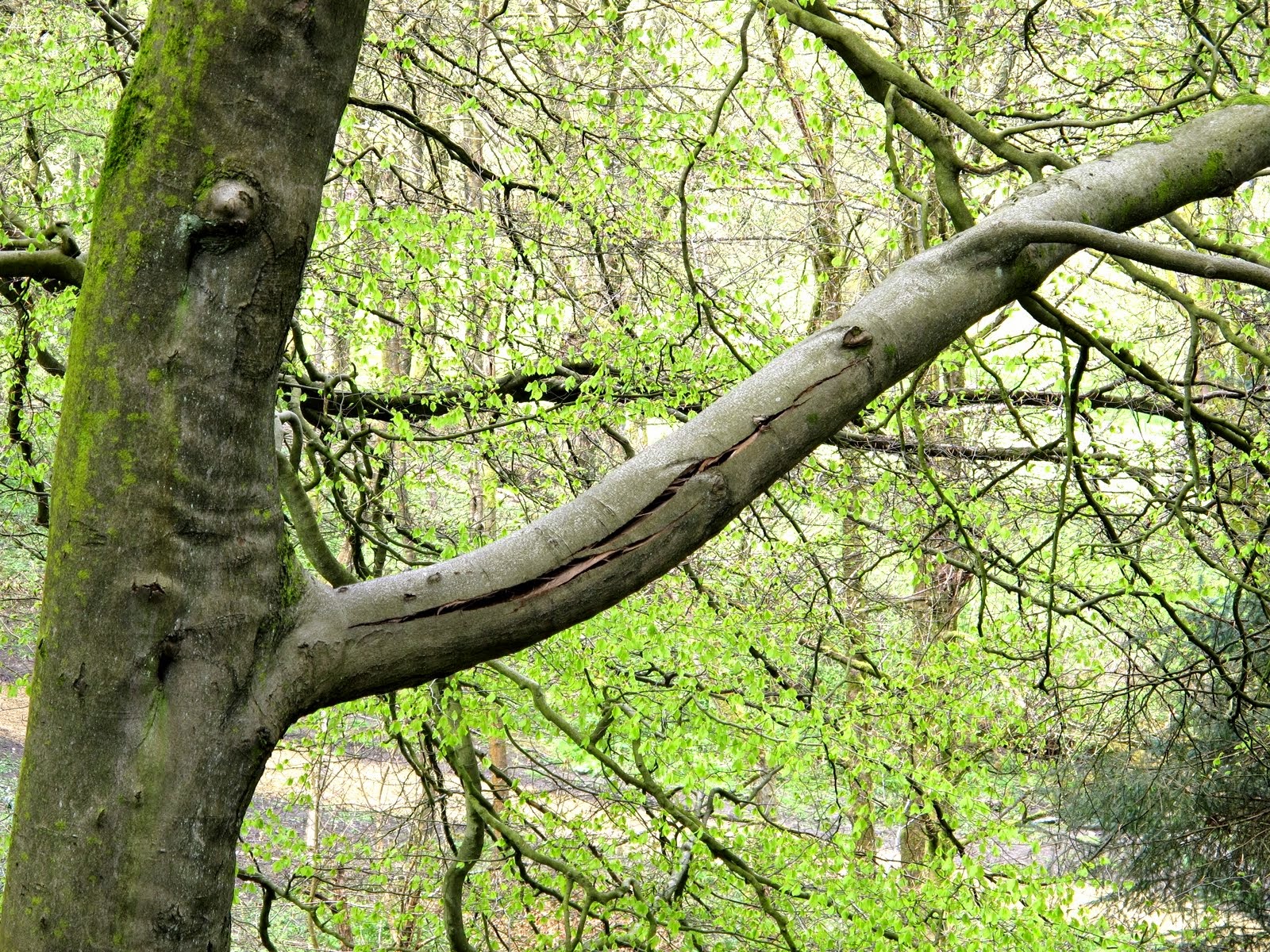
This picture is of a Beech tree branch in a wood at Todmorden, which has recently split along the centre. This is caused by the loading on the upward growing branch trying to reduce the curvature. In tree terms it is known as a 'Hazard Beam'.

These splits can be good habitats for wildlife but this branch will fail at some stage. On the main trunk there are some curious buckling ridges which show the tree has been under stress for some time.

I don't know whether it is general in the valley but in Todmorden many mature Beech are rapidly loosing vigour and collapsing. It doesn't seem to be necessarily old age that is the problem; I have seen Copper Beech loose all vigour and within a couple of years are dead.


Saturday, 16 May 2015

Jerusalem Farm

After the Grassland Training day at Jerusalem Farm on Friday 15th
I went for a walk with the dogs in the fields.
I bumped into Portia, Stella and Jude who had been at the meeting
and we set out to find the Lousewort which Ali and I had spotted last year.
We searched for a while with no joy but it was the wrong field,
when I got my bearings we found a large area covered in pink flowers.

Lousewort (Pedicularis sylvatica)


Pedicularis means Louse and it was thought that animals grazing this plant would catch lice.
Lousewort is rare in Calderdale and West Yorkshire.
This is the only location in Calderdale I have seen it and it is abundant. 

Having found this we set out to see what other interesting species we could find.
It wasn't long before Portia pointed out an interesting looking leaf.


She guessed that it could be the small fern
Common Adder's Tongue (Ophioglossum vulgatum)
A quick search showed that there were many of these leaves and some had unripe fertile spikes.


Although this is described as common in Calderdale
we are not aware of any recent records and none of us had seen it locally.

As we walked back Stella drew our attention to a Cuckoo
calling out from across the valley.

Today I returned to the site in the hope of finding some Moonwort
another small fern for which we have no recent records.
Sadly I was unable to find it but in another field further up the valley
I did find another "common" plant that I have been looking for but not yet found.


Heath Milkwort (Polygala serpyllifolia)


This delicate plant has pretty flowers that come in blue, pink and white.
It differs from the Common Milkwort in having some opposite leaves, often low down on the stem.


Polygala means "having much milk" and it was believed that cows grazing on this plant would produce more milk.

Sunday, 10 May 2015

Some flowers and birds along the Calderdale Way, Midgley Moor Section.

We had a great afternoon walking this scenic section along the moor edge today.
Some fields near Far Shawcroft Farm, Oldtown had a good selection of meadow flowers among the grass.
Large bittercress was waving its pure white flowers with purple anthers, next to Cuckoo Flower with lilac flowers above Midgley.

Birds included many Meadow Pipits, Great Black-backed Gull, Kestrel, Reed Bunting, Wheatear; we listened to a Snipe chipping as we ate our picnic, and counted 5 Lapwings at the Oldtown end, as well as three noisy Curlews together. We heard one Red Grouse.

A male Grey Wagtail preening beside the stream at Luddenden was probably near its mate sitting on eggs nearby.

And the only nest we recorded - as we approached the car we left at Luddenden, a Blue Tit flying into a hole in a wall gave away its nest with at least three stretching and gaping blind, naked young.

Wednesday, 6 May 2015

Meadow Pipit's nest yesterday, and Golden-scaled Male Fern.


We were looking for nests and reptiles at Wainstalls but flushed a Meadow Pipit by chance, though we had been looking at its mate, watching us from a rock in the middle-distance.

The camera focused on the front of the nest, rather than the eggs, which I didn't notice at the time, as I only spend a few seconds at a nest where I have flushed the bird.  Then it's best to walk away in full view, so the bird sees you going away. It doesn't differentiate between a human and a grazing animal.
Never risk flushing birds in cold, showery weather.

We also recorded a Woodpigeon's nest nearby with two eggs visible from ground level, and watched a Willow Warbler carrying nest material around in an aimless way.

The data will go in with my other BTO Nest Record Cards. (British Trust for Ornithology.)


The pipit's nest is just above the centre in this picture, in a spot where it would be unlikely to be stepped on. (Tucked into a little bank, well hidden by long grass.)


Golden-scaled Male Fern, ( Dryopteris affinis group)
There is a magnificent colony of these on some wet rocks beside the road just before the Cat in'th' Well Pub at Wainstalls. Many of the ferns are at their most spectacular as they are unfurling like this in Spring.


Wednesday, 29 April 2015

Toad Migration over for another year - Counts.

The Toad Patrols went well at the sites that were monitored, with only a small proportion of toads seen being road casualties, which is what we are aiming at, though it would be nice to have none run over.

A single male and a female with a male clinging on her back "in amplexus"
Safely on their way to the pond.
------------------------------------------------------


Naomi's help organising the patrols in the Upper Calder Valley was much appreciated, and this gave chance for  Portia to carry on patrolling her own patch, having stepped down from the position of overall organiser for the Upper Valley.

Naomi was doing work experience with Hugh Firman of Calderdale Countryside Dept. We wish her well with her studies and career.

Sorry to anyone who wanted to help and didn't get called, (including Naomi's mum). My excuse is it can be quite unpredictable when they are going to start moving - a combination of day length and temperature. Please volunteer again next year.

There were 8 of us regular volunteers in the Lower Valley. Thanks to Kathryn, Martin, Lynn, James, Oden, Mark, and Steve Cummings. Apologies again if I missed anyone off.

In the Upper Valley there were Sam, Portia, Brian, Shirley, Gordon, Eileen, David, Cheryl and Karl plus three other ladies, names unrecorded.

Despite doing it for years, I learn something nearly every season. This time I experienced a rise in temperature after it had gone dark, when a blanket of cloud came over a clear sky. Also most movement was on dry nights, as there wasn't much rain.

Birds like the seven Dotterel yesterday are, not surprisingly, what get most naturalists started, but we had a great Tawny Owl year while out toading. They were hooting and squealing and making all sorts of noises at all three sites I attended, and one patroller got great views of two having a go at each other on a branch just above her head. It was a good breeding year in 2014 for Tawnies.

Two of us were also treated to a sight of Great Crested Newts as Chris Tindal passed by with some for the Cromwell Bottom Newt-night Experience, and stopped to have a chat. My buddy that night, Martin, had never seen any before.

Sam Moore and his helpers up at Portsmouth, Cornholme, had a big year again, but Sam suffered the disappointment of having the material he submitted to a Yorkshire Post reporter being garbled as often happens when general journalists try to write about nature. Sam did have the great success of getting the call of the male Common Toad on BBC Radio 4 as the "Tweet of the Day" (usually a bird).

Toad and other Amphibian Records. Spring Patrols 2015

Thornhills Beck Lane, Brighouse.
9th and 7th April only - Toads 52 moved 6 squashed (but Chris Tindal had moved some.)

Boulderclough Dam, Sowerby.
12th March to 11th April Toads 734 moved 49 squashed
                                        Frogs 17
                                        Palmate Newts 13

Lumbutts near Todmorden.
355 Toads moved plus 20 casualties. (Big drop from 2014 when 654 moved and 63 killed.)
Gordon reports significant daytime movement, also a feature of Hebden Hey Dam.

Washer Lane, Sowerby Bridge.
This site is much depleted, possibly because of loss of most of their ponds, despite our protests.
7th and 9th April - Toads 13 moved 1 dead. (One moved was a full-sized huge female.)

Dobroyd Lane, Todmorden.
Portia and Brian counted 290 toads,  with  only 20 squashed.
                                         27 frogs
                                         148 newts !
                                         Best year ever for this site.

Portsmouth Dam, near Todmorden.
13th - 20th April. Toads 1265 moved 43 dead.
Sam also reported 100's killed on the nearby A646 on 10th April, so more volunteers needed there.

Upper Shaw Wood Rd. (Todmorden area)
25 toads. David intends to more fully monitor this site next year. Thanks for the emailed form David.

Wood House Lane, Todmorden
138 toads plus 29 killed, great work and great spreadsheet Cheryl and co.

Well done everybody, apologies if I've missed anyone out.


Please let me know of any omissions or inaccuracies. steve.blacksmith@gmail.com

_________________________________________________________________________________

A new high level site for Toads has been seen at Upper Walshaw Dean Res. by Niall Roche, who reported Toads and Frogs squashed on 6th April. Probably too far out to monitor.


Friday, 24 April 2015

Interesting trees

This Sycamore lapsed pollard must be the largest girth of any I have seen within our area. It is not in Calderdale but at St Ives just outside Bingley. There are some impressive trees in this former medieval estate and it is worth a visit. Rather a shame there is no continuity of planting for when these giants leave us. (many have collapsed). But that seems to be the case in most places. Plenty of new woodlands being planted but no trees for the future.


The other picture is of a Hawthorn at Dobroyd Castle, Todmorden. The spiral trunk resembles twisted lianas and leads to wondering how it grew like that. Every spiral look like they could be separate columns of sapwood.

Monday, 20 April 2015

Old trees

These lovely old trees are near Sowerby town. There are many field margin mature trees nearby but these seem older than the others. Apart from the beech, the 2 sycamores and 1 ash appear to be lapsed pollards. The ash in the background shows good re-growth following a large branch collapse. The middle sycamore has the characteristic pollard head where cutting has taken place in the past.

Trees such as these should be cared for and cannot be replaced in our present landscape. Many of these type are collapsing locally and are not regarded for what they are. They are suitable for being managed to last for many years and are local treasures.

Wednesday, 15 April 2015

Elland Park Wood 15/04/2015

Michael had a walk through the wood today and found a wonderful display of Bluebells in flower so hopefully anyone who attends the walk on Saturday will not be disappointed. 


Michael's gorgeous photograph.

Tuesday, 14 April 2015

Cromwell Bottom

If you follow this link to Calderdale council webpage you will read about plans to "Unlock the potential" of Cromwell Bottom. It sounds like there are a lot of new ideas and plans for this area. http://news.calderdale.gov.uk/unlocking-the-potential-of-brighouse-site/

Monday, 13 April 2015

Colden Valley trees

There has been some woodland management in the Colden Valley by ring-barking a small number of Sycamore trees. The first photo show one that has also been topped and then a coronet cut made on the end of the remaining trunk.
This technique was originally developed for branch reduction on ancient trees to try and mimic a natural break, the theory being the tree responds with new growth better than when cut cleanly across. Not sure what the purpose of this coronet cut is in the Colden situation.

The second photo shows one of the most interesting Sycamores in Colden; I do hope they leave this one alone. Characters need preserving.


Friday, 10 April 2015

Last Chance to see one of Gordon's films!

Tuesday 14 April             Talk
 Irreplaceable Gordon Yates with his ultimate film
  “Snowy Owl, King of the Arctic” Not to be missed. In the Central Library, Halifax at 19:30hrs